I love words. I especially love words that are made up of other words, and have deeper, sometimes more profound meanings the more you dig into their etymology – i.e., their origin and history. I have only been depressed (beyond the standard being sad about sad events) once in my life, and the two things that sustained me during that time were painting and reading the dictionary. I would scour the pages of the huge two-volume Oxford dictionary I bought at a charity shop, to find words that matched the ache in my soul and tumble down the rabbit hole of connected words and their meaning. That was in the days before I had access to all the dictionaries in the world. Now my favourite word-nerd thing to do is look words up online.
This week in our group tutorial, we were asked to consider the words elusive and taxonomies in relation to our art practice. Of the two words, I thought elusive to be the most interesting.
The suffix ive makes adjectives from verbs, and means “pertaining to, tending to etc.,”
elus is from the Latin eludere – “finish play, win at play; escape from or parry (a blow)”
parry – “to turn aside or ward off (an attack or blow of a weapon) with a counter move; a defensive or deflective action; pushing a weapon away or putting something between your body and the weapon.
I really like this deeper understanding of the word elusive. Beyond its modern definition “difficult to describe, find or achieve”, its earlier meaning suggests the intentional and defensive act of ending a potentially damaging encounter. In combination with its modern understanding then, elusive could rightly be used in the sense of deliberately obscuring something in order to protect it.
We were also asked to think of a word that is currently pertinent to our practice.
The word I chose was intuition:
From Middle French – “the ability to understand something instinctively, without the need for conscious reasoning.”
From medieval Latin Intuicioun – “insight, direct or immediate cognition, spiritual perception,” originally theological, from Late Latin intuitionem (nominative intuitio) “a looking at, consideration.”
I chose intuition because of something I had read by the film director David Lynch earlier that day:
Intuition is the key to everything, in painting, filmmaking, business – everything. I think you could have an intellectual ability, but if you can sharpen your intuition, which they say is emotion and intellect joining together, then a knowingness occurs.
Although Lynch’s definition is a departure from its medieval counterpart, both have given me something to chew on the past couple of days and, along with the word elusive, have helped illuminate something that has been frustrating my practice for a while now. Such is the power of words.
As I was writing this entry, I came across a quote by Edgar Allen Poe, I’m not sure it’s pertinent, but it sure is delicious:
Words have no power to impress the mind without the exquisite horror of their reality.
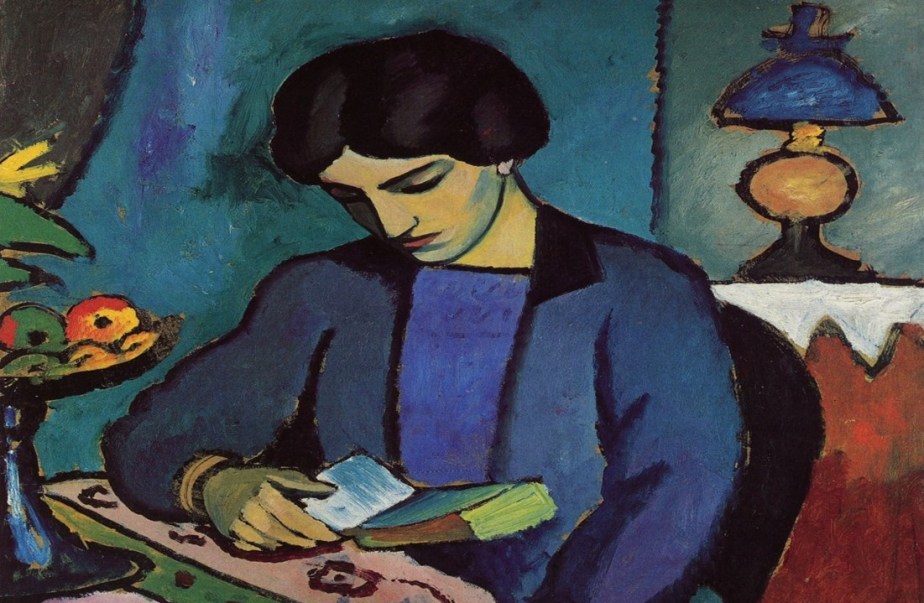
Image: Blue Girl Reading (1912) August Macke
 bexODESSA