The bear went over the mountain

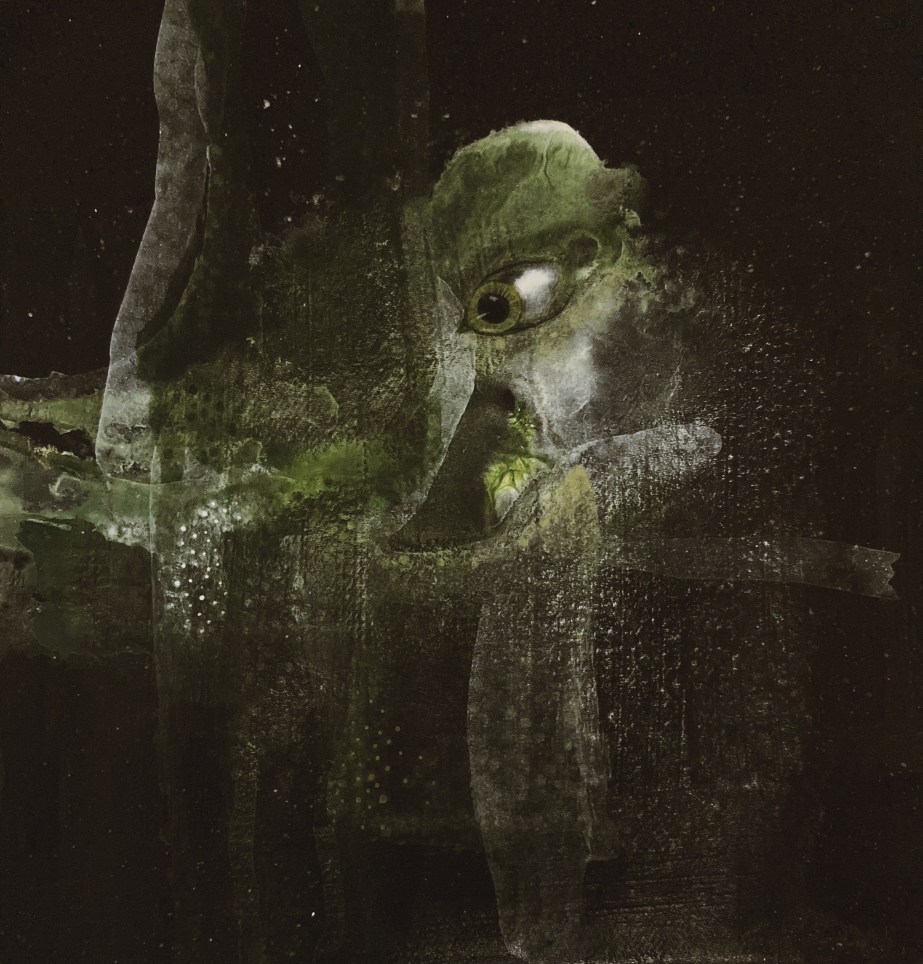
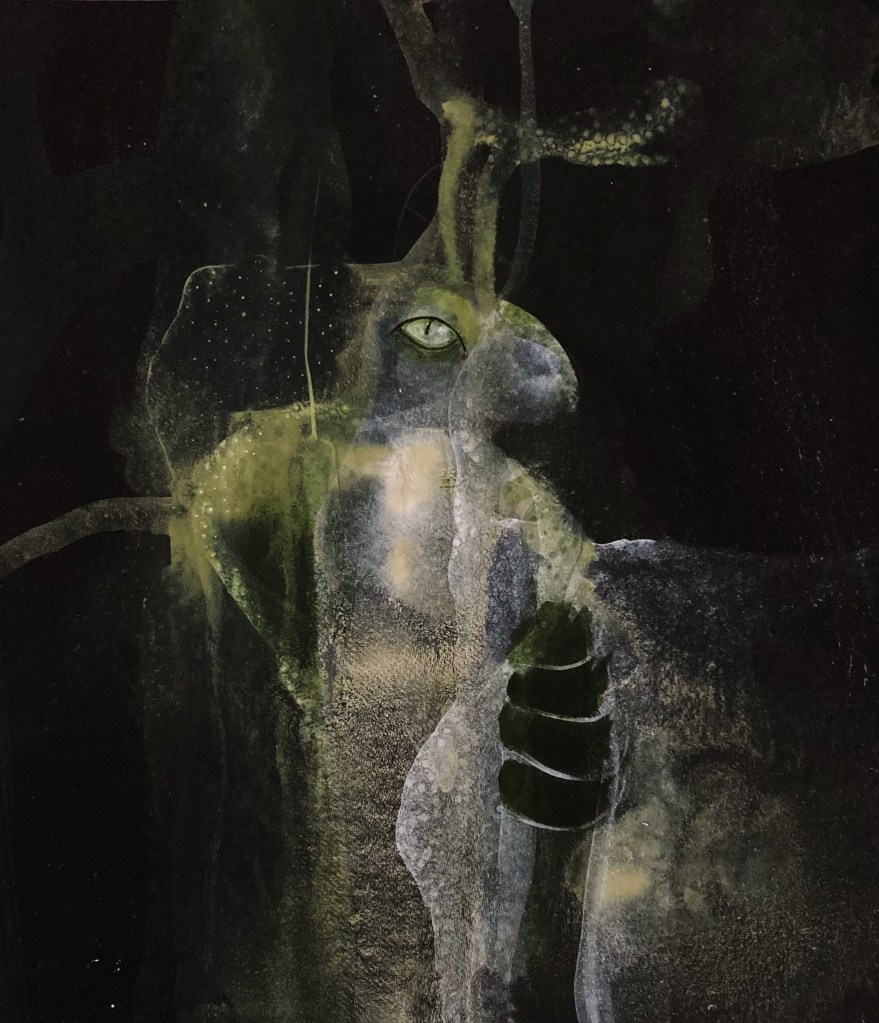
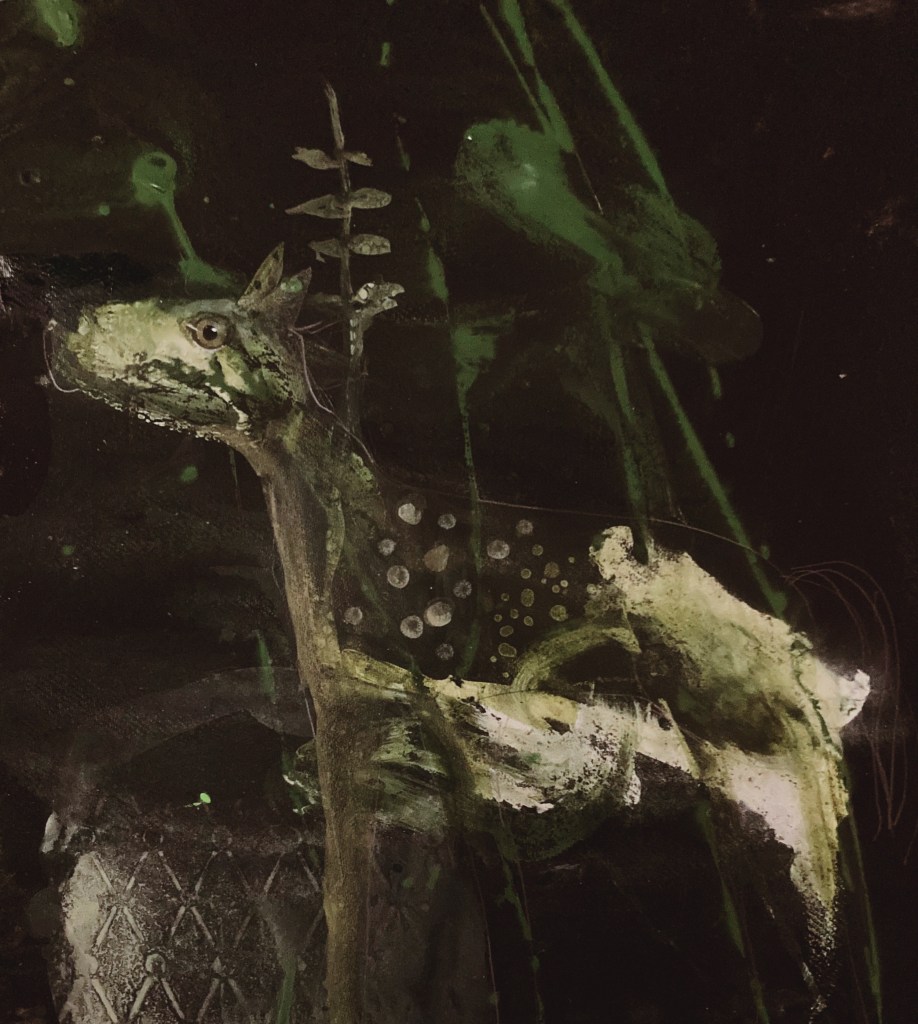
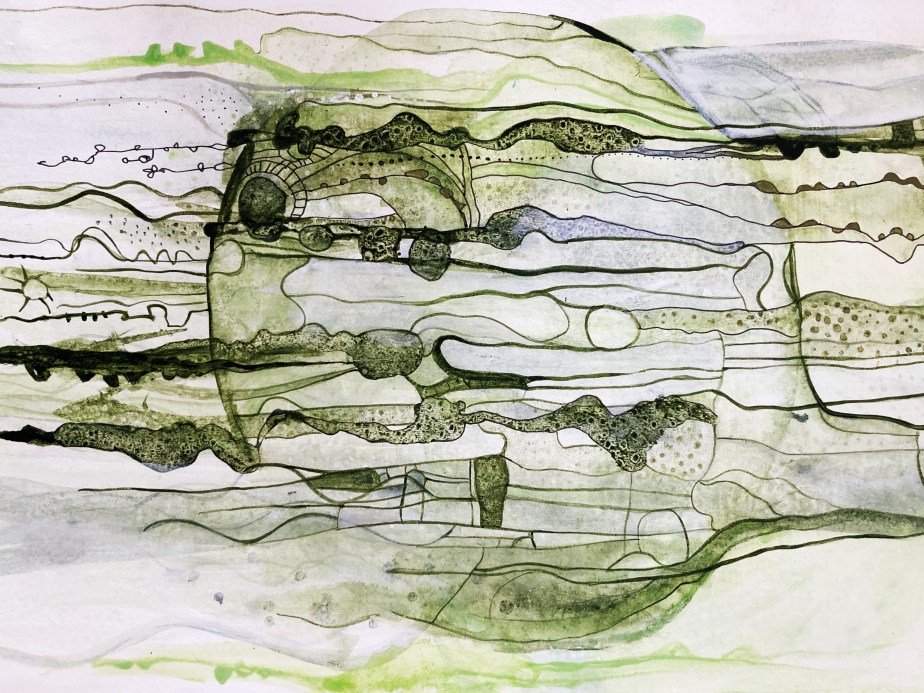
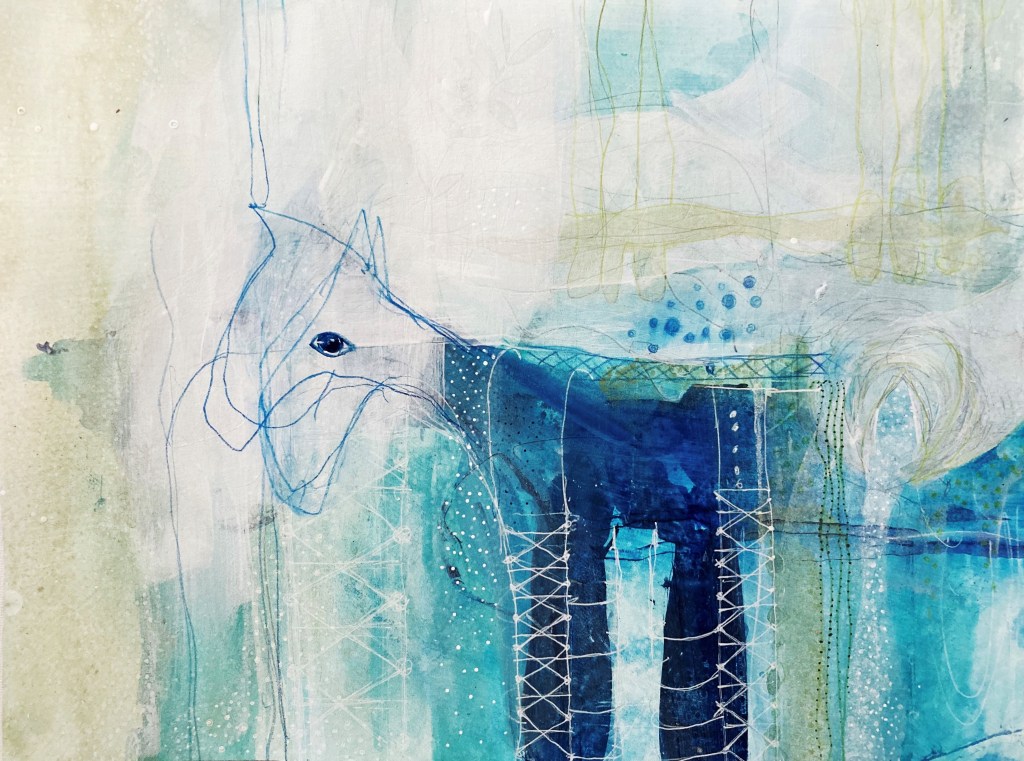
I had a painting breakthrough this week, which is always a double-edged sword. On the one hand there was a huge sense of excitement and relief, like I am finally getting somewhere and all my previous hard work on this particular project appears not to be in vain. On the other hand, it’s like the bear in the children’s song who reaches the top of the mountain, and what does it see? Another mountain! That’s exactly how it felt, I was momentarily thrilled at the progress I made and the paintings I produced, but I was soon brought back to earth when I realised how far I still have to go to achieve the paintings I want to.

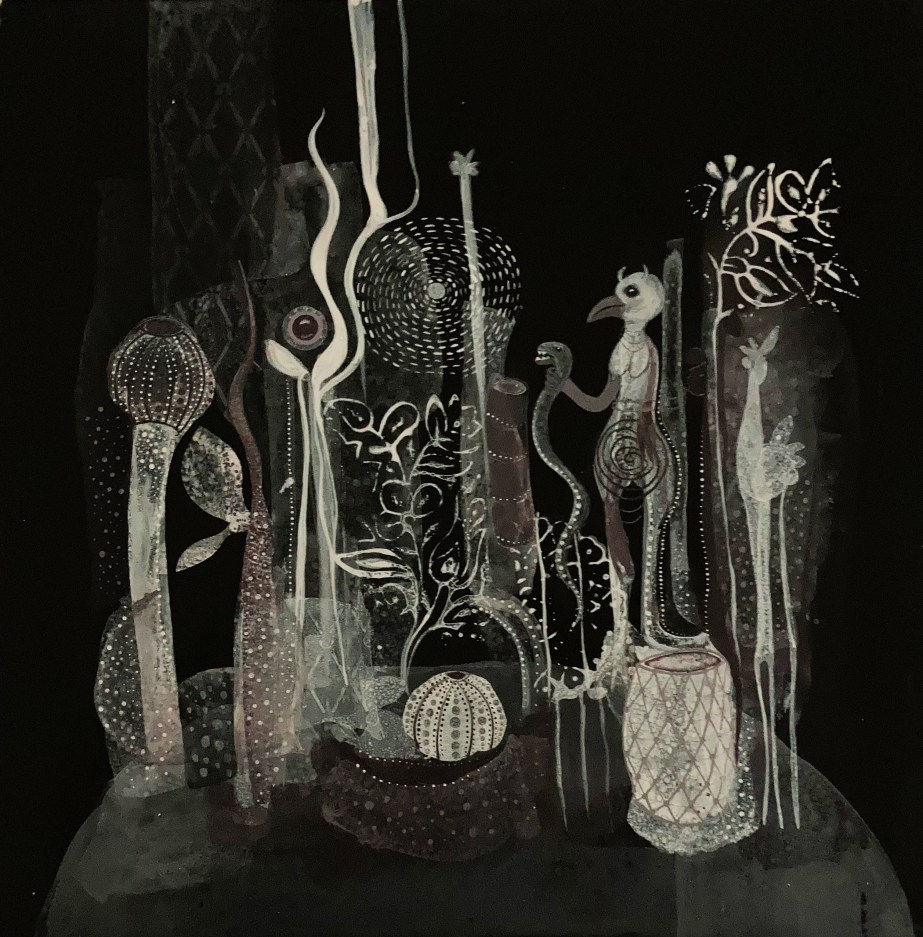
The paintings I did this week are just little snippets of what I hope to be much larger paintings. Scaling up is no easy task, and when it comes to figurative painting, I am yet to manage it, but I will surely to keep trying. One thing is certain after the week I’ve had, the drawing discipline I started at the beginning of the year is definitely paying off.

I’ve also been busy this past week writing the overview of my research paper, so our tutor can see what we intend to write about and give us feedback and guidance. I decided to do mine on the Ars Moriendi, the medieval dying how-to-manual that I mentioned in my last post. It hurt the old brain cells to do, but it was definitely worthwhile, as I now have a clear direction for the paper, which will make it much easier to write over the summer. I actually think I’ll enjoy writing it, as it is a fascinating subject, and has already sparked some interesting conversations with friends and family.

You can read my overview here if you have the time and/or inclination.

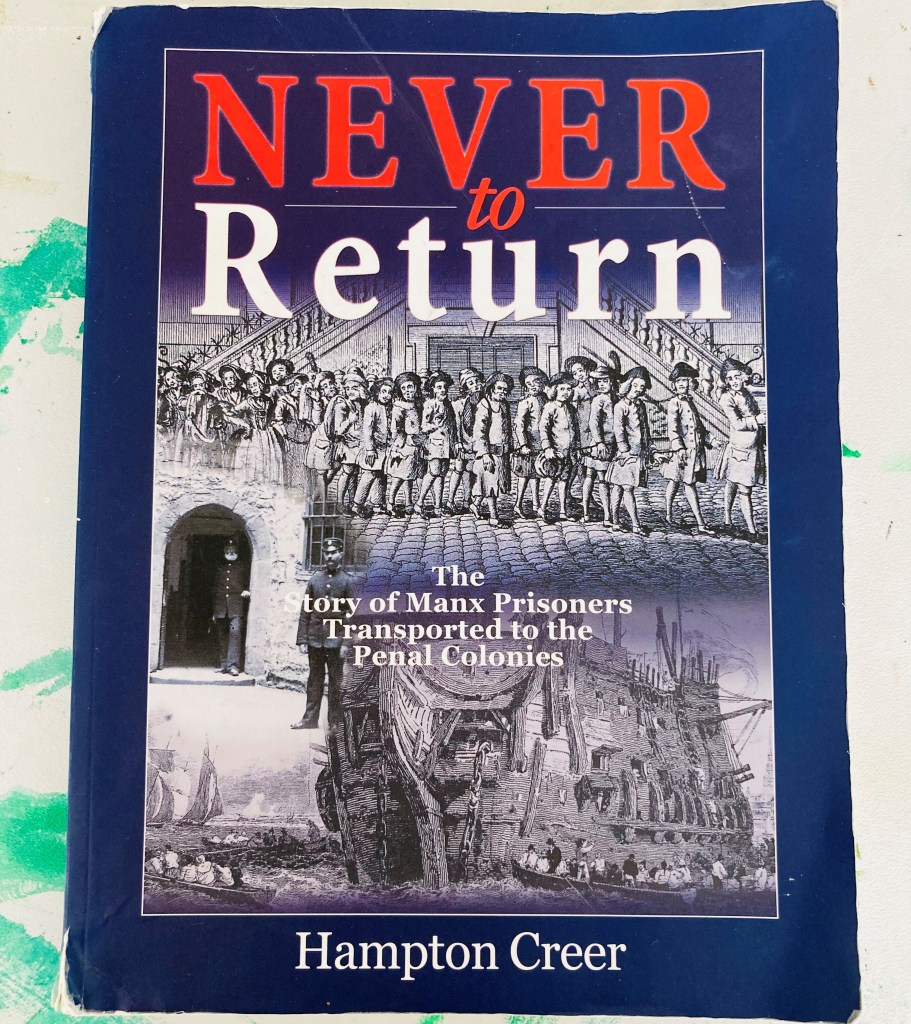
In other news, my fella and I have decided to make a documentary about Ann’s story. To begin the process, we had a pre-interview meeting with Hampton Creer, the author of “Never to Return”. It was such a privilege to meet him and his lovely wife Joy.

I absolutely love his book, it is beautifully written, and is a page turner from start to finish. It was also very special, because it was from his book that I first learned about Ann and was inspired to do a painting about her. We had a wonderful time talking all about penal transportation and other aspects of Manx history, such as witches. Once the TT races are over in a couple of weeks, my fella and I will return and interview him on camera.
All cakes are not created equal!

I had a very productive week in the studio, and am finding my feet with the figurative paintings. I am still very much at the experimental phase, but am slowly discovering the kind of paintings I want to make.

Here are two of the paintings I did this week. I like them both, however, the one on the right has an underpainting that I made with the sea, and I think it adds a greater sense of dynamism. I definitely think a dynamic underpainting is the way forward. I don’t like figurative paintings that look too finished or realistic, except for the eyes.

The main focus of the course at the moment is the research paper we each have to write. I haven’t got much further than a vague notion of a topic, death. So far I have been looking into memento mori (a medieval artistic convention designed to remind people they will die), memorial art (which is right up my alley artistically), or ars moriendi (a medieval instruction book on how to die). Not very cheery, true, but death is a topic I am very interested in, both as a painter and a mortal. I will to have to pick a lane soon, as we have 1,000 word overview due next week.

I actually had a dream last night about doing my research paper on the Ars Moriendi. The book is from the mid-15th century, and instructed a person in how to have a “good death”, which basically consisted of letting a group of angels and demons battle it out for your soul on your deathbed, in the hope that your soul (which was depicted as a mini-you that popped out your mouth when you died) got to go with the good guys. The likelihood of that happening depended on answering a series of questions. Didn’t get the questions answered in time? Sorry, that’s eternal damnation for you! The book was wildly popular throughout Europe, and peasant and king alike were subject to its teaching.

One of the woodcuts from the Ars Moriendi.

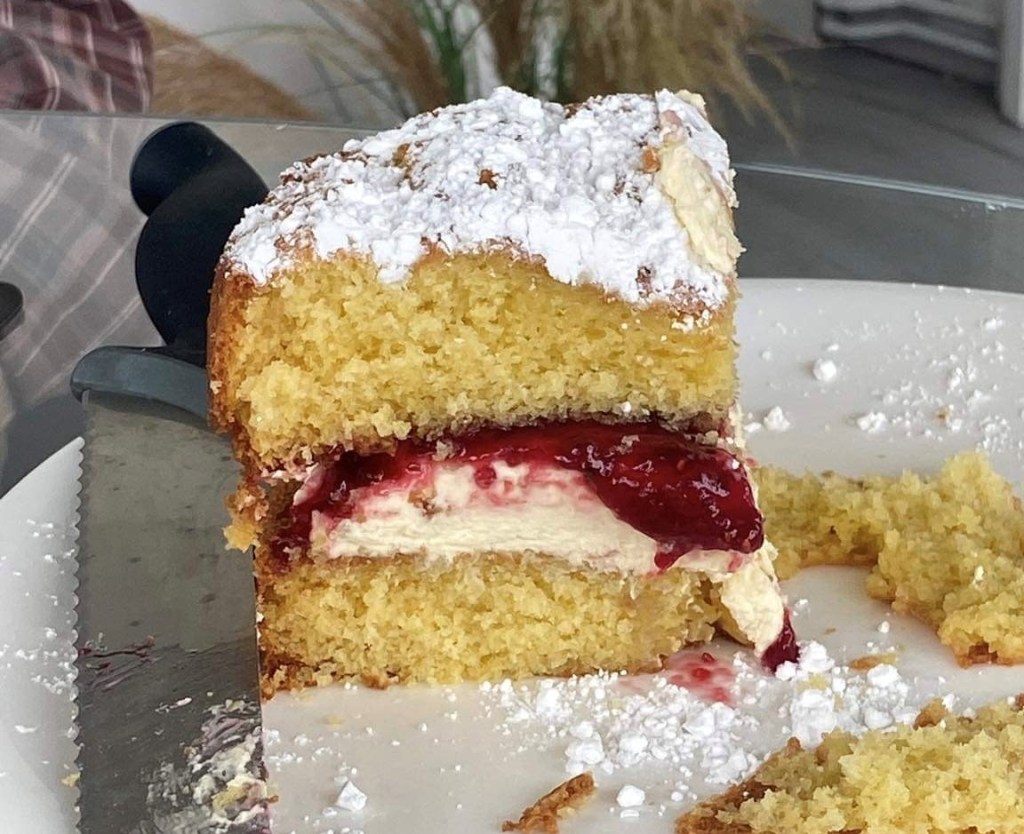
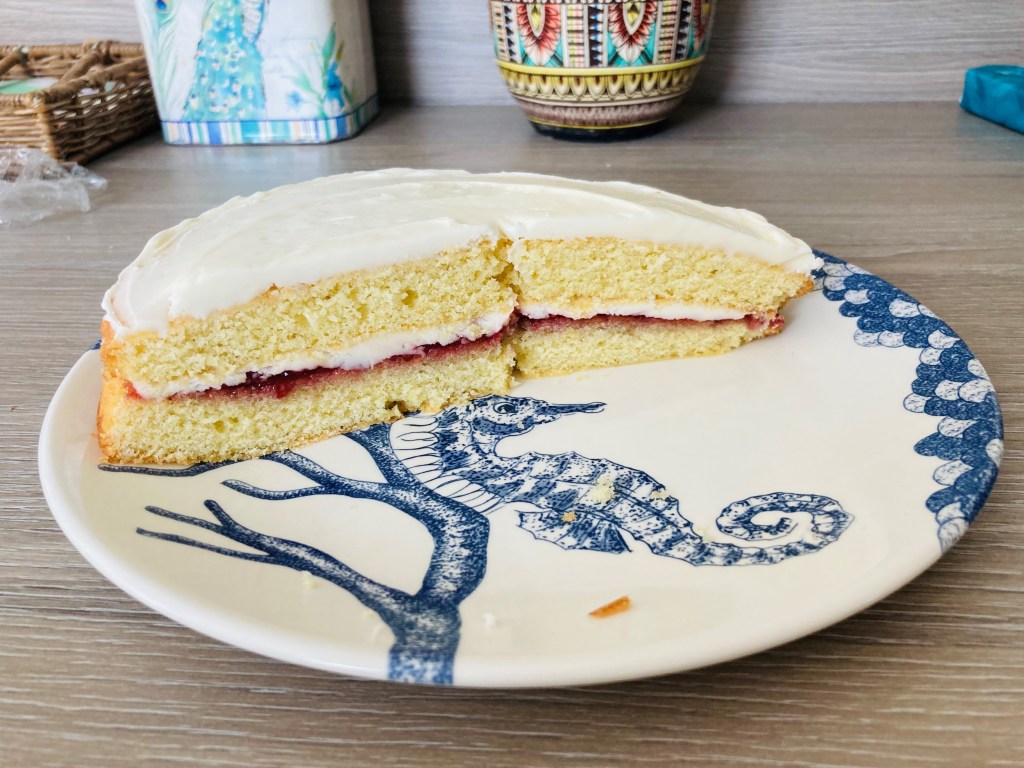
My sister was on the Island for a few days, which was lovely. We had a family bbq at Anam Cara on the Sunday, and I showed them the Ann painting. It made my tender-hearted sister cry, which was either a sign that the painting is beautiful, or the Eurovision hoolie at my brother’s the night before was too much for her. My fella did me proud and didn’t burn the sausages, and made the most glorious Victoria sponge, which almost made me cry. Below is the only photo we have of the whole event, but to be honest, I reckon its the thing we’ll all remember the most. It was a damn good cake!

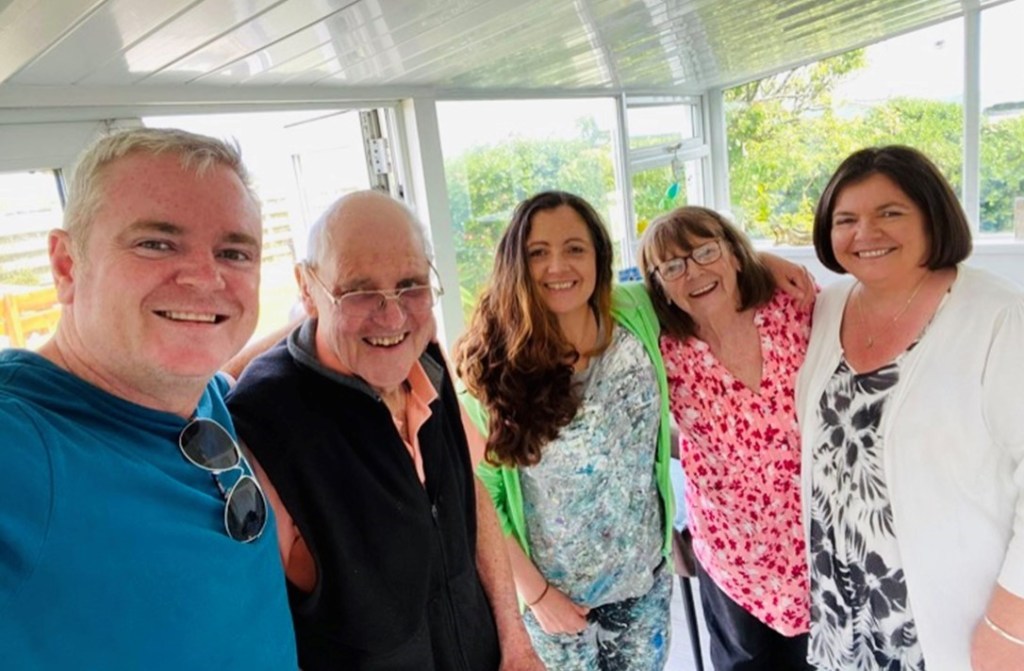
Thankfully, we did manage to get some photos of us all when the gang popped out later in the week. We had a lovely time just sitting there chatting, and marvelled at the fact that we were still sitting there chatting after all these years.

My fella is in Rotterdam for work this week and I miss him terribly, not just for his cake baking abilities. Though, it would be reason enough, as I had a go at a Victoria sponge and I don’t know what kind of WI witchery he used in his, but mine came out flat as a pancake. Still, the jam and icing has made it edible.

Bubble bubble toil and trouble

All and all it has been a good week in the studio. I continued with the sea paintings, and ranged far and wide with my experiments, with various degrees of success. One element that kept cropping up was bubbles. That’s because I have been learning about them and watching them.

Sea foam is made up of bubbles, and they are what helps the sea breathe. The sound a wave makes when it crashes is the sound of the individual bubbles being formed, and the tone of each bubble tells you what size it is. I think this fascinating, mysterious, and beautiful, and I love watching them come in and out of existence.

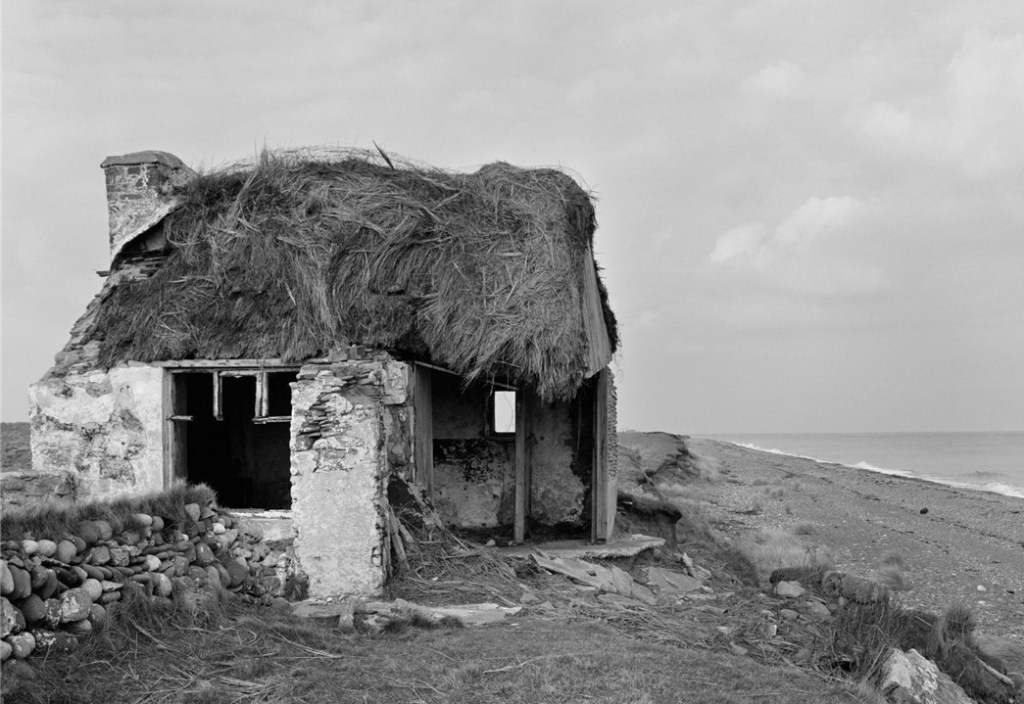
I have been thinking a lot about the power of the sea, something that is inescapable when you live so close to it. I came across a beautiful photo that demonstrates just how powerful it is. It was taken by renowned Manx photographer, Chris Killip, in the early 1970’s, and shows a house being taken by the sea at Cranstal, Bride (the same stretch of coast I live on). I think it is a sobering and romantic image.

For me, it is a memento mori (Latin: remember you shall die), which was a type of medieval painting that depicted various objects that reminded people they will one day die – such as skulls, hourglasses, rotting fruit, wilting flowers and, of course, bubbles. I think Killip’s photograph is an especially poignant memento mori in this day and age, with global warming and the predicted rise in sea levels etc., making coastal erosion and its attendant destruction a present and coming reality. As with sea related disasters, such as tidal waves, death can come upon a person suddenly with little or no warning, but for most, as with coastal erosion, death creeps upon us slowly, diminishing our life force a little at a time, until there is nothing left. It may not be everyone’s cup of tea, but I think it’s worth bearing that in mind.

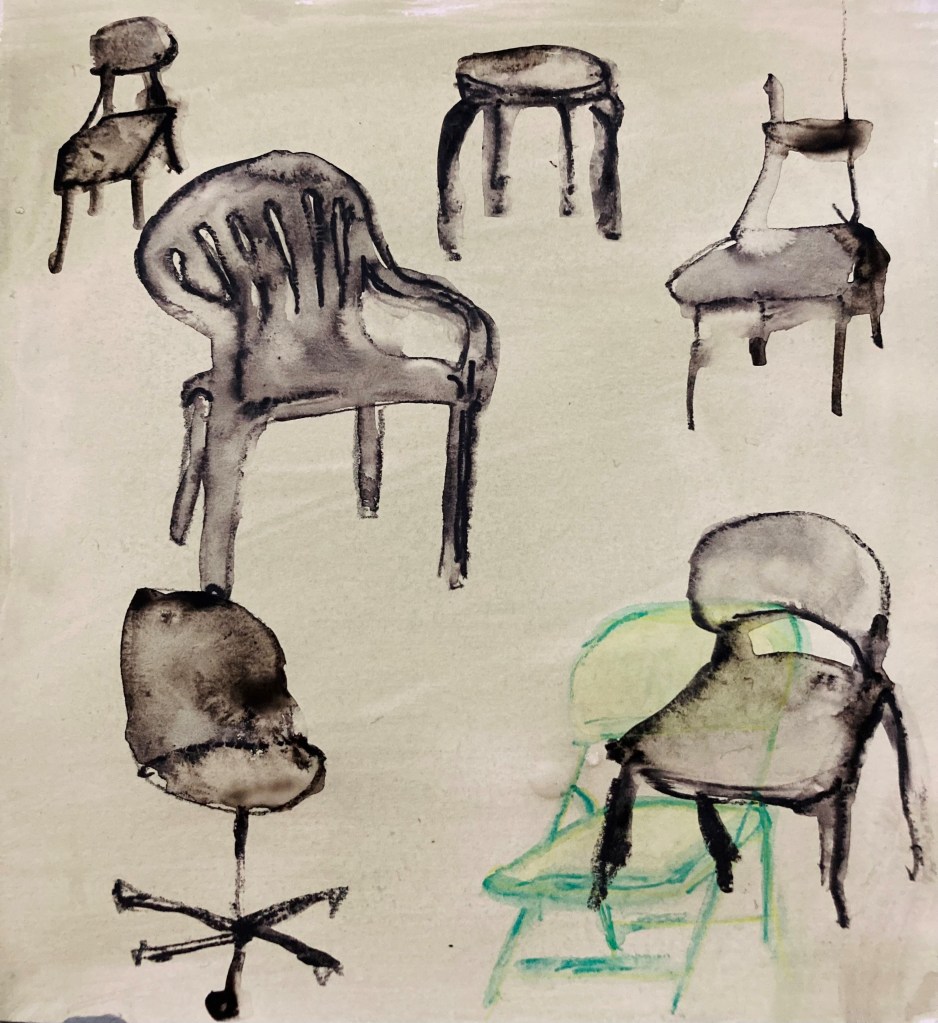
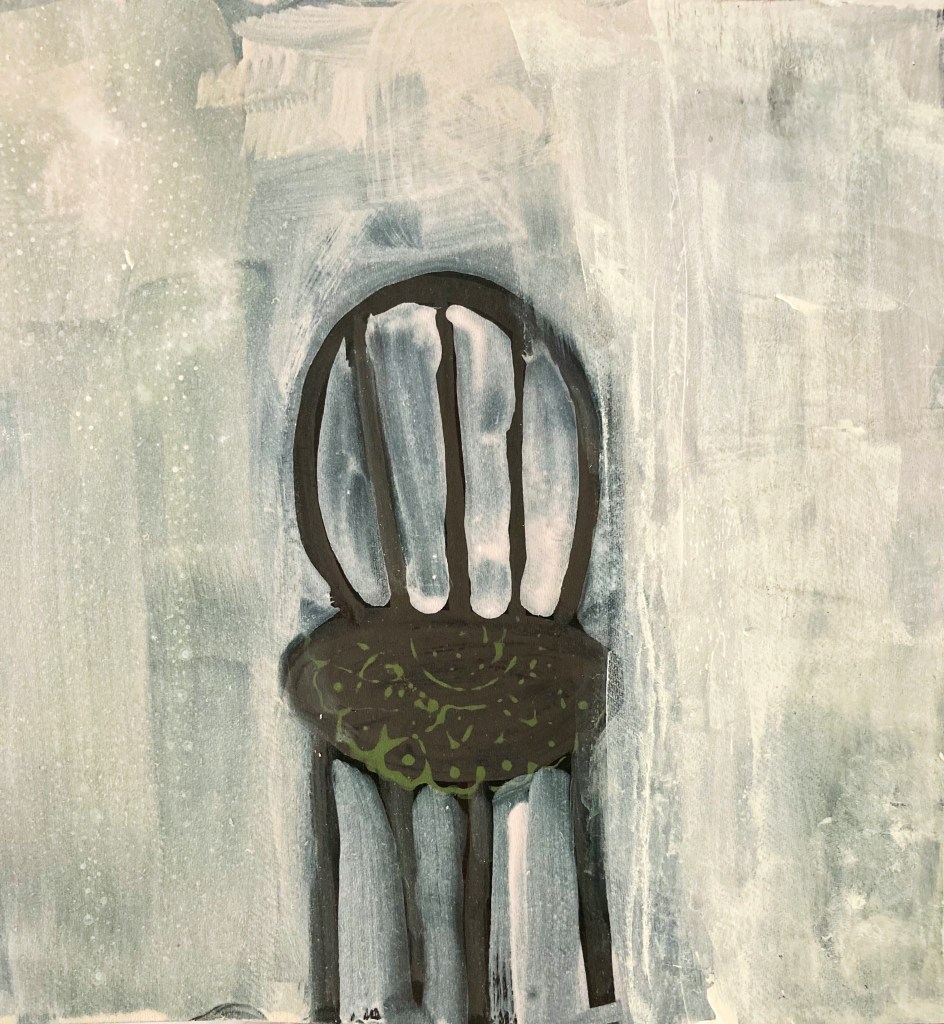
In other news, I continued drawing chairs this week. My favourite to draw are white-plastic lawn chairs. They are tricky to get the knack of, but I really love them for some reason. I have certainly sat in my fair share of them.

Week 23 Experiments

I thought it might be a good idea to create a weekly post (that I add to daily) of my painting experiments for the confluence project, a kind of visual-log of my progress.

NB: unless otherwise stated, all paintings are acrylic on paper

Monday, 24 April

No.1 – I like the colours and balance.

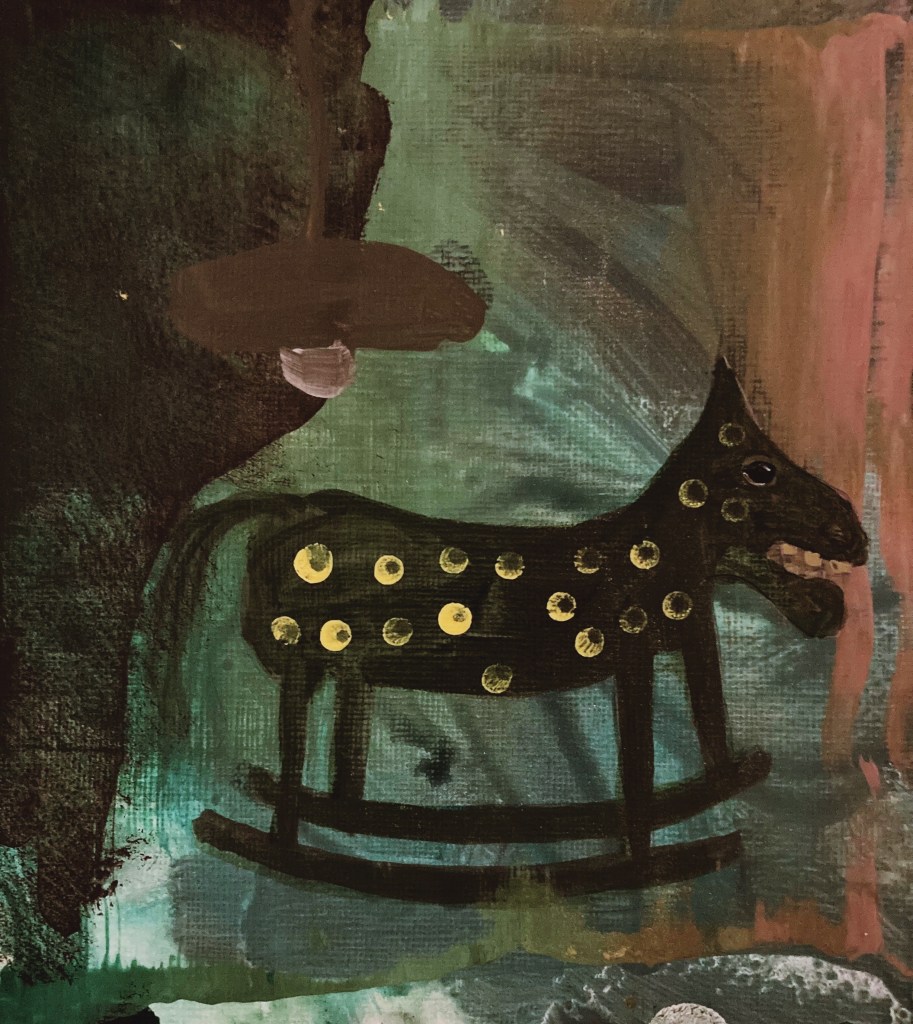
No.2 – I like the light, and the highlights on the horses legs.

No.3 – Although flatter than the other 2 paintings, I like the smooth finish on this one. I also like the white line drawings.

Tuesday, 25th April

No.4 – I like the falling water (it has a mystical quality, which is appropriate for water). I also like the bird’s eye. I want the eyes in my paintings to be soulful and convey emotion.

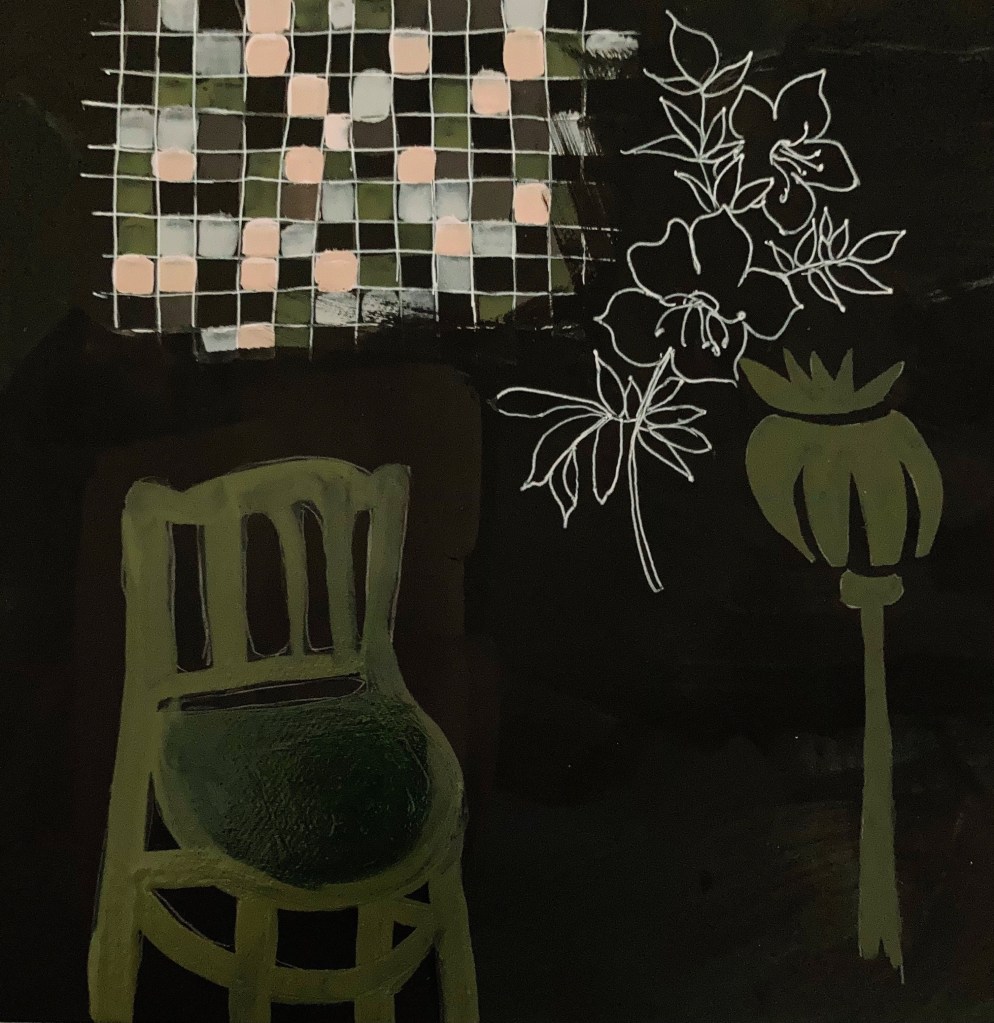
No.5 – I love the grid, especially the white outlines. I also like the chair (for some strange reason I love chairs in paintings…I wonder if it has to do with the fact that a chair is usually the example given when discussing Plato’s world of forms). Although I do like the white line drawing, I think I prefer a more abstract drawing, like no.3.

Wednesday, 26th April

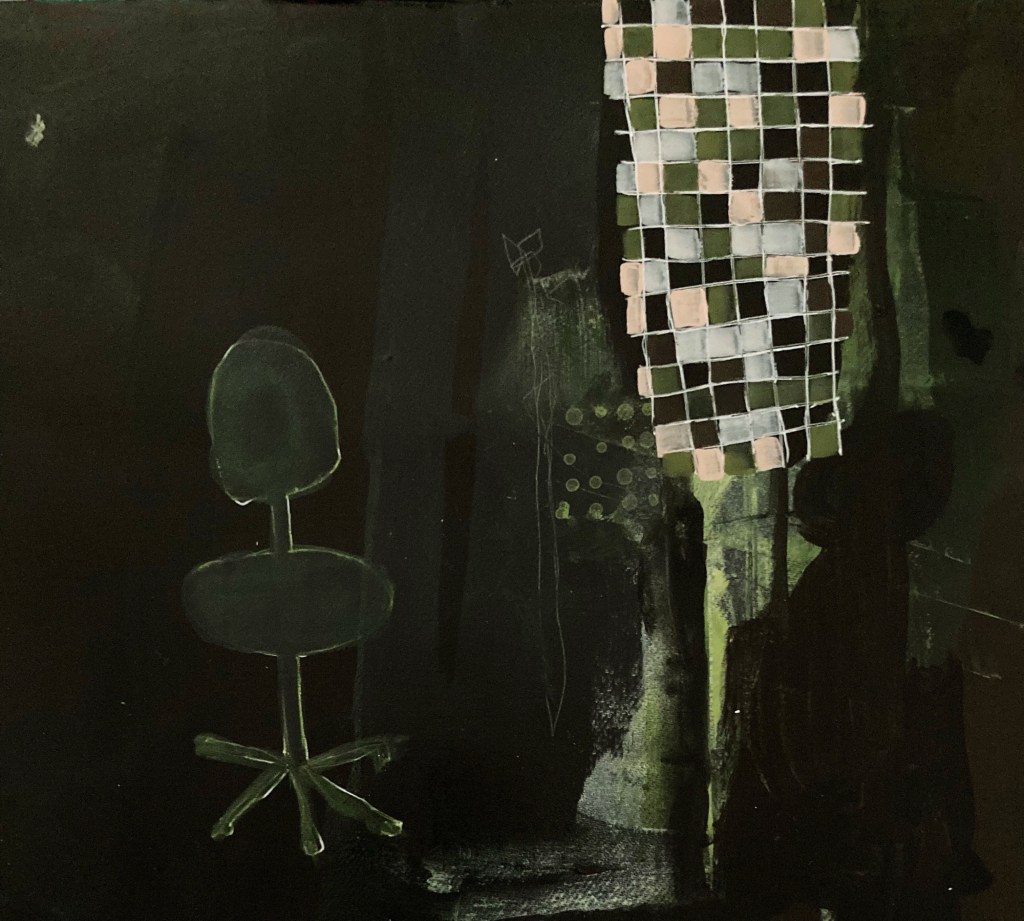
No.6 – This is my favourite so far, everything about it works for me. I think the grid is gorgeous, the inspiration for it was from a photo a friend in NZ posted of Instagram of a building in Wellington. She did her masters thesis on Hecate, the goddess of crossroads. I was just reading about Hecate and crossroads the other day. A river confluence is a type of crossroad, hence why they were seen to be imbued with power. I thought it might be interesting to represent a river confluence in my paintings with this grid, as opposed to an actual depiction of two rivers meeting.

I also like this type of chair, and think it looks good in a painting. Palette good.

No.7 – I love cranes and industrial machinery, especially those involved with water. In general, I find cross-hatching aesthetically pleasing. I think a crane (or in this case an oilrig), will work better as a line-drawing in a painting than flowers (as No.5 above).

Thursday, 27 April

No.8 – I absolutely love this painting. It is about death, as symbolised by the following: the grid – confluence (entrance to the underworld); apples = seeds of new life (the Celts buried people with apples – a tradition that is thought to go much further back); material = (the veil between this world and the next). The palette is great.

No.9 – I really like the white colour, which I made using Titan buff and a touch of orange and magenta. It is the salmon-looking colour I have been using in the grid. It goes really well with green and brown.
Friday, 28th April

No.10 – This is a gear shift from the other paintings this week. It was such a beautiful day, so I decided to take some paper and paint down to the sea. Similar to the rain paintings last term, I then painted into the marks made by the water. There are still elements from the other paintings present, such as the horse, water, and carne motif. I’m not as keen on the palette, although I guess it suits this type of painting. I would be interested to see it with a palette like No.8. It was wonderful to paint with the sea, and I would like to do more of that over the summer.

Sunday, 30th April

No.11 – This is another sea painting from Friday, that I then painted into. I love how the organic shapes made by the sea, leant themselves to the final image. It is also interesting how the sea paintings are akin to the rain paintings from last term. I think I should explore this style further. Ultimately, I’d like to merge the two styles together.

Dotty is as dotty does

I love dots. I love seeing them and I love putting them in my paintings. Nearly all my paintings have at least a little bunch or line of dots. In fact, most have lots of dots, and there are some that are completely covered in them. Dots are a pleasure to paint and are like sugar for my eyes. Basically, I can’t get enough of them.

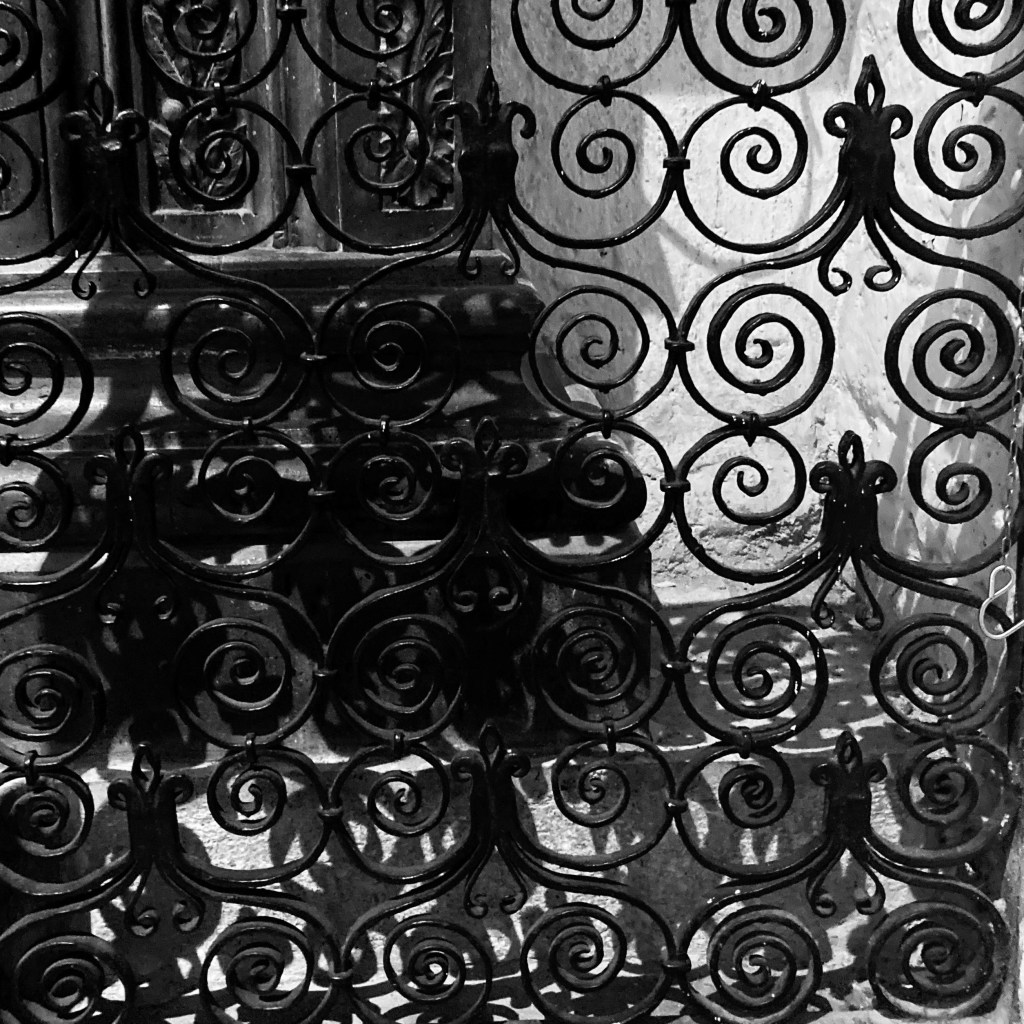
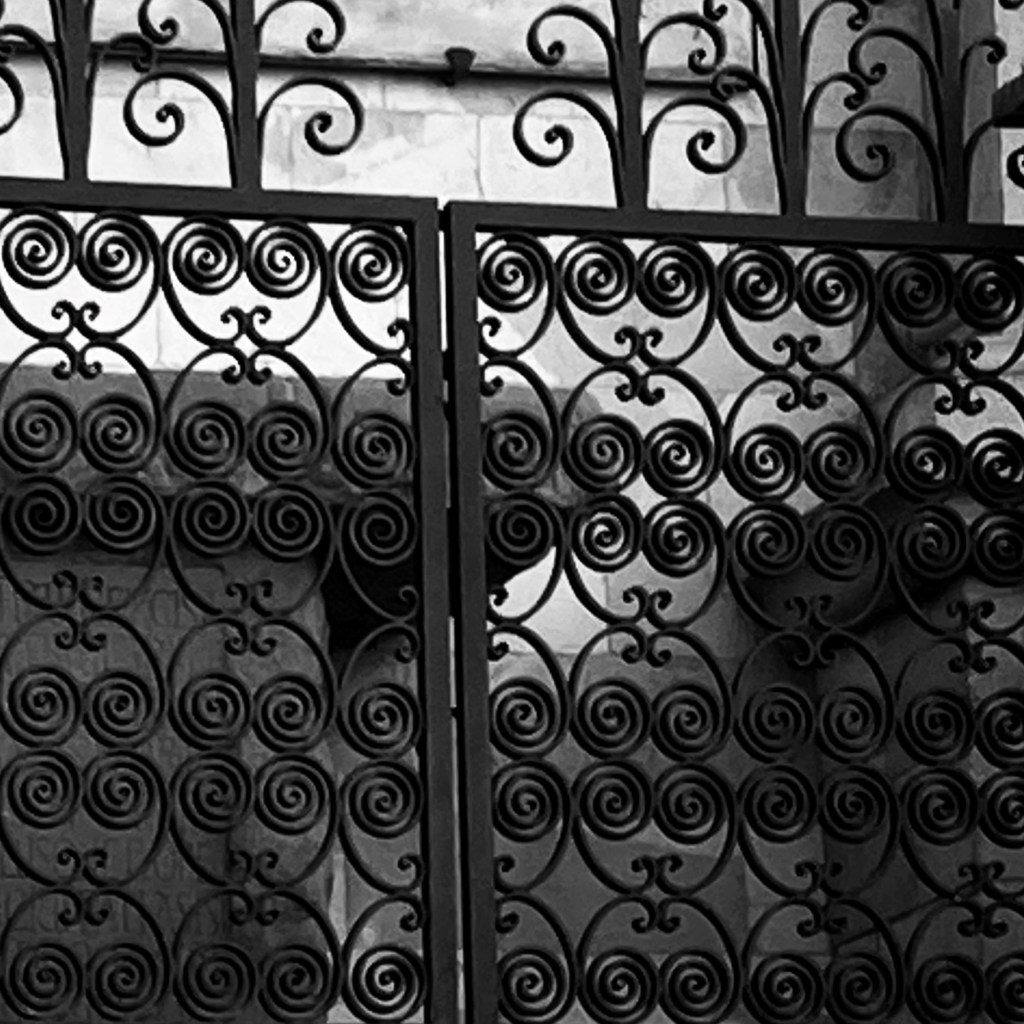
Another thing I love are patterns. Whether in nature or by human hand, seeing a pattern makes my heart happy. If coupled with symmetry, as any self-respecting pattern is, then I am compelled to stop and stare, and invariably take a photo. For this reason, I have more photos of the spectacular wrought-iron work I saw on our recent holiday to Tuscany, than of the stunning scenery. Just ask my fella, he had to stop and hold my handbag every time I saw a lattice, and practically every house in the hill-top medieval towns we visited had them.

The beauty of the lattice-work I saw, inspired me to begin including it my paintings, which I did for a series I painted while at the Royal College of Art Summer School. I think it’s probably best not to over do it, but I little here and there looks lovely.

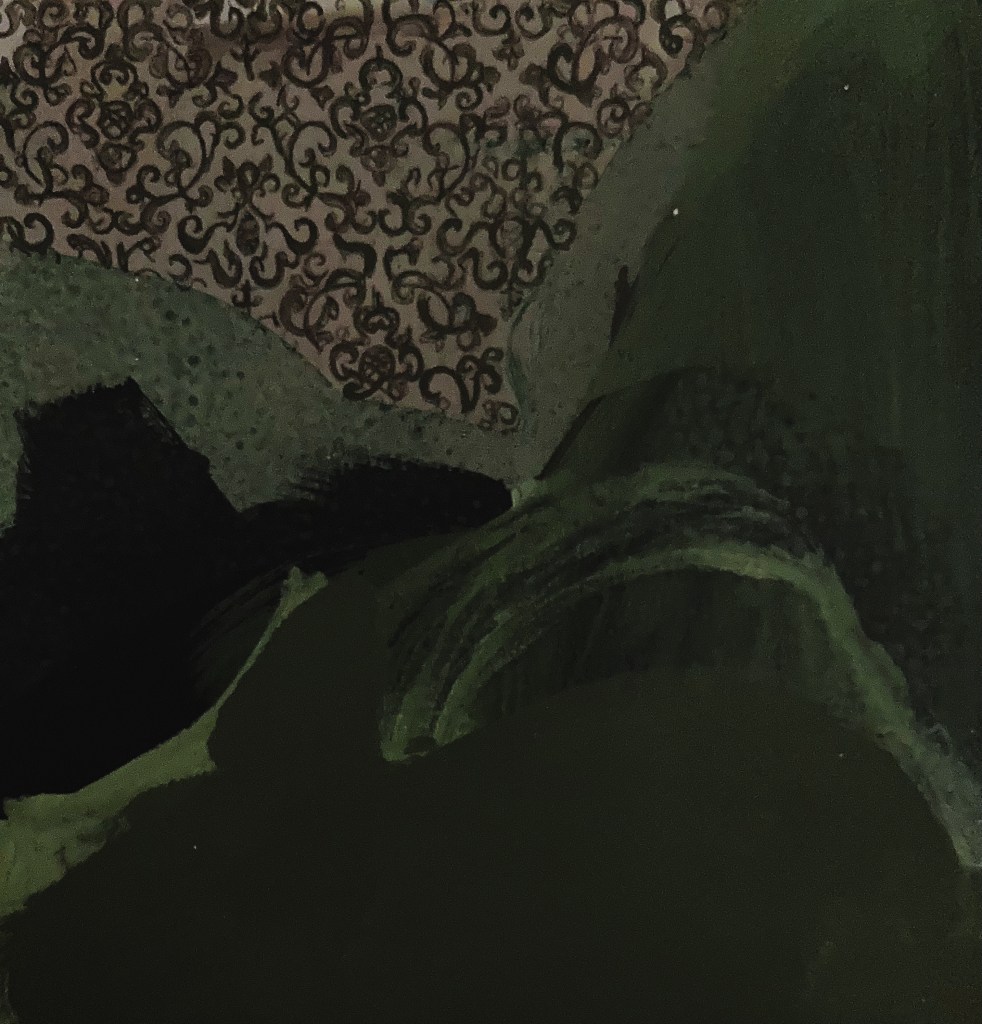
For the green paintings I’m doing for my first research project, I’d like to include more complex pattern work. So this past week, I have been experimenting with patterns from Victorian wallpaper. I like the results so far. When I am in London next week, I will try and visit the Victoria and Albert Museum to find some more inspirational patterns.

I miss my dead-lady-bed

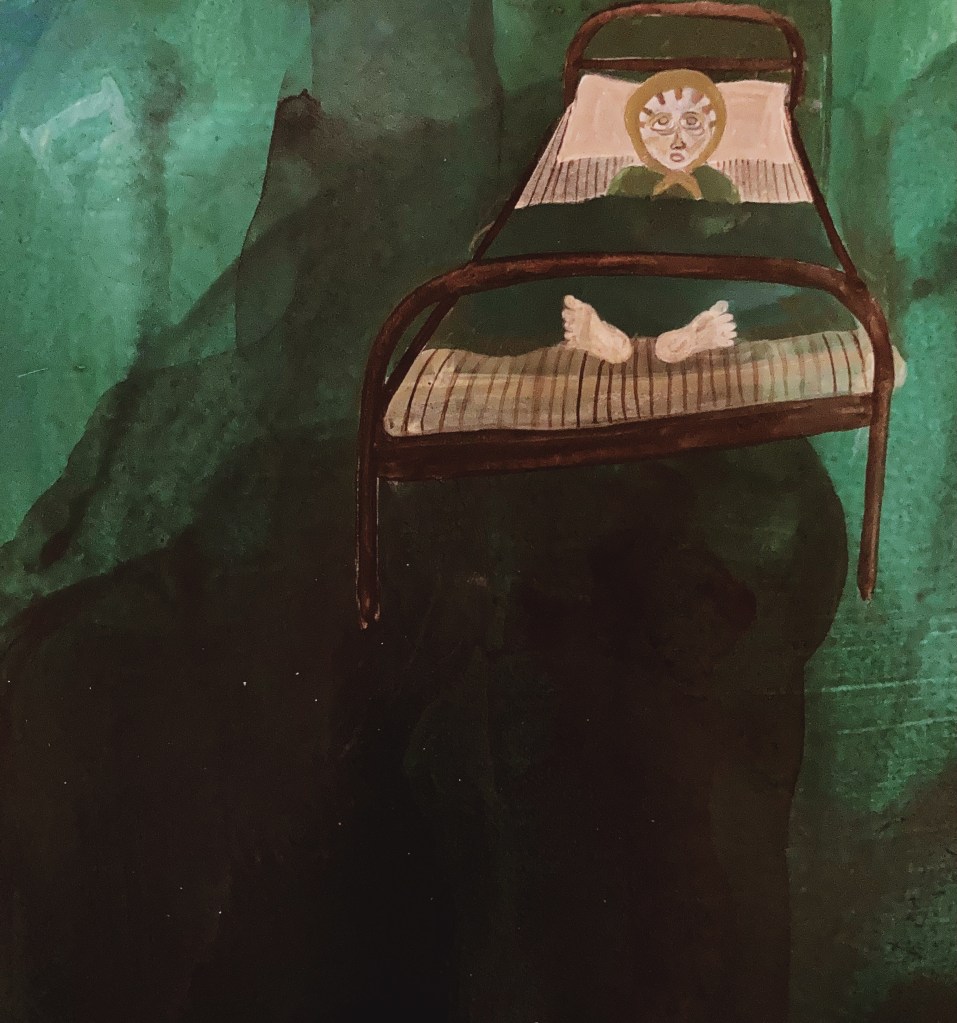
I love a good nap. And by far the best napping I have ever done was in my dead-lady-bed. The bed was a fixture in my last apartment, which I rented for 12 years (the longest I’ve lived anywhere). It got its dead-lady moniker because I am convinced an old lady died in it. It was a single, motorised bed that moved up and down, like you find in an old-folks home, and had a mattress so insanely comfortable, that even though I now sleep in a fancy super-king bed with a memory-foam mattress, I still find myself hankering for the warm embrace of my dead-lady-bed.

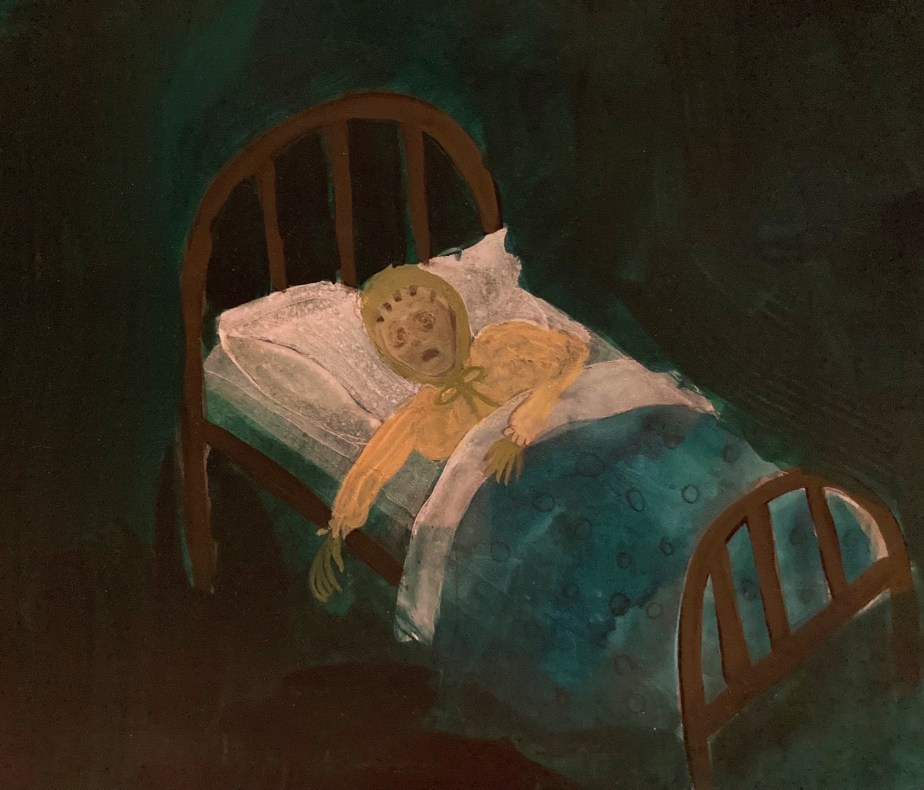
Coincidently (or perhaps not), the painting I had in mind for the Interim Show featured a dead lady in a bed. Although I wasn’t able bring the whole concept of the painting to fruition in time (of which the dead-lady-in-a-bed was just one element), it certainly wasn’t for want of trying.

Even though the painting doesn’t yet exist in its final form, I love it with a passion, and will do everything within my artistic powers to make it exist. Seeing the little experiments above gives me heart that it will!

Keep it simple, Stupid

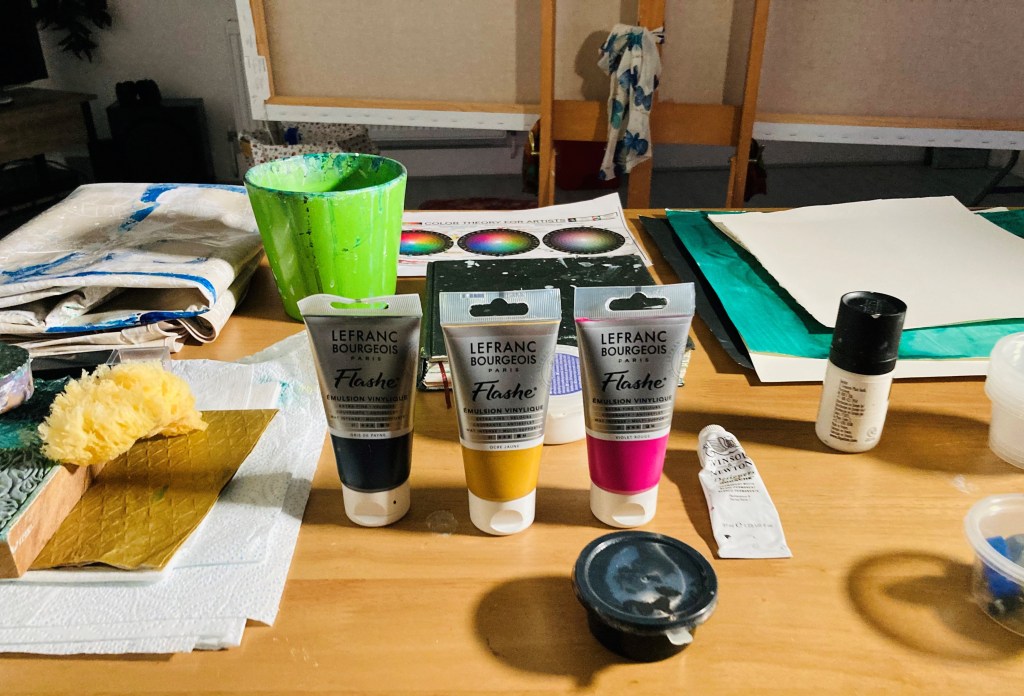
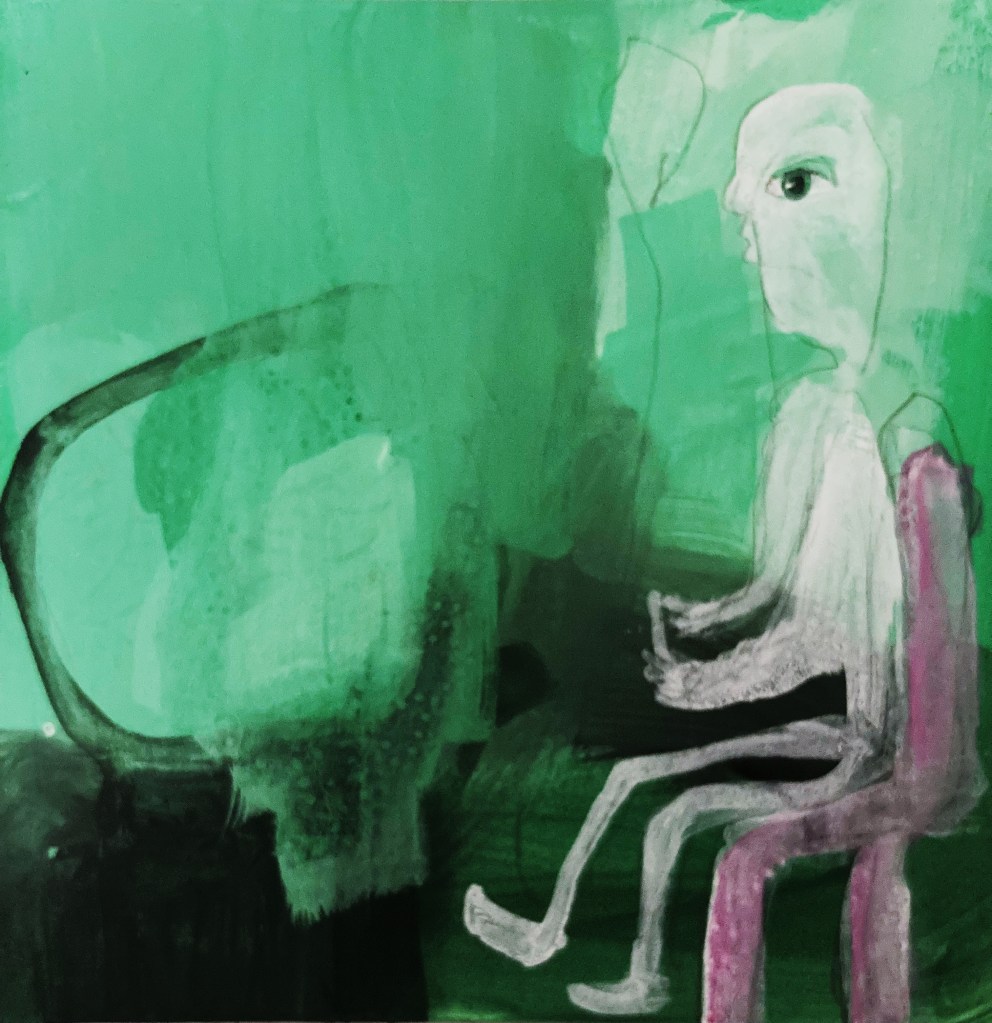
After getting myself in a right pickle with my interim show painting, and almost flogging it into oblivion, I decided to take a more simple approach to the green paintings. My main focus at the moment is colour. Using the colour wheel I mentioned in my last post, I set myself the task of mixing my own greens using two colours, and then adding black and white to create different tones. I then added a colour on the opposite side of the wheel, known as a complimentary colour, and painted some little paintings to explore the colours and tones I created.

For my first experiments, I used phthalo green (blue shade) and yellow light, with red violet as the complimentary. It was nice not to have the pressure of creating an actual painting, and because I wasn’t trying so hard, some little paintings did pop out. The lighter tones are too bright and minty for the underwater paintings I have in mind, although they might be good for the odd highlight here and there. I really like the darker tones, and will definitely keep them in my bag of tricks. I also think it works better when the complimentary colour is quite strong, as in the painting below (which is of my fella playing Destiny and losing his hair from the stress of it).

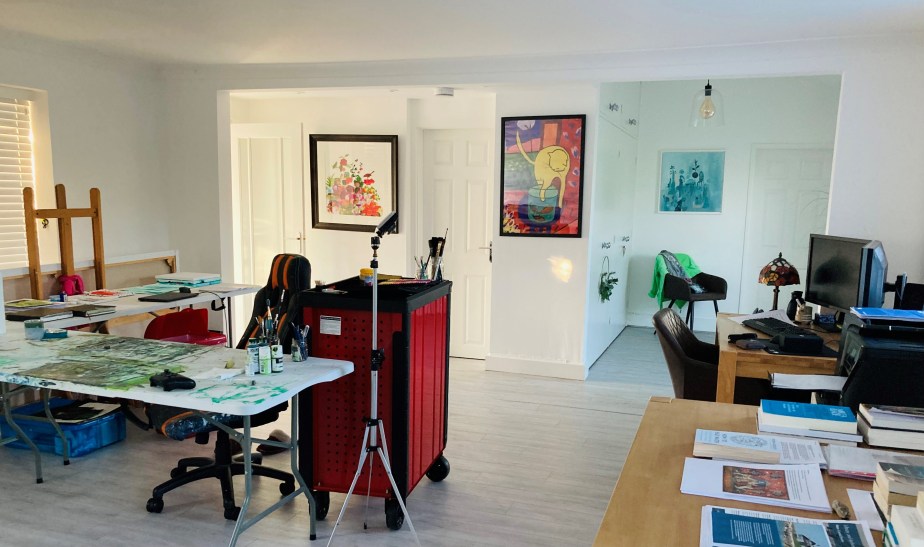
Last week I decided to declutter the studio. Wow, what a difference it makes. I love being in here even more now, and find it much more conducive to arting. Of course, unless you’re a de-clutterer of the ruthless variety, the clutter has to go somewhere. Mine has gone into the room that my fella was going to use as an office. However, the non-fibre broadband we have out here in the woop woops isn’t good enough for his job, so he still works in his flat in Ramsey. With the empty space too tempting not to fill, it is now home to canvases and paints and things. According to my fella, I have now peed in every corner of the house, and if we ever do get fibre out here, he’ll need to water-proof the shed.

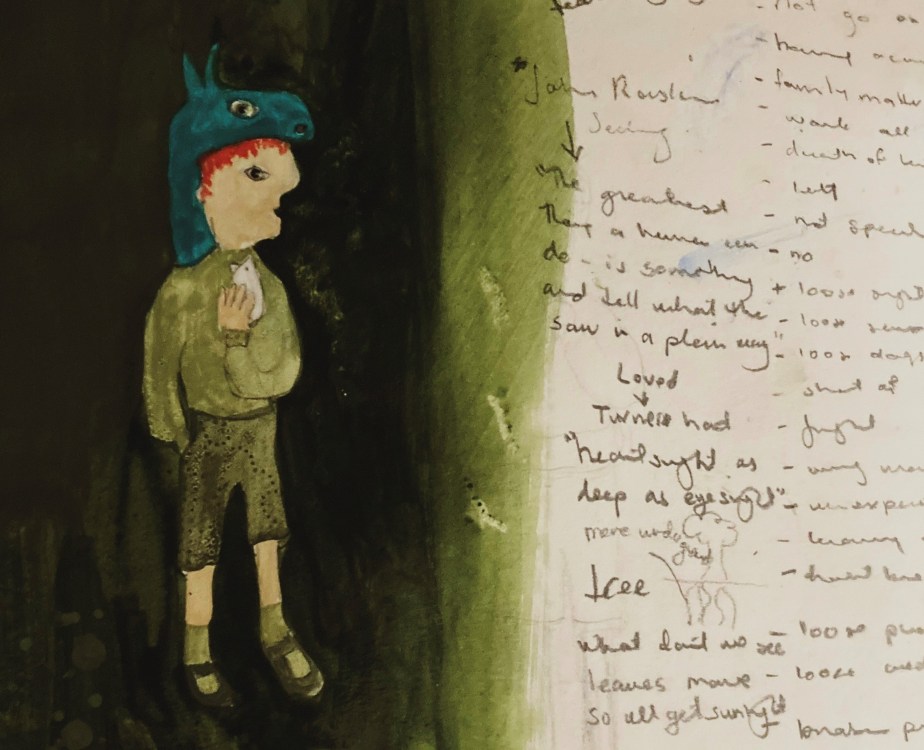
Flogging a dead horse-hat

The other day I was lamenting to my fella about the agony I was going through trying to paint my green paintings, one of which I was hoping to get finished for the Interim Show. To clarify, he asked if I meant the paintings that if I didn’t do them there would be absolutely no consequences. That made me laugh so much. Because he was right, not just about the green paintings, but about painting in general. Absolutely nothing of consequence would happen if I never painted another thing. Sure, I’d fail my MA, and have a lot of time on hands, but no one would die, and except for a handful of people, no one in the world would even notice. And yet, I put myself under an inordinate amount of pressure, and approach my painting practice like my life, if not the world, depends on it. This has been true of the green paintings, particularly the one I had in mind for the interim show.

I absolutely love the painting I had in mind for the show, but I have come to the painful conclusion that it simply won’t be finished in time. Because it is a new type of painting for me, there is a certain developmental process that it has to go through, and rushing or missing out aspects of that process has so far resulted in a frustrating, dead-horse-flogging mess. So, before I flog the idea into oblivion, I’m going to return to the beginning of the development process, so I can build a firm foundation for the type of paintings I want to do. In which case, for the next couple of months, I will focus on colour and drawing figures.

During my last one to one tutorial, Jonathan put me onto a brilliant colour theorist, Florent Farges. I’ve already watched one of his videos, and it was extremely helpful, as is his self-designed colour-wheel system, that takes into account hue, chroma, and value. It’s all pretty technical, but I think it will be well worth the time and effort it will take to get to grips with it. So, watching his other videos, studying his wheel/s, and experimenting with colour is high on my list of priorities.

I have also signed-up for a couple of online illustration courses. So far, they have been enjoyable and easy to follow. I don’t want to do realistic drawings, and am not interested in portraiture, but I do want to develop my ability to draw expressive characters which convey emotion.

Instead of showing one of the green paintings at the Interim Show, I am going to show a painting I did when I lived in Australia. I have never shown it before, and very few people have ever seen it. That’s because I hid it in my studio due to what I perceived as a mistake in it. I always thought it was a shame, because apart from that, I thought it was a beautiful painting. Then COVID came along, the world went crazy, and I finally plucked up the courage to paint-out the mistake, and I’m pleased to say it worked, and the painting is now fit to be seen.

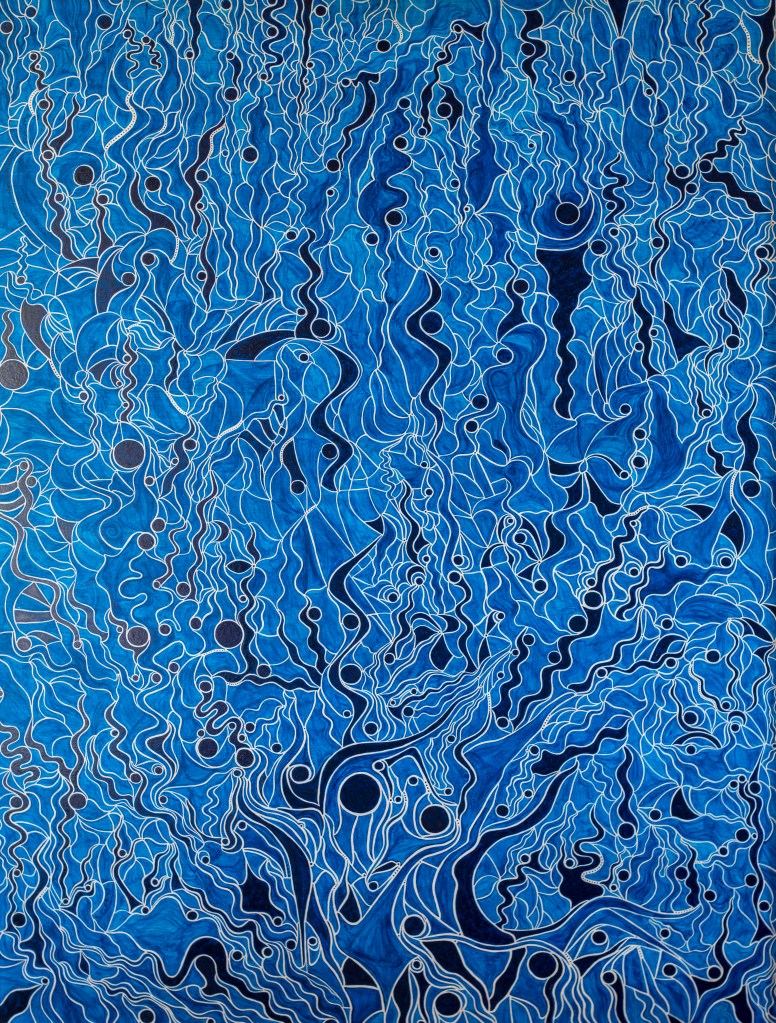
Acheron 90cm x 120cm acrylic on board

According to Greek mythology, Acheron (lit. river of woe) is the name of one the rivers in the underworld, which, along with the river Styx, Charon ferries the souls of the dead across. It’s an apt title for the painting, as I painted it at a time when I was miserable with unrequited love, an experience that sent my life into a tail-spin of hadesian proportions. Ahh, at least I got this painting out of it. A fair price I think.

I love a good workshop

One of the great things about my MFA course is the variety of workshops that are on offer. I took part in 3 this week, all of which were brilliant. The first two were textile based, and the 3rd, photography. Although my practice is primarily focused on painting, it can be helpful to branch out now and then, as it tends to be easier to loosen up and be more expressive in disciplines you are not so familiar with. The new inspiration you gain from this process can then feed back into your preferred/more practiced discipline.

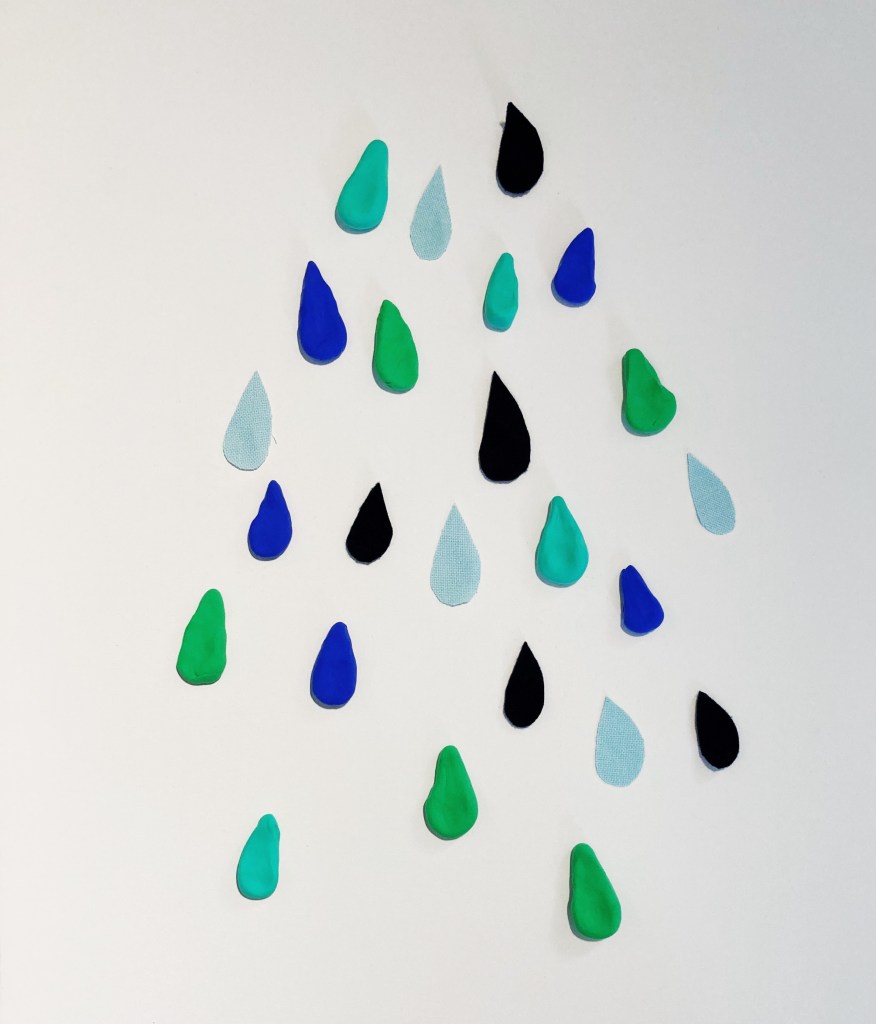
The first workshop was called ‘Sustainability through textiles‘, which explored the relationship between sustainability and our art practice, specifically in relationship to our masters project. This was perfect for me, as my masters project, about water, naturally has a sustainability aspect. Through a variety of creative/making exercises, we were asked to consider our experience, values, and attitudes towards sustainability.

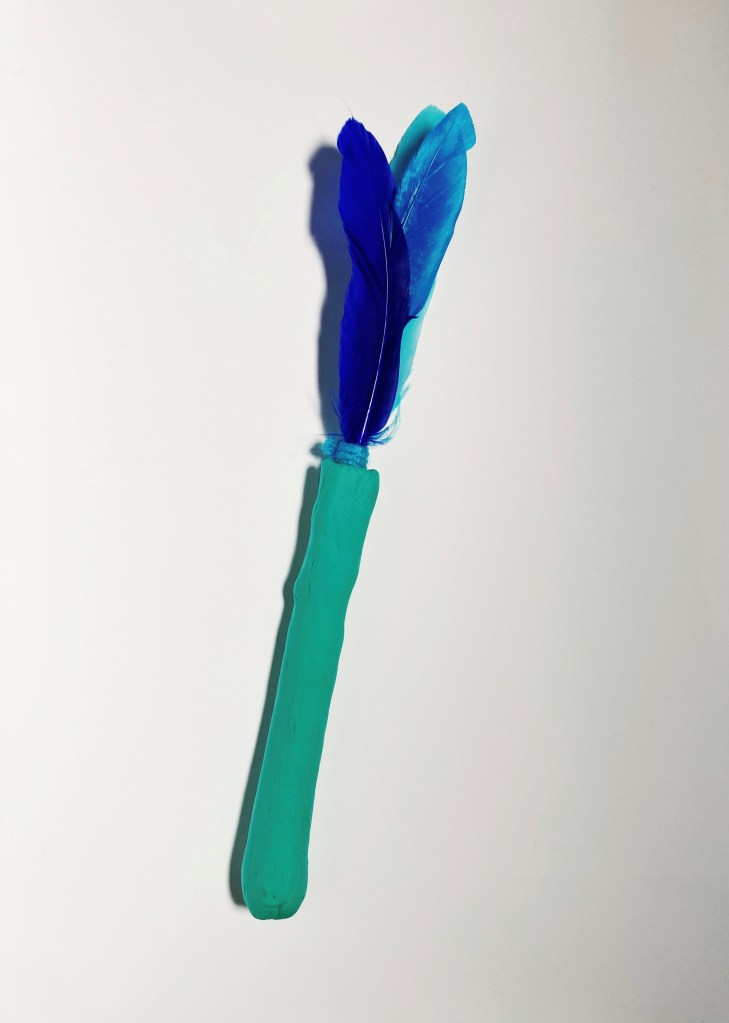
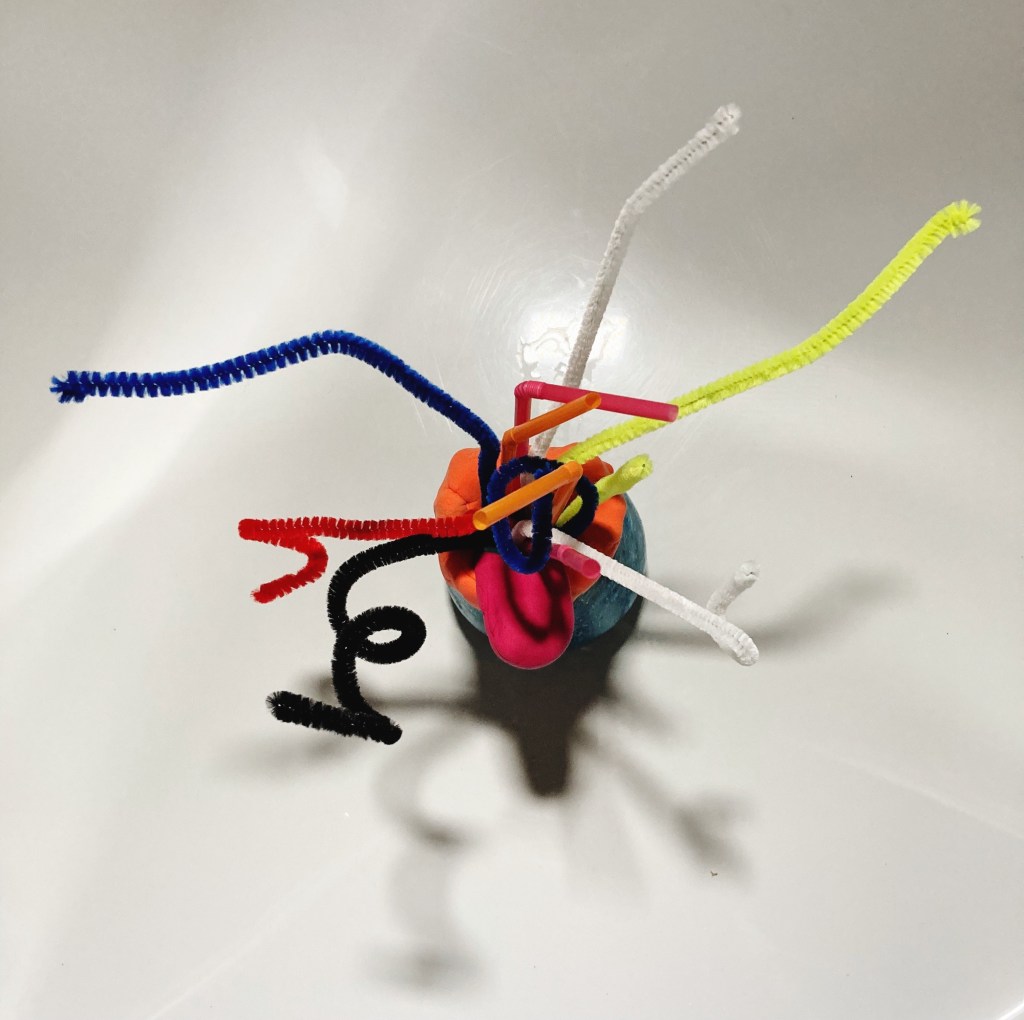
Below are some things I made during the workshop:

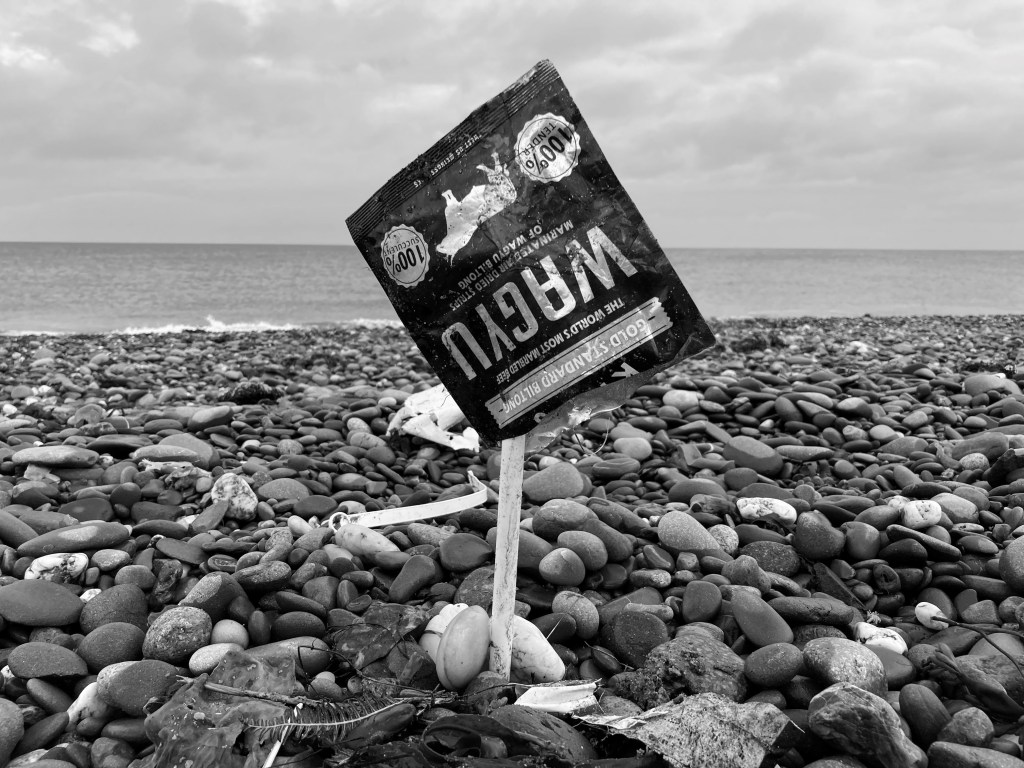
At the end of the workshop, we were asked to consider future actions we might take in our creative practice that demonstrated our values towards sustainability. I concluded that the best thing I could do is pick up the rubbish on the isolated stretch of beach in front of my house, that the sea kindly delivers every hightide. Hardly anyone walks on the beach but me, so I figure it’s my responsibility to keep it rubbish free. Sure I can still creatively express my values if I want, but to do that without picking up the rubbish shows I have no real values at all.

The second workshop was called ‘Emerging dialogues through the positioning of textile and visual arrangements‘. I’m not really sure what that means, but I had a great time. I happened to be the only person taking the workshop, so it was more informal and interactive than usual. I was able to discuss both my water and Ann projects with the tutor, and her feedback was very helpful. I also did all the exercises she’d planned for the class, all of which I found challenging, inspiring, and enjoyable.

Here is one of the things I made (the thing itself is a little naff.. but I do like the photo):

The third workshop was called ‘Finding inspiration: exploring photography through movement‘. I really loved this one. Rather than teaching photography techniques per se, it was more focused on finding ways to access your own creativity. It followed the same structure as the textile workshops, that of instruction, creating/making, and class participation. I found it genuinely inspiring, and will be able to use what I learned, not only to take more interesting photos, but also in my painting practice.

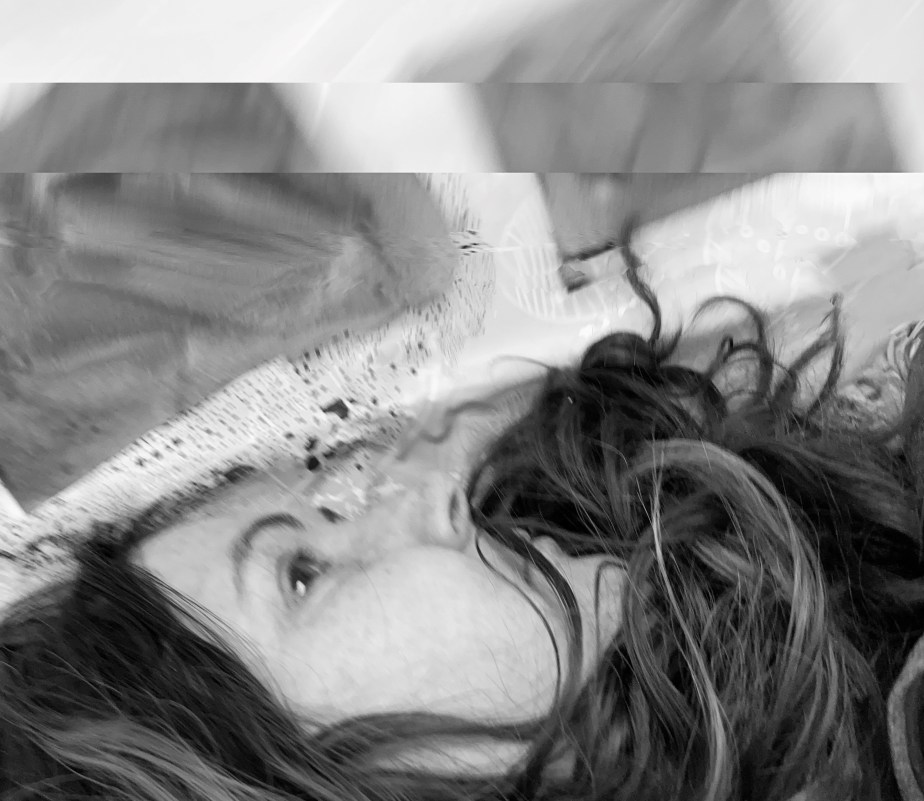
Our main task for the workshop was to take a series of photos of ourselves while moving about. My favourite is the photo below. Even though I was moving when it was taken (as evidenced by my hair falling upwards), there is also a stillness to it that I really like. I also like the one at the top of the post, though it would’ve been better without my phone in the reflection.

As enjoyable as the workshop was, the highlight of the day was going down to the sea during the break and having a surprise visit from Fonzi and his friends. It filled my heart with joy.

Falling into green

Picasso was a horror when it came to women, but his insights into painting were spot on – like this:

Painting isn’t an aesthetic operation; it’s a form of magic designed as a mediator between this strange hostile world and us, a way of seizing the power by giving form to our terrors as well as our desires.

or this:

Colors, like features, follow the changes of the emotions.

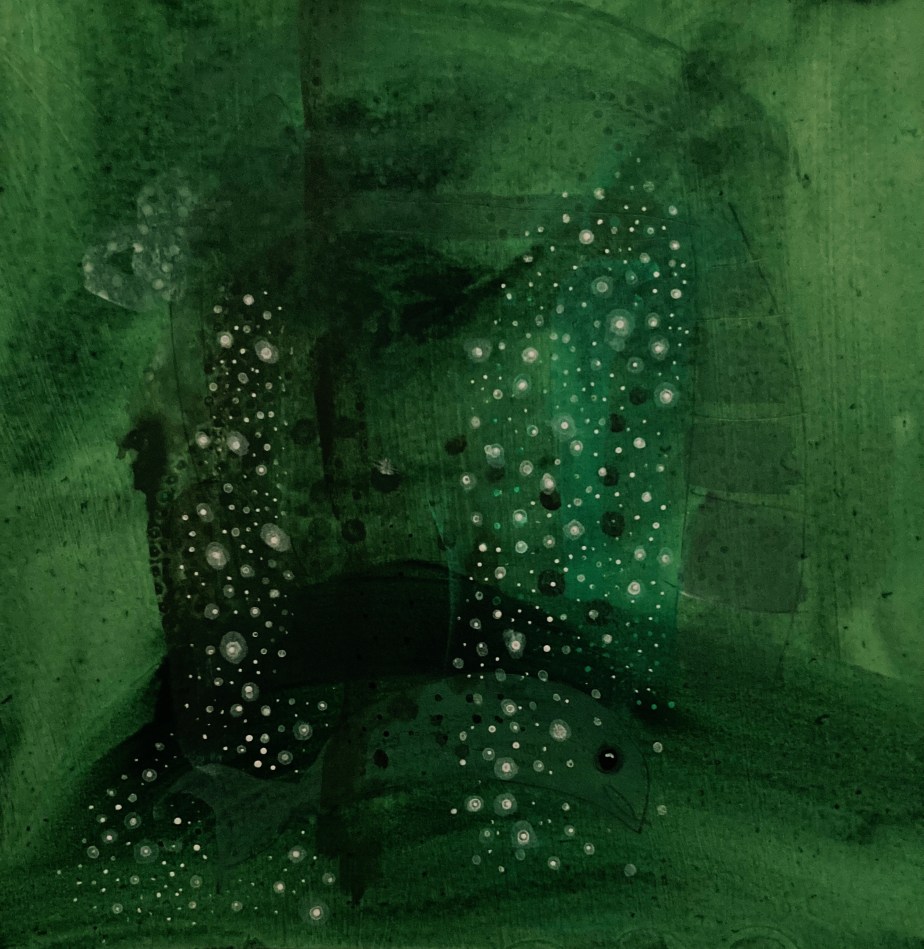
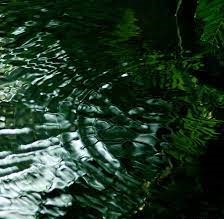
I am particularly interested in this second insight at the moment, due to my recent colour change from blue to green. Blue has always felt like a safe, knowable colour to me, which is why I typically used it when experimenting. But green – it is completely different. I don’t yet know its boundaries, or what its emotional resonance will be on a large scale. On a small scale, it feels mysterious and other-worldly, if not a little bit spooky. When I paint with its darker tones (as above), I am reminded of a time when I was a child, in a boat on the edge of a lake. I remember looking deeply into the water which rippled and swirled with tones of impossibly dark green that merged into unknowable inky darkness. I was completely captivated. Even though I was only a small child, probably no more than 5 or 6, I knew I would never forget what I was seeing, and so I never have.

The above picture, which I found on the internet, is the exact colour/visual I remember. Looking at it, even with its poor resolution, I have the same sensation of wanting to fall into its depths. What a truly mysterious colour. However, the trouble with this shade of green is, it doesn’t really go with anything else (perhaps because it is perfection in and of itself), so it would not really be suitable for the figurative painting/s I have in mind for the Interim Show (although, never say never).

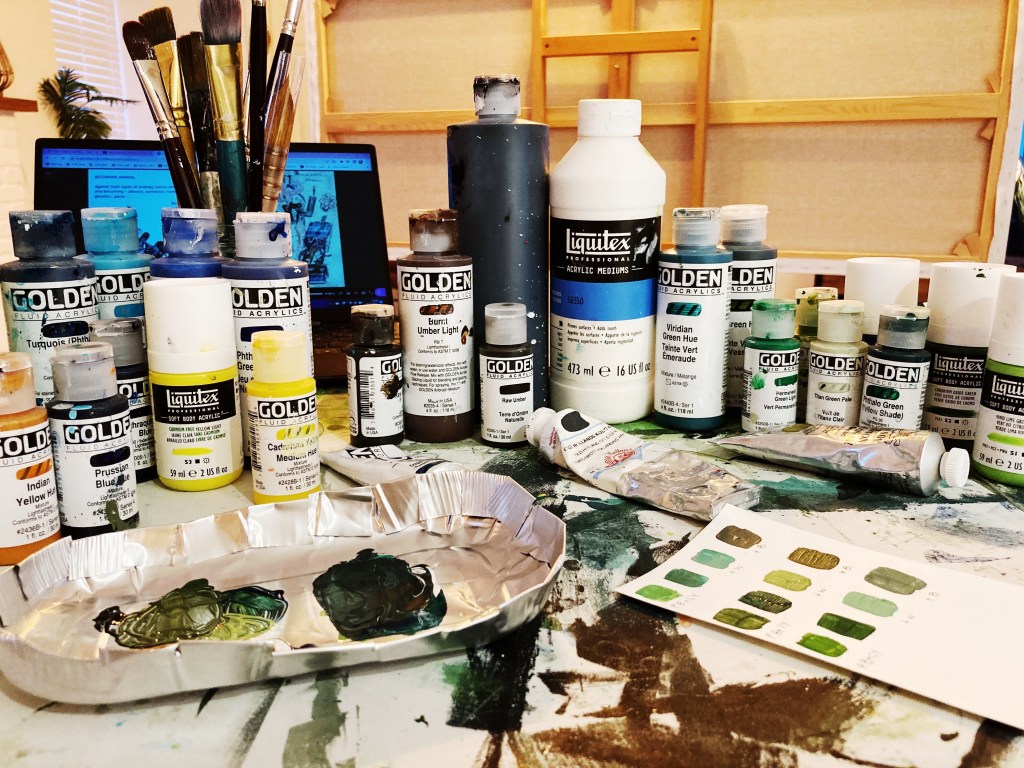
One thing is certain, if I am going to paint with green, I have to get it right, or I will end up with a garish mess that no one will want to look at. To avoid this pitfall, I have set myself the task of creating a suitable palette, so I’ll have a better chance of getting it right when it comes to the final work/s.