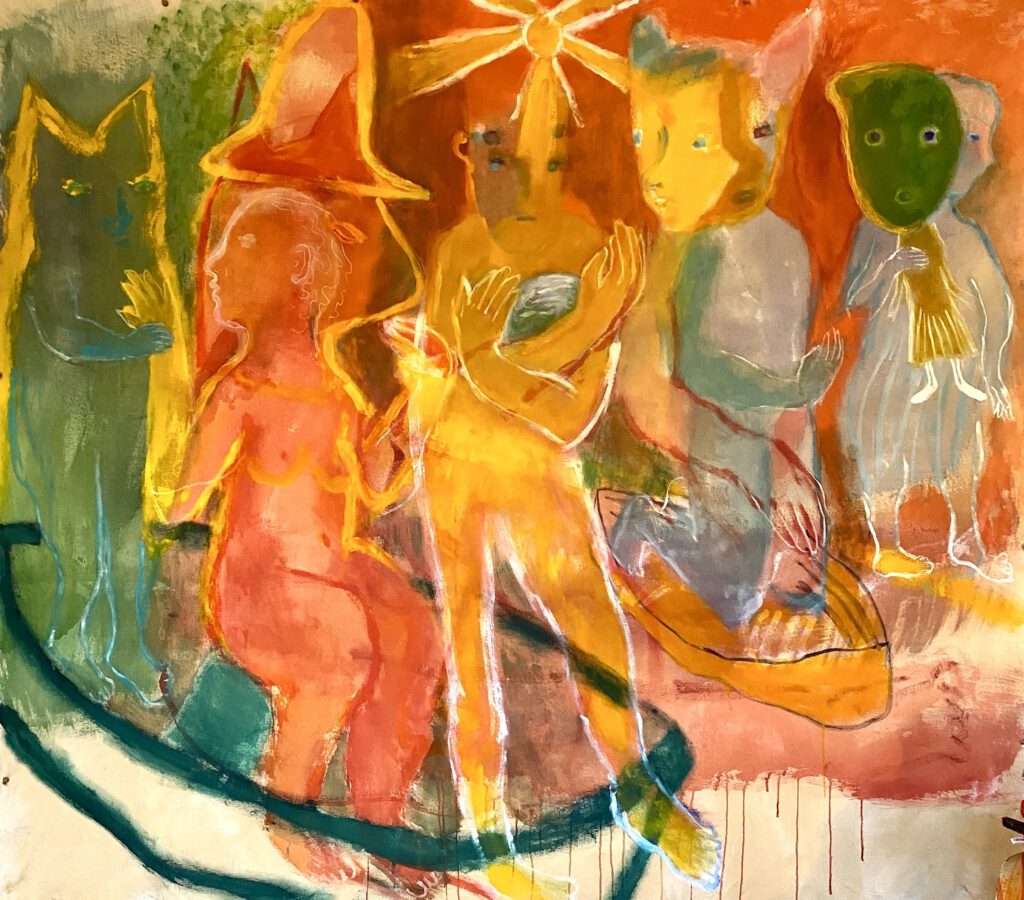
Flogging a dead horse-hat

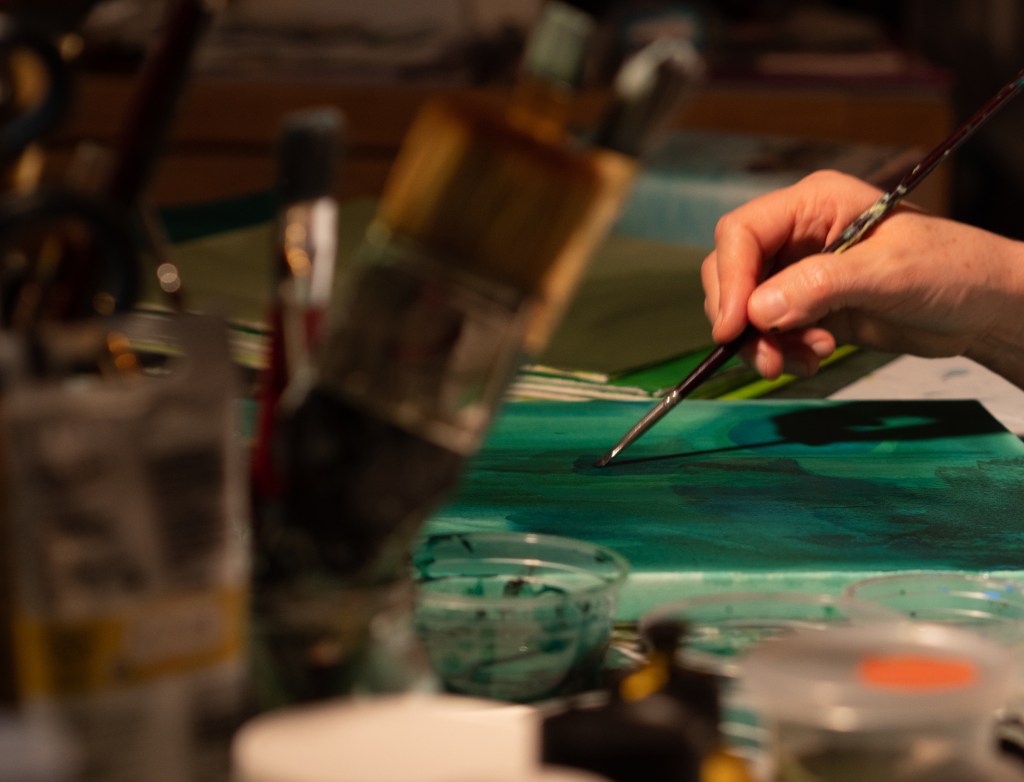
The other day I was lamenting to my fella about the agony I was going through trying to paint my green paintings, one of which I was hoping to get finished for the Interim Show. To clarify, he asked if I meant the paintings that if I didn’t do them there would be absolutely no consequences. That made me laugh so much. Because he was right, not just about the green paintings, but about painting in general. Absolutely nothing of consequence would happen if I never painted another thing. Sure, I’d fail my MA, and have a lot of time on hands, but no one would die, and except for a handful of people, no one in the world would even notice. And yet, I put myself under an inordinate amount of pressure, and approach my painting practice like my life, if not the world, depends on it. This has been true of the green paintings, particularly the one I had in mind for the interim show.

I absolutely love the painting I had in mind for the show, but I have come to the painful conclusion that it simply won’t be finished in time. Because it is a new type of painting for me, there is a certain developmental process that it has to go through, and rushing or missing out aspects of that process has so far resulted in a frustrating, dead-horse-flogging mess. So, before I flog the idea into oblivion, I’m going to return to the beginning of the development process, so I can build a firm foundation for the type of paintings I want to do. In which case, for the next couple of months, I will focus on colour and drawing figures.

During my last one to one tutorial, Jonathan put me onto a brilliant colour theorist, Florent Farges. I’ve already watched one of his videos, and it was extremely helpful, as is his self-designed colour-wheel system, that takes into account hue, chroma, and value. It’s all pretty technical, but I think it will be well worth the time and effort it will take to get to grips with it. So, watching his other videos, studying his wheel/s, and experimenting with colour is high on my list of priorities.

I have also signed-up for a couple of online illustration courses. So far, they have been enjoyable and easy to follow. I don’t want to do realistic drawings, and am not interested in portraiture, but I do want to develop my ability to draw expressive characters which convey emotion.

Instead of showing one of the green paintings at the Interim Show, I am going to show a painting I did when I lived in Australia. I have never shown it before, and very few people have ever seen it. That’s because I hid it in my studio due to what I perceived as a mistake in it. I always thought it was a shame, because apart from that, I thought it was a beautiful painting. Then COVID came along, the world went crazy, and I finally plucked up the courage to paint-out the mistake, and I’m pleased to say it worked, and the painting is now fit to be seen.
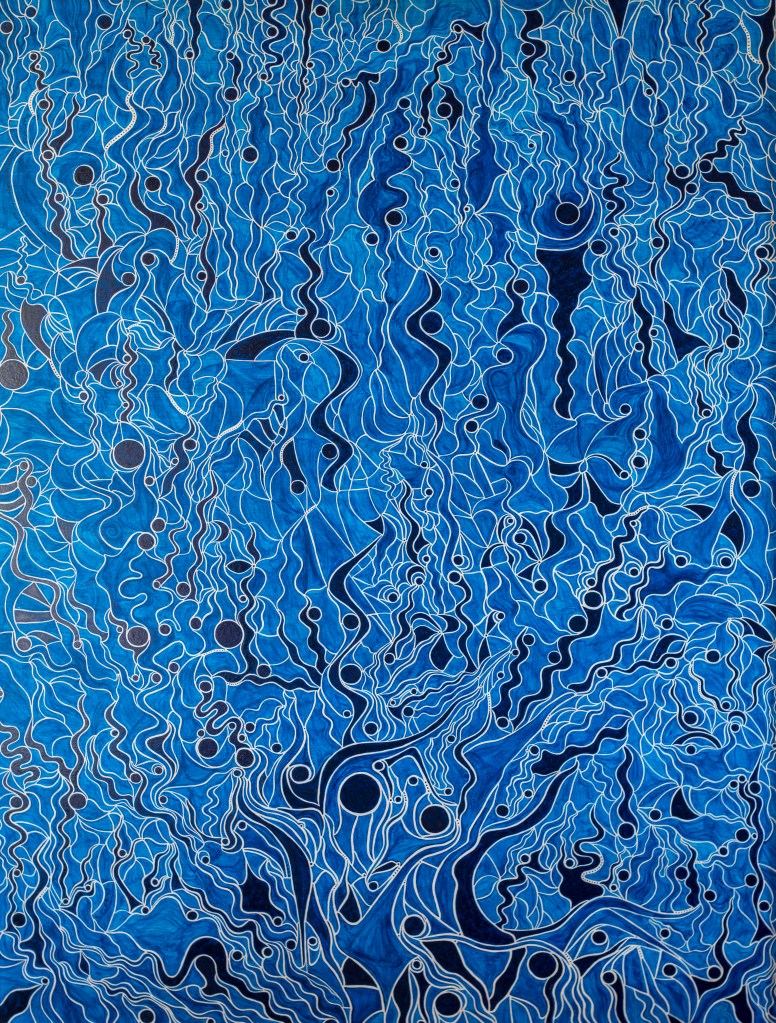
Acheron 90cm x 120cm acrylic on board

According to Greek mythology, Acheron (lit. river of woe) is the name of one the rivers in the underworld, which, along with the river Styx, Charon ferries the souls of the dead across. It’s an apt title for the painting, as I painted it at a time when I was miserable with unrequited love, an experience that sent my life into a tail-spin of hadesian proportions. Ahh, at least I got this painting out of it. A fair price I think.
A word salad with the right dressing is delicious

A word salad is defined by the Cambridge dictionary as:

a mixture of words or phrases that is confused and difficult to understand.

Borrowed from psychiatry, where it describes the unintelligible speech of those afflicted with particular psychiatric disorders, a word salad has come to be used to describe a style of academic writing or speech that is unintelligible to the uninitiated (and sometimes even the initiated). Often touted as the panicle of the academic word salad is the writing of philosopher and literary theorist Prof. Judith Butler. It’s not hard to see why with gems like this:

The move from a structuralist account in which capital is understood to structure social relations in relatively homologous ways to a view of hegemony in which power relations are subject to repetition, convergence, and rearticulation brought the question of temporality into the thinking of structure, and marked a shift from a form of Althusserian theory that takes structural totalities as theoretical objects to one in which the insights into the contingent possibility of structure inaugurate a renewed conception of hegemony as bound up with the contingent sites and strategies of the rearticulation of power.

Further Reflections on the Conversations of Our Time, published in the scholarly journal Diacritics (1997)

Personally, I find the above completely inaccessible and it hurts my head to even try. Unless Butler is being deliberately obtuse, and there is no “there there”, I assume an expert is needed to teach the meaning of what is being said, because knowing the language in which the ideas are being expressed is simply not enough. Of course, this is nothing new, the history of western philosophy is littered with great thinkers whose ideas were pretty much incomprehensible in their lifetimes, and remained so until greater minds rehashed and broke down the ideas over the years, making them accessible to average-Joes like me. So, who knows, in 100 years everyone might comprehend Butler.

There is an anomaly to my aversion to Butler’s word saladrey, that is a lecture Butler gave at a symposium called Topography of Loss, about Doris Salcedo’s 2017 The Materiality of Mourning exhibition at the Harvard Art Museums. The lecture was titled Shadows of the Absent Body, and I have to say it was the most powerful, mind-expanding, and heart-wrenching art lecture I have ever heard. On the surface, much of it is incomprehensible. However, the ethereal way Butler strings words together seem to perfectly reflect the theme of the exhibition, that is the terror and loss of disappeared people.

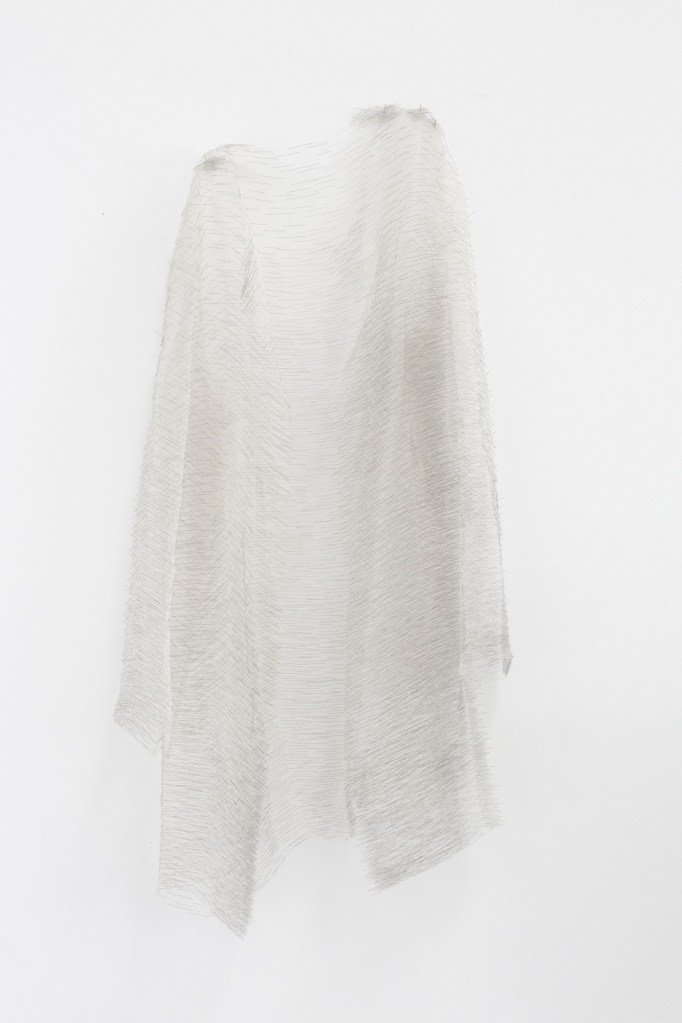
One of the best things about the lecture, was it introduced me to Doris Salcedo’s work, and allowed me to access it and fall in love with it in a way that I wouldn’t have were it not for Bulter’s sublime word salad. I am deeply inspired by Salcedo’s The Materiality of Mourning exhibition, particularly the textile piece below.

Disremembered VIII Sewing needles and silk thread

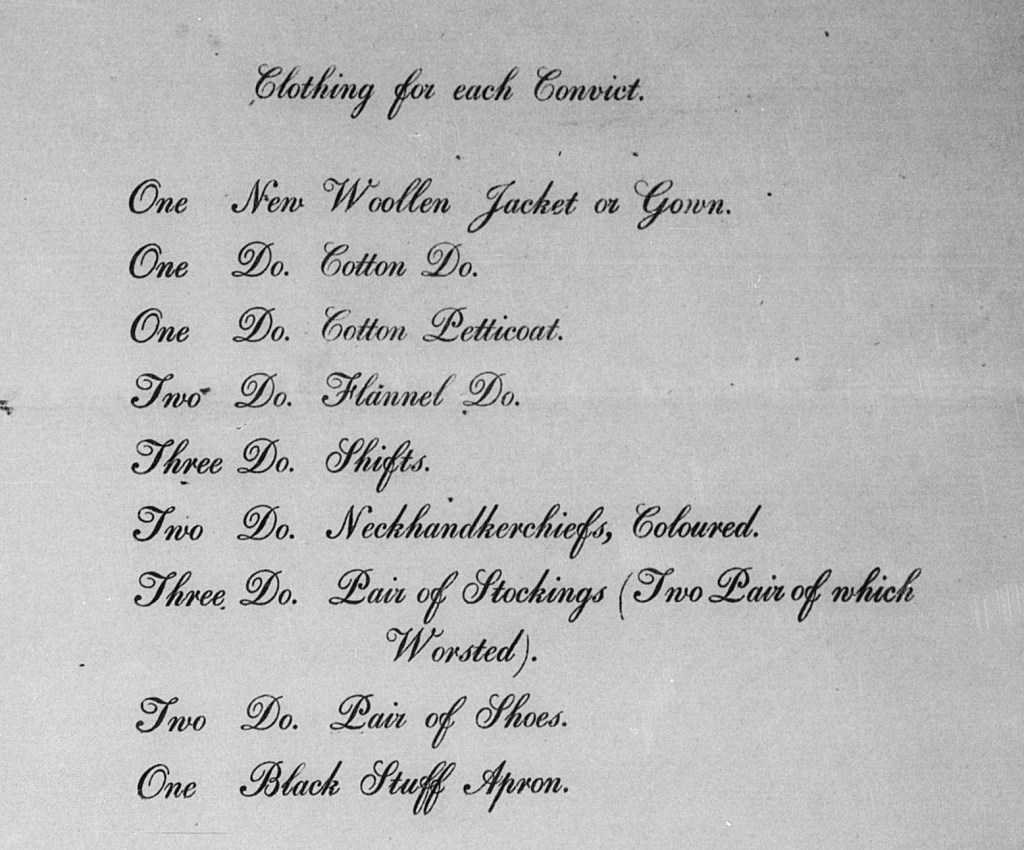
I would like to make a textile piece for my Ann project, to be shown with the painting. The idea I am toying with is something related to the clothes the transportation system officials required be sent with each prisoner, the list of which I found in Ann’s court records.

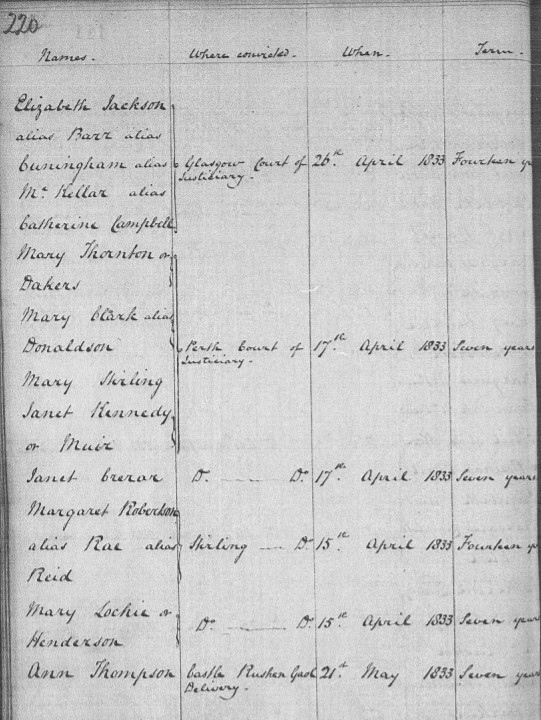
I am also thinking of including the list of the female convicts who were on the Amphitrite, all of whom died when it was shipwrecked. I think the contrast between the beautiful penmanship of the writing and the terrible fate that awaited the woman on the list is both poignant and haunting.

Amphitrite Indent List – Ann’s name at the bottom of the last page

I’m not quite sure how I will marry the two together, but as soon as I have finished the Ann painting, I will start experimenting with different ideas and fabrics etc. Who knows, maybe something will come to me in a dream in the meantime.

The benefits of getting high(er)

Having recently completed my study statements (detailed descriptions of my aims and objectives for my two projects, and how I intend to realise them), I now have a clear idea of where I am headed, and how I intend get there. The statements were arduous and uncomfortable to produce, as I had to think about, and then articulate, what it is I am up to, and what I want from my work and my time on the course. However, having gone through the process, the clear view I now have is my reward. It’s similar to climbing a hill. Sure, it hurts on the way up, but the expansive view (commensurate with the height of the climb) is generally well worth the effort. It helps you situate yourself in the landscape, and allows you to see the direction and path you should take to get to a particular destination.

On Saturday, my fella and I went to the pub. On the way, we decided to walk up a hill. After much huffing and puffing and moaning that quads hurt when you use them, we finally made it to the top. The view was spectacular, and our thumping hearts and near-hyperventilation made the moment transcendent, and reminded me that exertion in pursuit of elevation is usually worth the effort. Of course, sitting by the fire in a cosy pub and eating chips is also pretty transcendent, especially after you’ve just walked up a hill.

Prior to the hill-walking and pub-sitting, we went in search of a confluence (of the river variety), which is the title I have chosen for my water/green paintings project. The project centres around the idea of confluence – the meeting and running together of two or more things. Using the metaphor of a river confluence (a place where two rivers meet and begin flowing together), I want to explore various historical “confluences”, where natural and human-engineered forces came together and resulted in disasters involving water. Within the selected historic disasters, I hope to find individual and/or forgotten stories of people who died as a result, specifically through drowning, and tell their stories. I also want to create a confluence within the paintings themselves, combining two or more stories within a given painting. If successful, the paintings will be an allegorical warning as to the fate that awaits more and more people due to the natural and human-made confluence of global warming.

Naturally, it remains to be seen if the paintings I produce even work as paintings, let alone achieve something as highfalutin as an allegorical warning (which, lets call a spade a spade, sounds pretentious). Still, I like the idea, and want to give it a go.

Anyway, back to the river confluence we went in search of. We found an absolutely beautiful one in Tholt-y-Will glen, where the Sulby river (the largest river on the Island) meets with a tributary (I don’t know its name) that runs down from the hills. It’s a heavenly spot, filled with magic and mystery. It is no surprise river confluences were once thought of as scared places where the gods danced. They were also viewed as portals to the underworld, and places where propitiatory offerings were made to secure the favour of the gods.

I meant to take a photo of the confluence, but I was too busy securing a favourable outcome for my project. However, I did take this video of a beautiful pool above the confluence, which is part of the tributary that flows into the Sulby.

Oh, and we also found a cave where I suspect the Cabbyl-Ushtey lives. The Cabbyl-Ushtey is a malevolent Manx water-horse that lures passers-by onto its back. Once on there, the person is stuck-fast, and the Cabbyl-Usthey leaps into the river and drowns them.
Geoff Day on Fire

For me, painting is an obsessive drive that consumes my every waking hour. If I’m not doing it, I’m thinking about it. It is no exaggeration to say my life revolves around my painting practice, the discipline of which is anchored down deep. Not only does my fella support my love of painting, he actively facilitates and protects it. Were it not for him, I’d be a lonely cat-lady with no cat, pushing my trolley around town with paint in my hair (I’m not kidding, that’s how he found me). Instead, I’m painting all day in a beautiful studio next to the sea, doing my MFA, and generally living a life I could previously only dream of. True, I still have paint in my hair, and don’t have a cat, but I am loved and warm and completely indulged, and am no longer in need of a trolley. Its a wonderful life, and I am thankful everyday that I get to live it.

Each week, I have a break from the studio (from Friday evening till Saturday evening), so Geoff and I can spend some quality time together. Geoff refers to this period as Bexapalooza, Bex-in-the-park, or simply Bexfest. That’s because we typically end up doing Bex-related activities, like visiting graves, wells, or my parents. By way of a counter-balance, every now and then we have Geoff Day – i.e. 24 hours of Geoff-related activities. When I say “every now and then“, I mean once every two years. That’s until last Friday when we had Geoff Day on Fire (after already having a standard Geoff Day in December). As we were celebrating his birthday as well, I wanted to make this Geoff Day extra special (hence the Fire), so I booked a night in a swanky hotel and organised some activities I knew he would like.

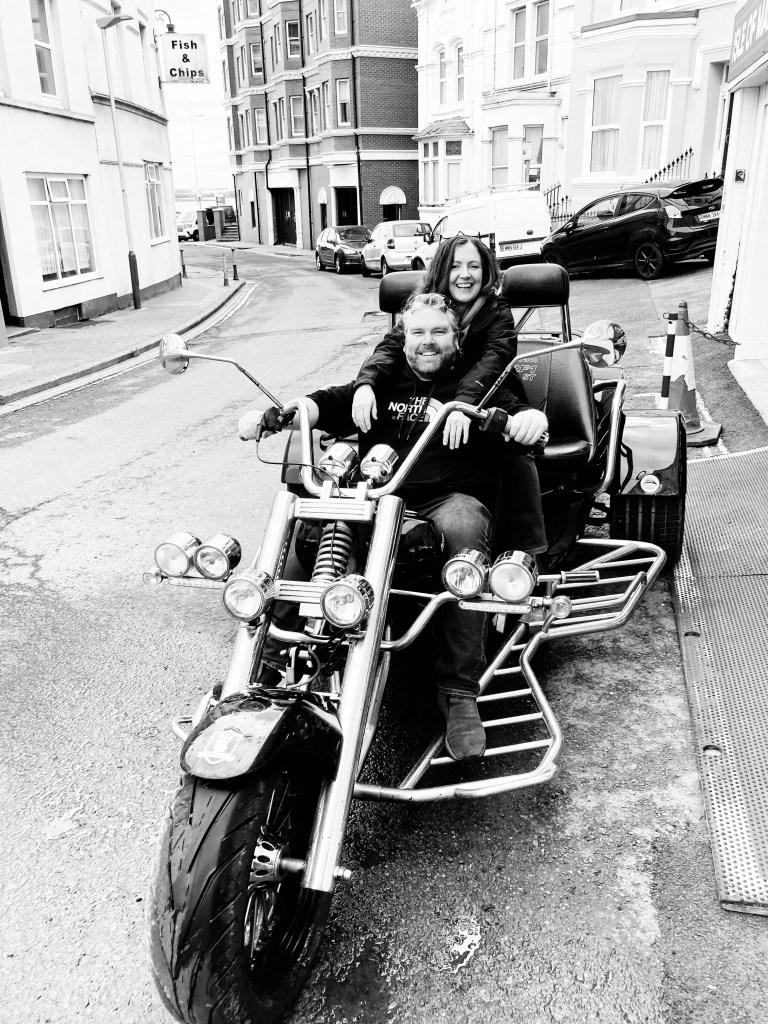
First on the list was a Trike Tour around the Isle of Man. Our particular tour was called “The Road Less Travelled”, which took us on the stunningly beautiful roads in the centre of the Island, while our tour-guide (aka our friend Simon) regaled us with tales of the grizzly murders and goings-on in the isolated cottages and farms along the way – like the son who ran-through his father with a pitchfork, over a quarrel about a cow. It was a fabulous tour, and we both thoroughly enjoyed it.

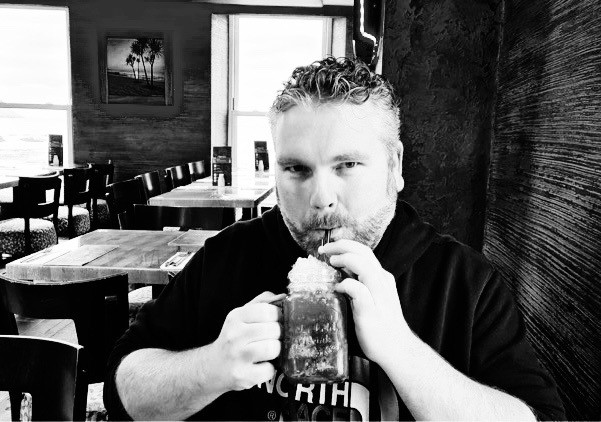
Next, we went boozing. I took my book in case the conversation got slow, and Geoff displayed his uncanny ability of making a raspberry mojito look manly.

Then it was back to the hotel for some wine and birthday presents, one of which was a fancy massage gun, which obviously needed testing, so I graciously obliged…after all, it was Geoff Day on Fire!

We then had a delicious dinner at the hotel’s Asian-fusion restaurant, after which we retired to our room. I’d like to say a great time was had by all, but I was struck-down with a migraine and kept Geoff awake all night with my fidgeting and moaning (of the “holy smokes my head is sore” variety). Added to which, the bathroom stank of raw sewage, due to the old-as drains that had likely not been changed since the Victorians were knocking about.

Geoff Day on Fire having already devolved into Bexfest, Geoff took us the long way home the next day, so we could stop off at a cemetery, and look for a well (both of which were involved in a story I am researching for a post-Interim Show painting). We then popped in and saw my folks for good measure. To show my appreciation, I let Geoff do something he’s been wanting to do since we met. That is, take me on his motorbike. He got a little choked up when I agreed to do it, as he’s never had a girl on the back of his bike before, only Phil and Belal. To be honest, I’m not a fan of motorbikes, on a account of all the dying, but I trust Geoff, and knew he’d ride sensibly. Still, I was terrified.

I’m pleased to say, I survived the ride, and Geoff survived another Geoff Day, despite the no sleep, residual smell of sewage that was burned into his nostrils, not to mention the grave-visiting, well-searching, in-law-seeing Bexapaloozing! I bet he can’t wait for the next one!

Stealing is so passé

There’s an adage in the art world – the gist of which is attributed to numerous people, from Picasso to T.S. Elliot – that goes:

Good artists copy, great artist steal.

We discussed this idea in our group tutorial a couple of weeks ago, and came to the consensus that such an idea is outdated. No one creates art in a vacuum, rather, we’re all influenced by what has gone before and those around us. Besides, the golden calf of originality has been knocked off it’s pedestal, in favour of connection and collaboration, so there is no need to steal. Therefore, do the decent thing and acknowledge your sources.

With this in mind, I thought I would write a post listing my favourite contemporary painters, whose work I both love and which serves as a source of inspiration. The latter is especially true in relation to the figurative paintings I am developing for my research project.

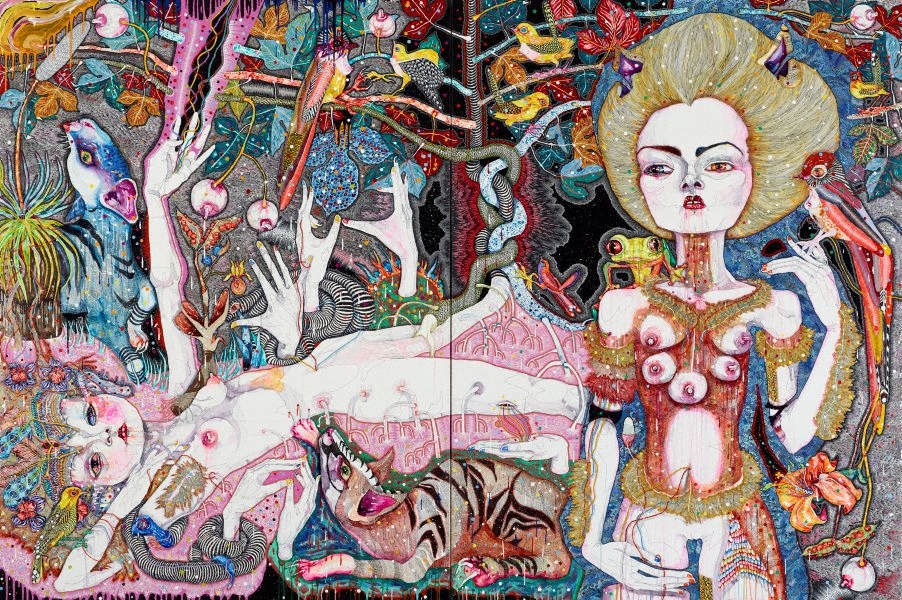
del Kathryn Barton

del’s work is glorious beyond compare. I’ve seen it in the flesh, and it doesn’t disappoint. Naturally, I love all the details, being a fiend for the iddy biddy, but it’s actually her figures I love the most. In fact, they are probably my favourite figures of any painter. Below is my favourite of del’s paintings.

come of things 2010

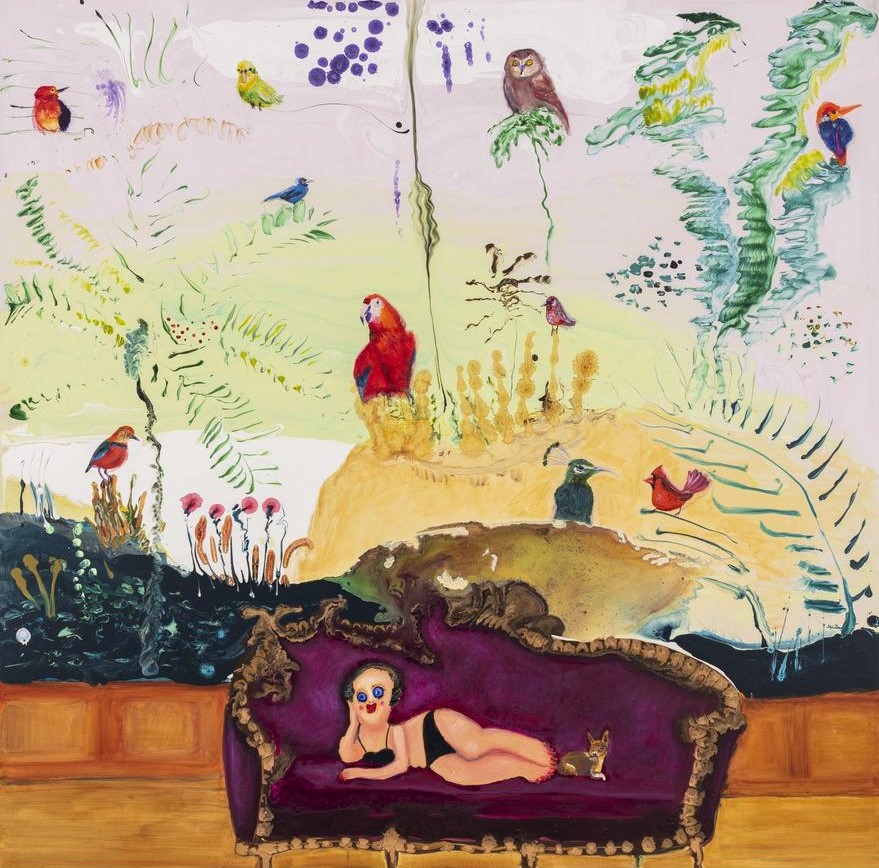
Genieve Figgis

Genieve is an Irish painter who came to prominence through social media when famed artist, Richard Prince, fell for her work and ushered her into the New York art world. It’s easy to see why, her work is sumptuous, quirky and daring. I particularly love the painting below and feel happy when I see it.

dreaming of Spring with birds 2022

Susan Rocklin

Susan and I met on a course at the Slade School of Art in London. Shortly after, she began her MA at the Royal College of Art, also in London. It has been amazing to see her work develop. I think it is utterly sublime. I love all her work, but especially the one below.

dreaming in Sanskrit 2022

Maryclare Foá

I follow Maryclare on Instagram under one of her art names M and F Mo. I didn’t know who she was (to be honest, I thought it was a bloke), I just loved her delicious colours and expressive figures. When I was looking a bit further into her work for this post, I was delighted to discover that Maryclare is a lecturer at Central Saints Martins, and also did her MA there. I hope our paths cross one day, so I can tell her how much I love her work.

Why the long face sunshine 2022

George Raftopoulos

Not wanting to leave the fellas out, I thought I would include George. Like del, he is an Australian painter. I love his work and find his figures particularly inspiring.

Aeschylus of the Underworld 2010

Well, there you have it, the contemporary painters I find inspiring. There are others of course, but I have run out of time, as I have a workshop in a few minutes (about creating an artist’s portfolio), so I better go.

Oh no, the workshop was cancelled, I guess because of the teachers strike. Never mind, I’ll go and see if that Fonzi wants to hang out instead. I’ll pick some rubbish while I’m there, as he tends not to come if I stand there looking for him.

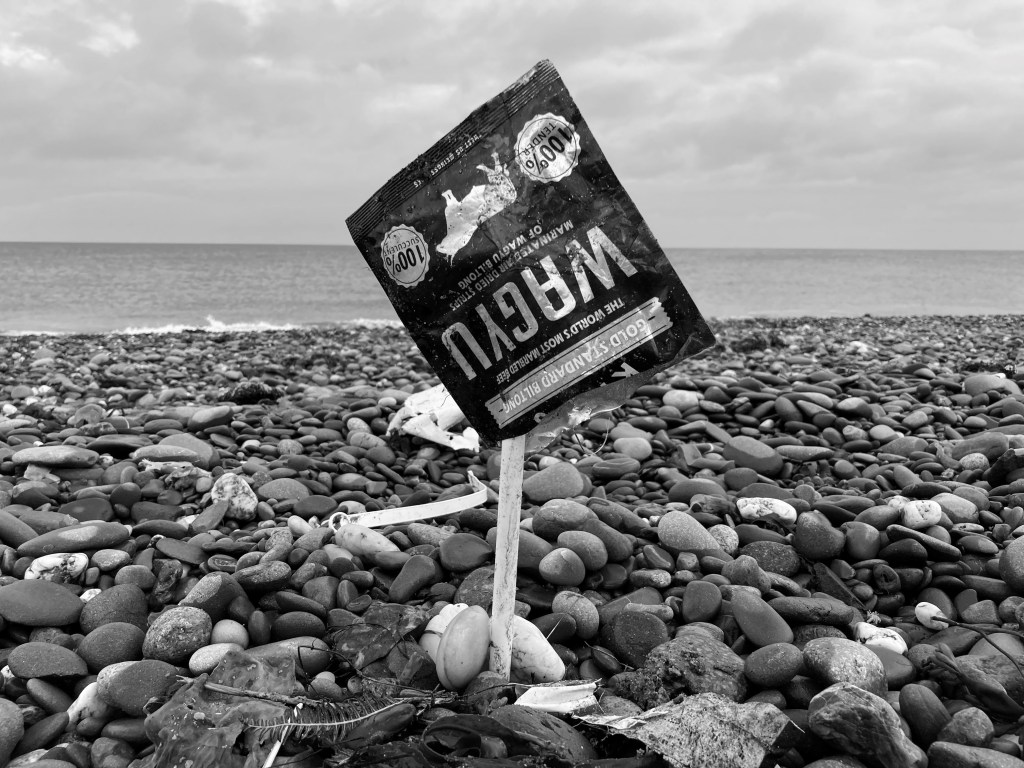
Nope, he wasn’t there. He’s either gone fishing or is playing hard to get. Ah well, at least I was able to pick up some rubbish…including a permanent marker that still works. Thanks Manannan!

If you’d like to see more work by the artists above, just click on the images.

I love a good workshop

One of the great things about my MFA course is the variety of workshops that are on offer. I took part in 3 this week, all of which were brilliant. The first two were textile based, and the 3rd, photography. Although my practice is primarily focused on painting, it can be helpful to branch out now and then, as it tends to be easier to loosen up and be more expressive in disciplines you are not so familiar with. The new inspiration you gain from this process can then feed back into your preferred/more practiced discipline.

The first workshop was called ‘Sustainability through textiles‘, which explored the relationship between sustainability and our art practice, specifically in relationship to our masters project. This was perfect for me, as my masters project, about water, naturally has a sustainability aspect. Through a variety of creative/making exercises, we were asked to consider our experience, values, and attitudes towards sustainability.

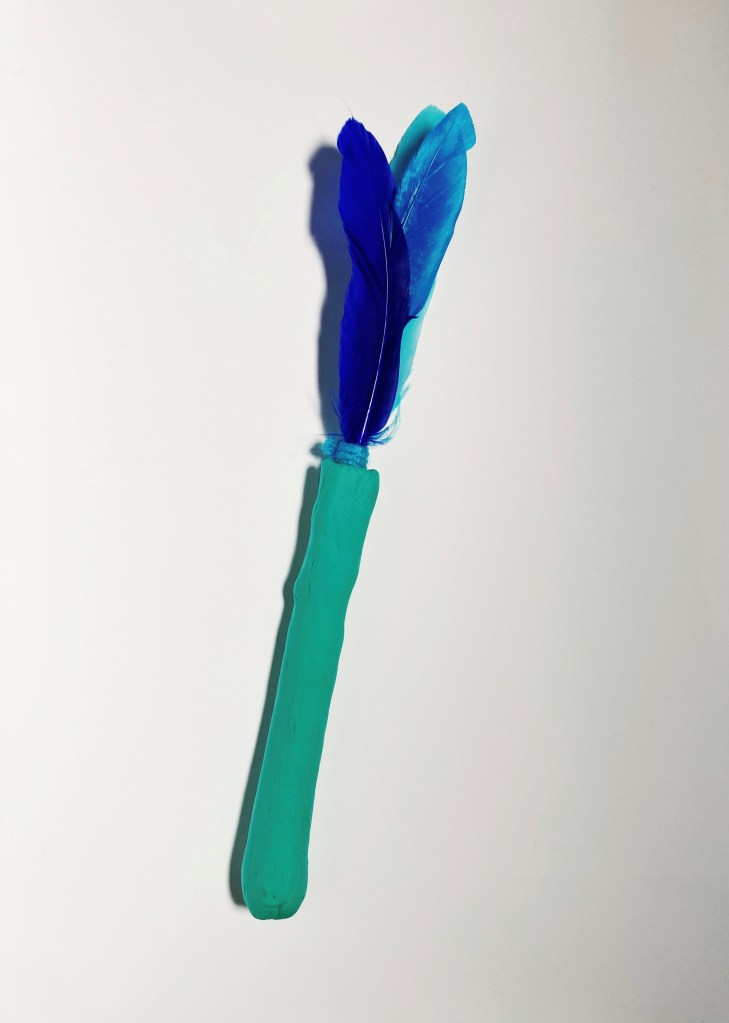
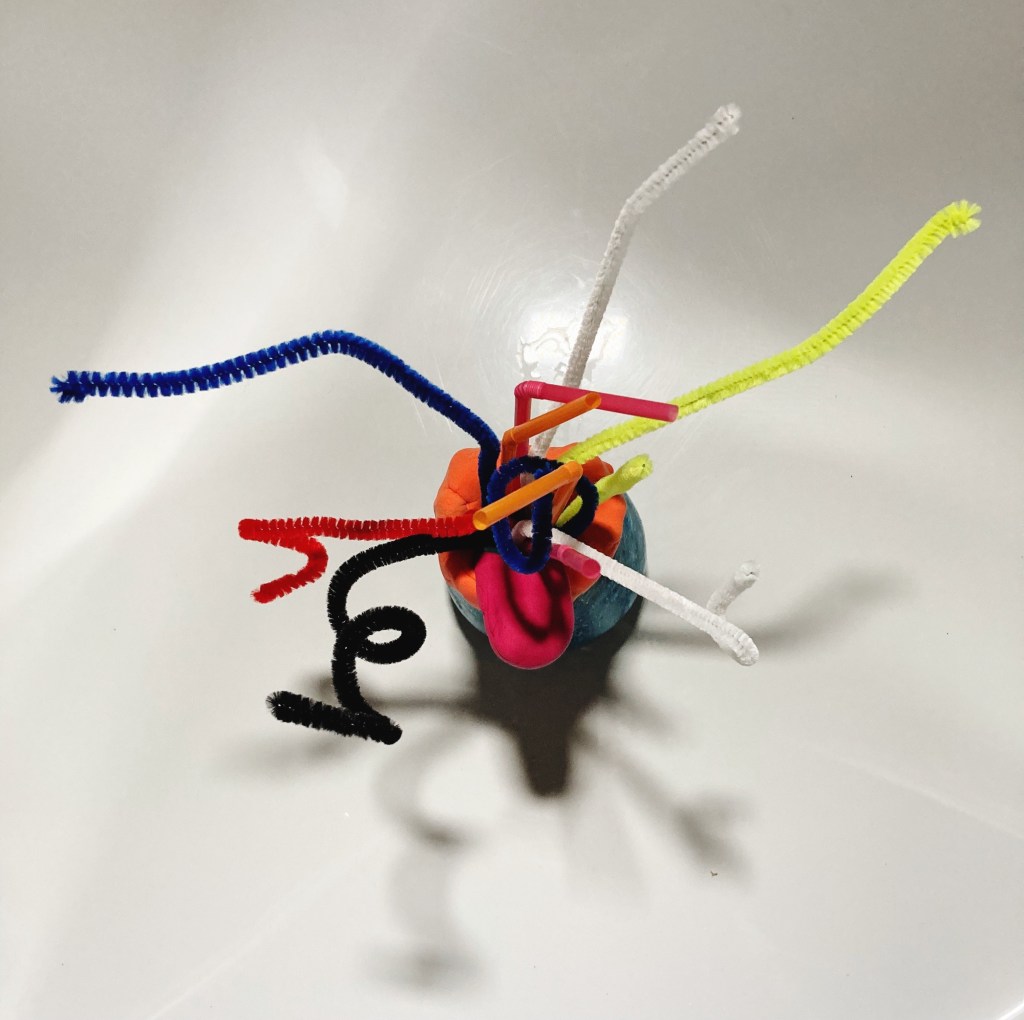
Below are some things I made during the workshop:

At the end of the workshop, we were asked to consider future actions we might take in our creative practice that demonstrated our values towards sustainability. I concluded that the best thing I could do is pick up the rubbish on the isolated stretch of beach in front of my house, that the sea kindly delivers every hightide. Hardly anyone walks on the beach but me, so I figure it’s my responsibility to keep it rubbish free. Sure I can still creatively express my values if I want, but to do that without picking up the rubbish shows I have no real values at all.

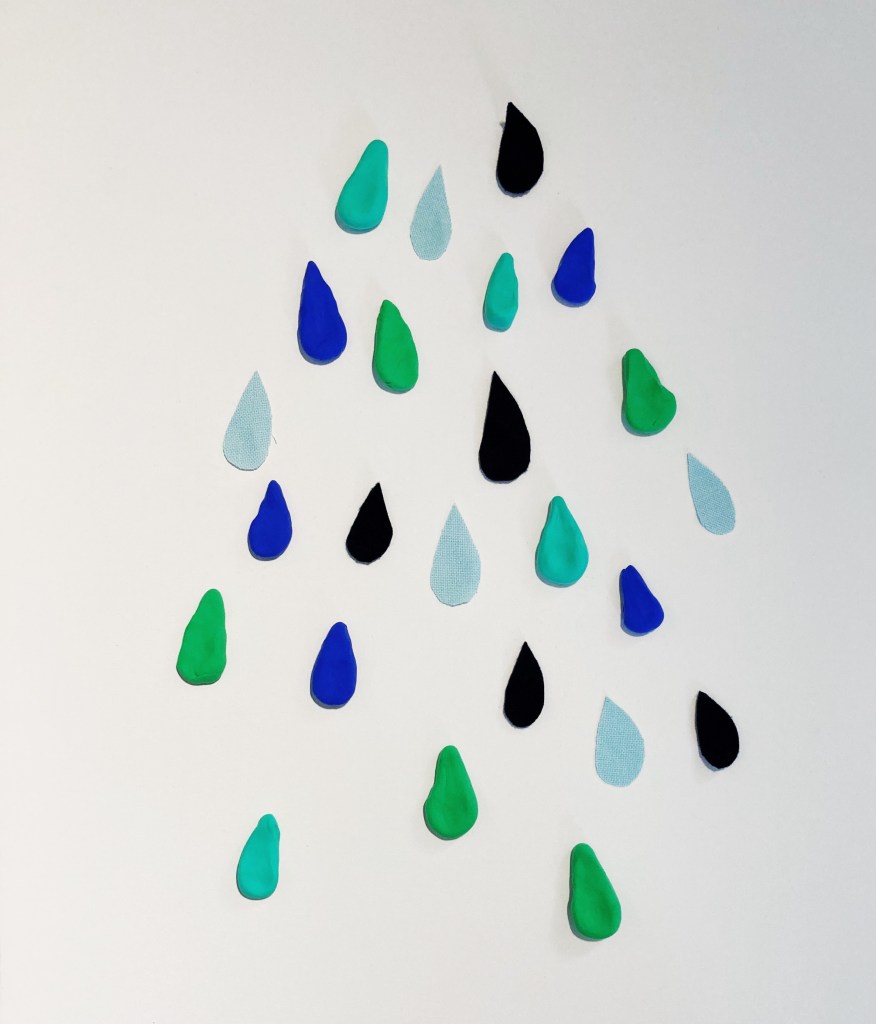
The second workshop was called ‘Emerging dialogues through the positioning of textile and visual arrangements‘. I’m not really sure what that means, but I had a great time. I happened to be the only person taking the workshop, so it was more informal and interactive than usual. I was able to discuss both my water and Ann projects with the tutor, and her feedback was very helpful. I also did all the exercises she’d planned for the class, all of which I found challenging, inspiring, and enjoyable.

Here is one of the things I made (the thing itself is a little naff.. but I do like the photo):

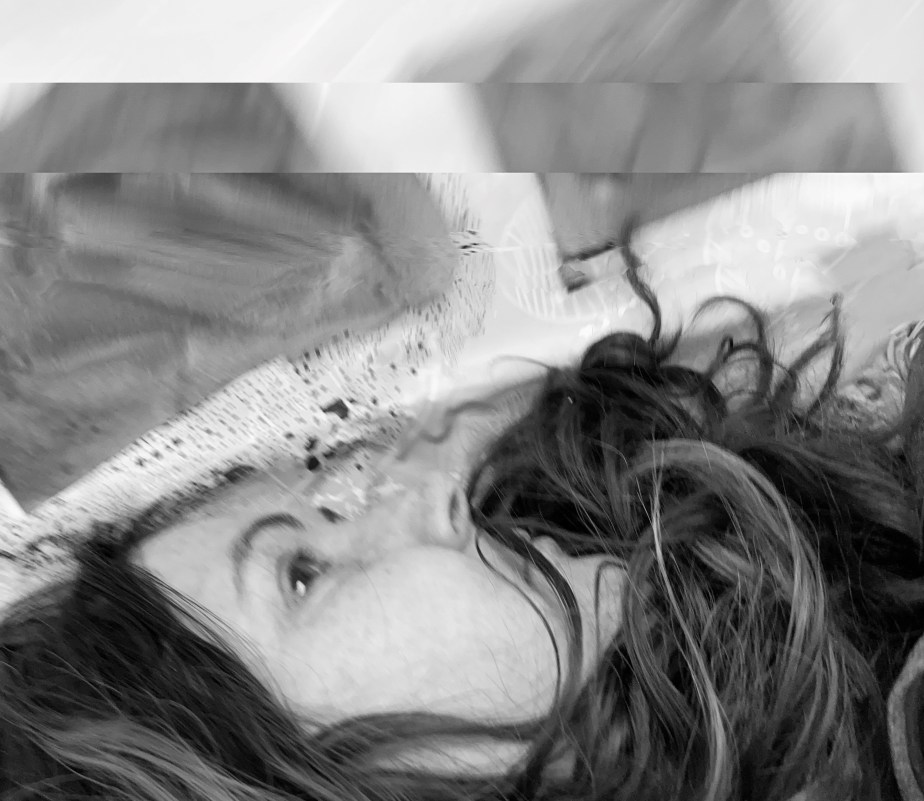
The third workshop was called ‘Finding inspiration: exploring photography through movement‘. I really loved this one. Rather than teaching photography techniques per se, it was more focused on finding ways to access your own creativity. It followed the same structure as the textile workshops, that of instruction, creating/making, and class participation. I found it genuinely inspiring, and will be able to use what I learned, not only to take more interesting photos, but also in my painting practice.

Our main task for the workshop was to take a series of photos of ourselves while moving about. My favourite is the photo below. Even though I was moving when it was taken (as evidenced by my hair falling upwards), there is also a stillness to it that I really like. I also like the one at the top of the post, though it would’ve been better without my phone in the reflection.

As enjoyable as the workshop was, the highlight of the day was going down to the sea during the break and having a surprise visit from Fonzi and his friends. It filled my heart with joy.

Falling into green

Picasso was a horror when it came to women, but his insights into painting were spot on – like this:

Painting isn’t an aesthetic operation; it’s a form of magic designed as a mediator between this strange hostile world and us, a way of seizing the power by giving form to our terrors as well as our desires.

or this:

Colors, like features, follow the changes of the emotions.

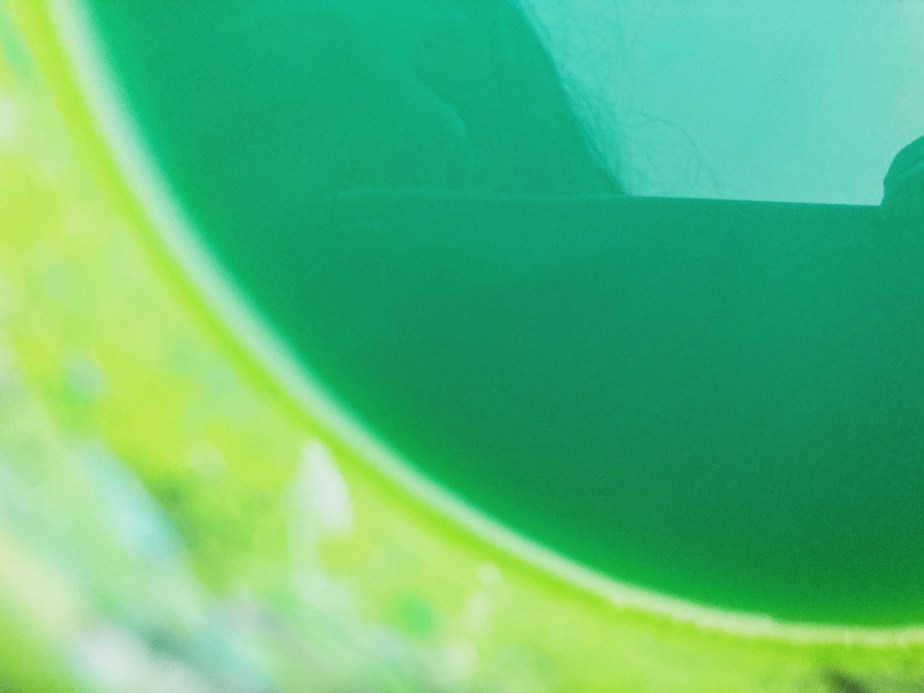
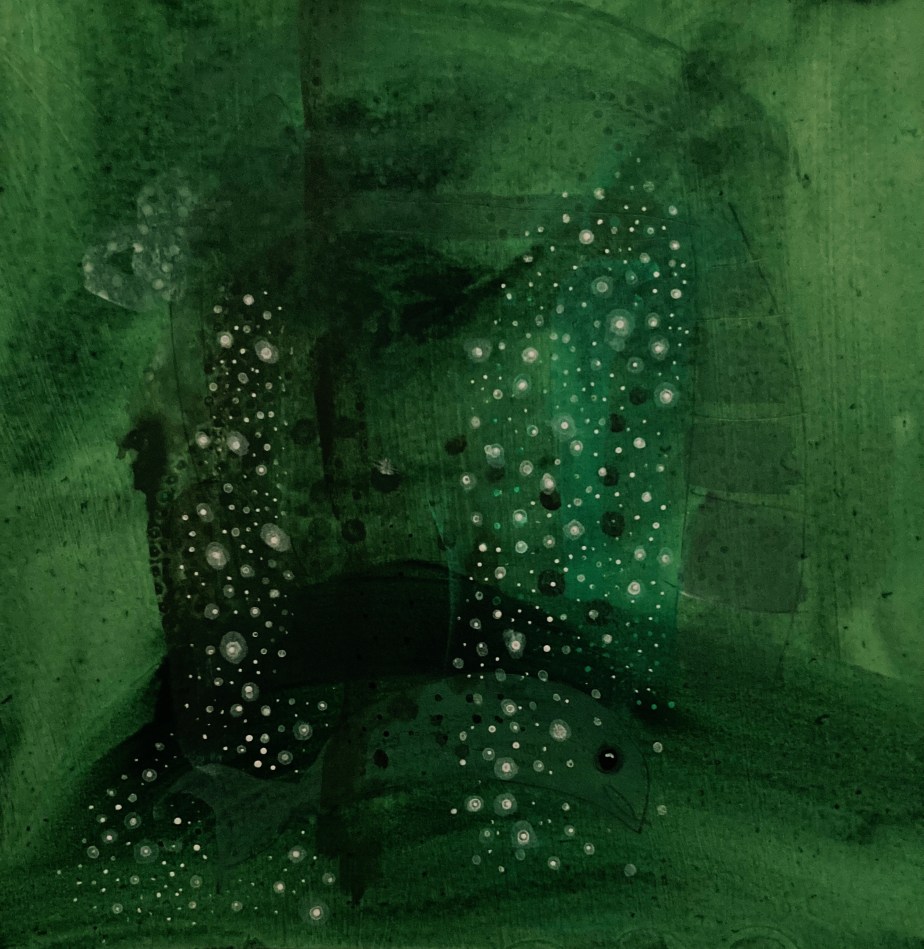
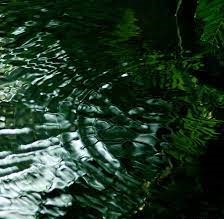
I am particularly interested in this second insight at the moment, due to my recent colour change from blue to green. Blue has always felt like a safe, knowable colour to me, which is why I typically used it when experimenting. But green – it is completely different. I don’t yet know its boundaries, or what its emotional resonance will be on a large scale. On a small scale, it feels mysterious and other-worldly, if not a little bit spooky. When I paint with its darker tones (as above), I am reminded of a time when I was a child, in a boat on the edge of a lake. I remember looking deeply into the water which rippled and swirled with tones of impossibly dark green that merged into unknowable inky darkness. I was completely captivated. Even though I was only a small child, probably no more than 5 or 6, I knew I would never forget what I was seeing, and so I never have.

The above picture, which I found on the internet, is the exact colour/visual I remember. Looking at it, even with its poor resolution, I have the same sensation of wanting to fall into its depths. What a truly mysterious colour. However, the trouble with this shade of green is, it doesn’t really go with anything else (perhaps because it is perfection in and of itself), so it would not really be suitable for the figurative painting/s I have in mind for the Interim Show (although, never say never).

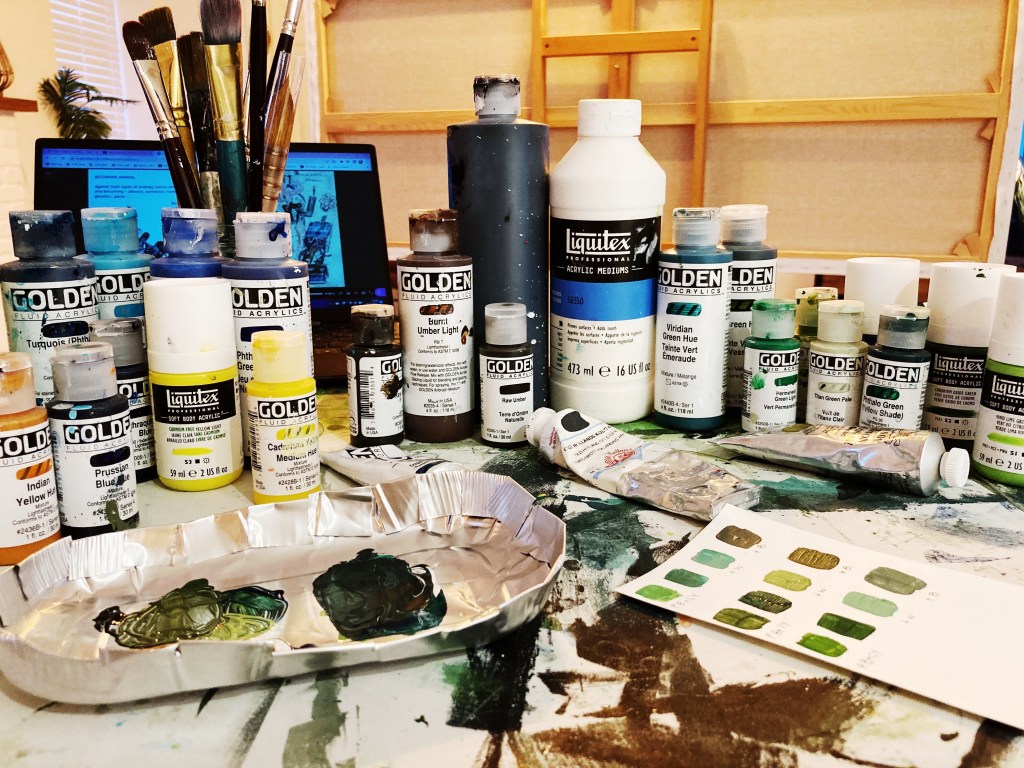
One thing is certain, if I am going to paint with green, I have to get it right, or I will end up with a garish mess that no one will want to look at. To avoid this pitfall, I have set myself the task of creating a suitable palette, so I’ll have a better chance of getting it right when it comes to the final work/s.

Down by the river-cide

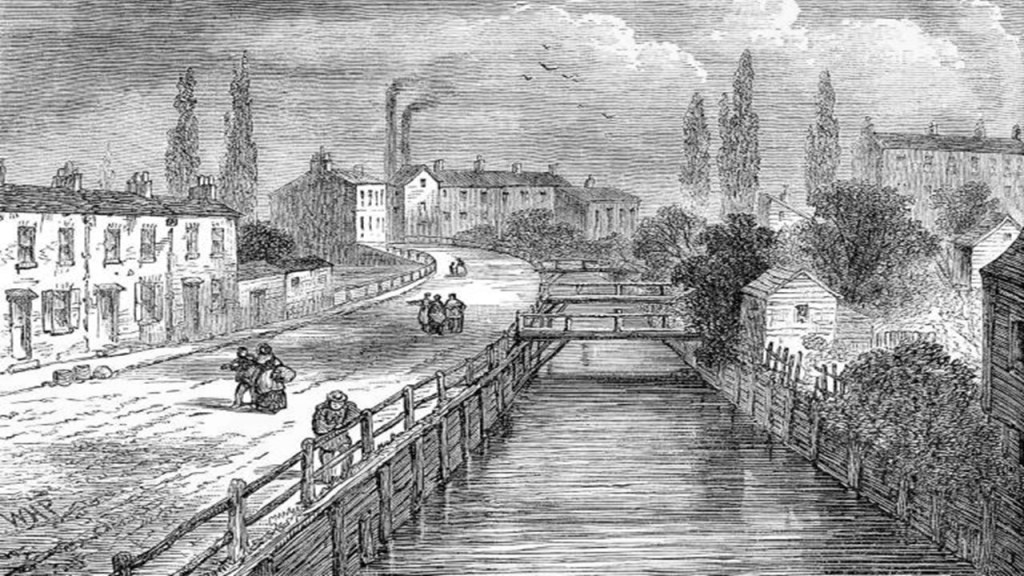
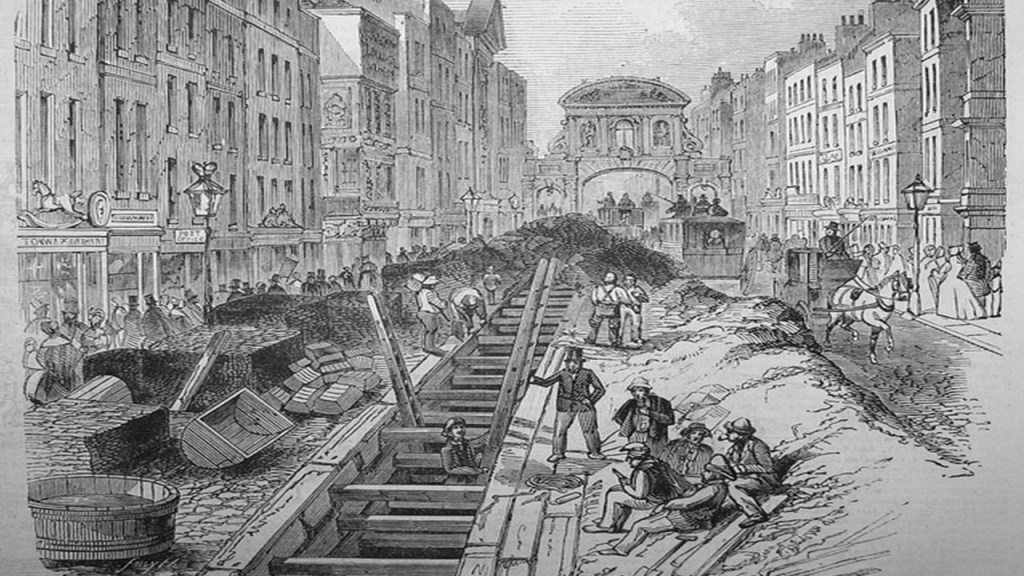
While researching the history of the Thames river for my Interim Show work, I came across information about London’s lost rivers, one of which is the Fleet. Technically, the Fleet is not lost, rather it is covered over and now functions as a sewer that spews its effluent-rich waters into the Thames under Black Friars bridge. Fleet Street takes its name from the river (ironic that a conduit of muck should lend its name to a thoroughfare synonymous with the British Press), which was alternatively called the Holborn – derived from the word ‘burn’ meaning ‘river’ or ‘stream’, after which the area of Holborn is named. Once a vibrant London river, with its headwaters in Hampstead Heath, the Fleet is now a subterranean Acheron that London has choked with its waste. It can’t be a good thing to kill a river. I wonder if the Fleet will have its revenge?

The Fleet river 1810
Covering the Fleet
The Fleet as a sewer

Along with the Fleet, I have been learning a lot about the Thames. The best source of information so far is a book by Peter Ackroyd, called “Thames – Sacred River”. It is beautifully written and utterly riveting 😉 .

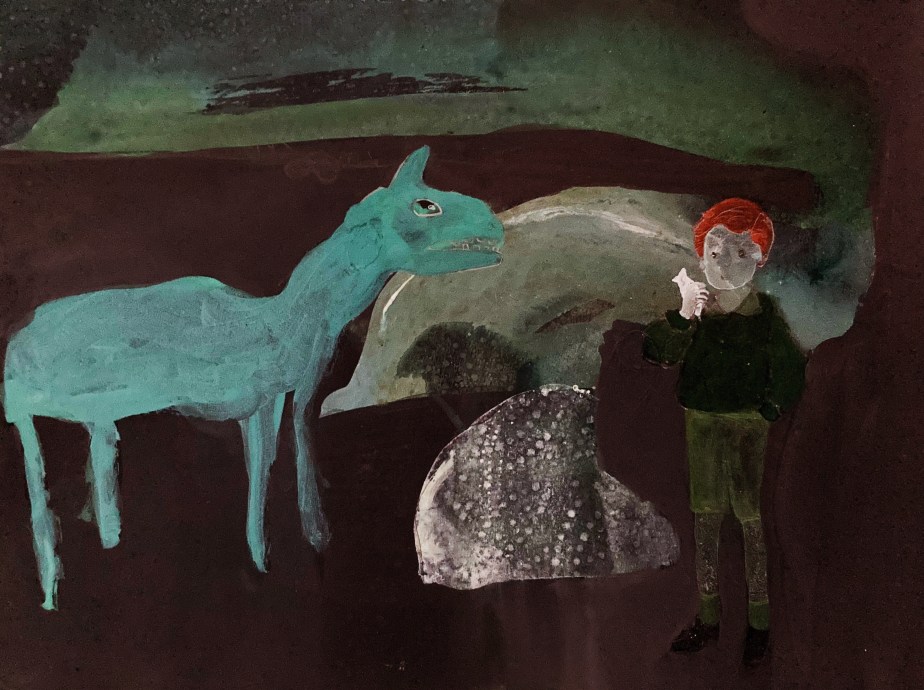
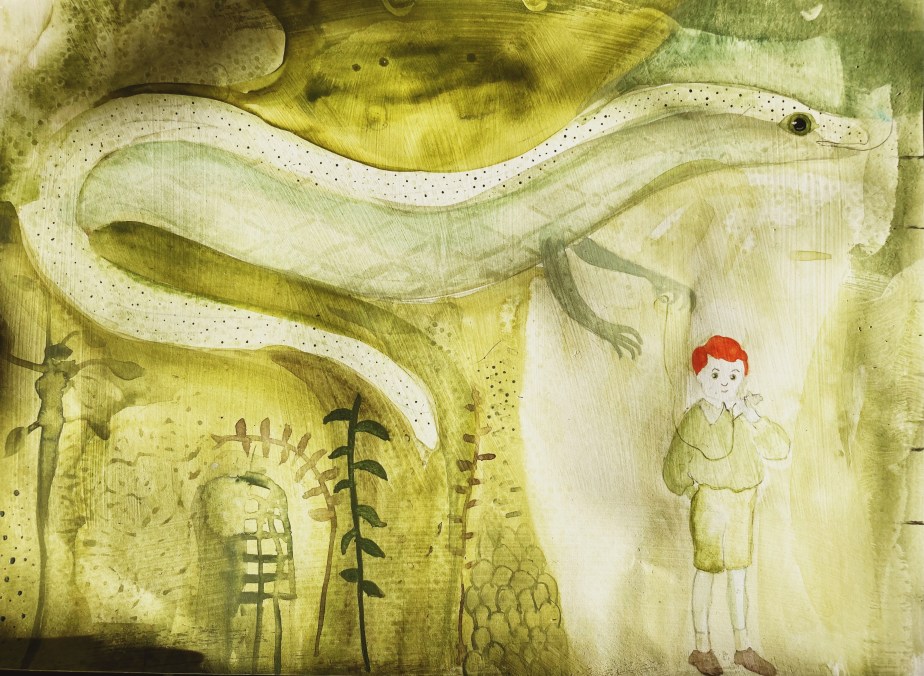
Never mind a single painting for the show, I think I could get a whole body of work out the subject, I am completely captivated. For now though, I will stick with the painting I have in mind. It is somewhat of a departure from the work I normally do, but it is a direction I have been wanting to go in for a while now (namely figurative). As such, it’s all a bit new and scary, but I guess that is why I chose to do an MFA, to be challenged and to develop my work. I am still not sure what style I would like to use for the figures in the painting, so I have just been experimenting this week. The header image is one such experiment.

When I go to London in March, I’d love to spend some time with the Thames, walking on its banks, crossing its bridges, perhaps even taking a boat ride on it. I also wouldn’t mind doing a spot of mudlarking – it would be great to find a little treasure lurking in its mud – though that might take some forethought, as a I believe you need a permit to do it.

Speaking of mudlarking, here is a video I made for The Wisdom Daily a while back, about London’s most famous mudlark.

The Dark One

Some artists like silence when they paint, others like music. Personally, I like watching documentaries (technically I like listening to them, though I do pop my head up now and then to see what’s going on). My absolute favourite are pre-history ones, especially if they deal with religious practices and/or death-related rituals. I also like documentaries about water, hence why I chose water as the subject for my overall MFA project. As with pre-history, I especially like the religious aspect of water, such as its role in creation stories and its use as a conduit of transformation and spiritual cleansing. These two roles of water are almost universal, which is something I find fascinating. I especially love Celtic beliefs surrounding sacred bodies of water – that they are portals to the underworld, repositories for sacred objects, sources of healing, and, as with rivers, the embodiment of deities.

My idea for the Interim Show is to do a painting about the river Thames (from Celtic “Tamesas” – “the dark one“). Not only is the exhibition space on the bank of the Thames, but it is also an incredible waterway, with a long and fascinating history. I have chosen a small aspect of its history to focus on, and am happy to say that I now have an overall concept for the painting. The above image is a little sketch of one element of the idea. I don’t normally show/explain my workings/preparations for a painting, but we are encouraged to do so on the course, so I thought I’d give it a go. Once I have the concept rendered in a series of small preparatory paintings, it is my intention to produce one big painting for the show. I am not sure if I will have enough time to produce the big painting, in which case, I will submit the small ones.

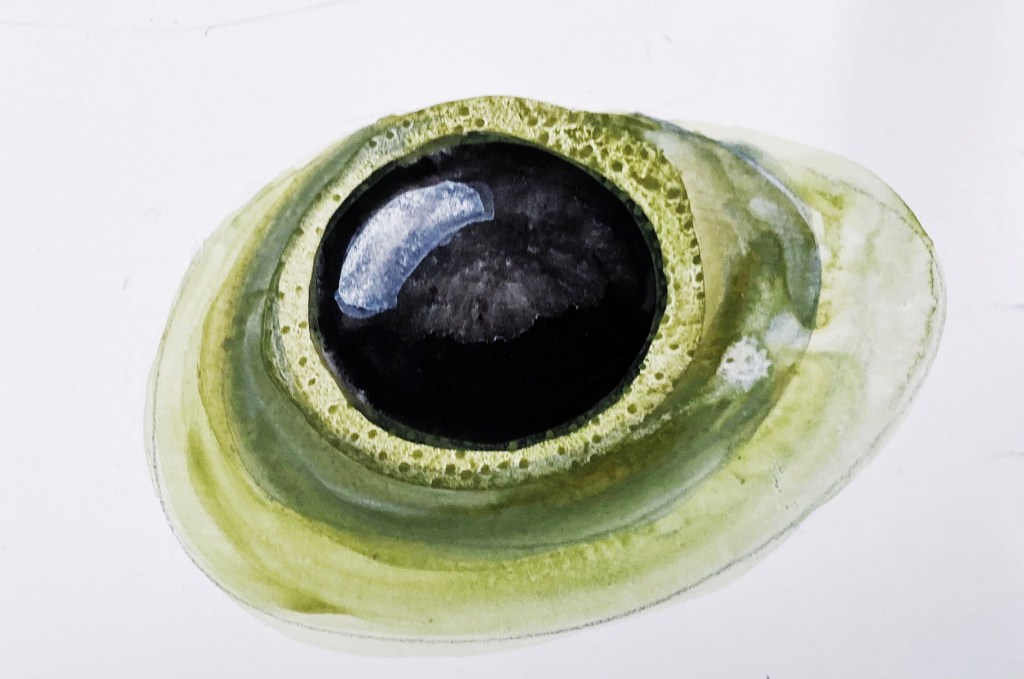
As well as developing the concept of the painting, I spent the weekend painting more eyes. I think I have done enough for now, so will move on to some of the other elements I want in the painting.

The eyes have it!

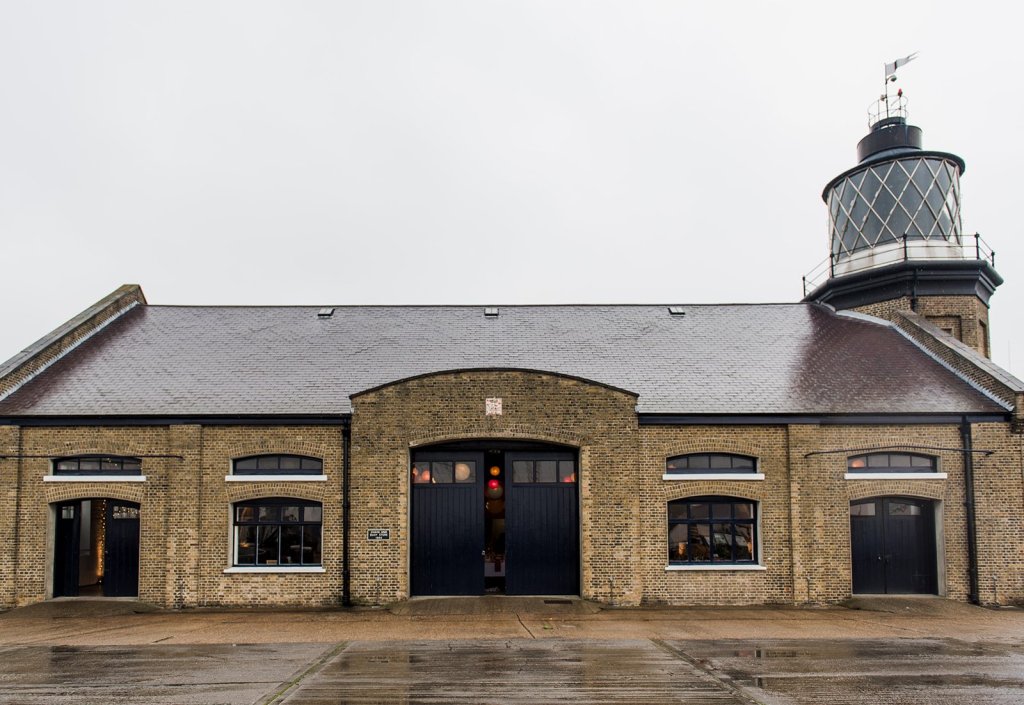
It’s been great to be back at school this week, though its made me acutely aware how quickly time is passing, and how hard I will have to work if I want to make the most of the course and the opportunities before me. Looming large is the Interim Show, which is a college-wide exhibition for first year students, due to take place in the second week of March at the Bouy/Chain Store, Trinity Warf in London. It is a wonderful space/location, and it will be a privilege to show some work there.

I’ve decided I shall align my submission for the show with my aims and objectives for my overall project about water, chief of which is to include figuration (people/creatures) in my work, and also to size-up (i.e. make bigger paintings). Whether I am able to achieve both or either in time for the show, remains to be seen. However, I intend to give it my best shot. To which end, this week I have been working on eyes.

Although I want my peopley-creatures to be quite loose and melt into their surroundings, I would like their eyes to be expressive and convey the emotion of a given painting. Again, it remains to be seen whether this is achievable.

It’s been a wrench to come off the Ann painting in order to focus on the Interim Show (IS) work. I only managed a couple of sessions of the latter this week. However, I’ve now put the Ann painting away for the weekend and intend to only bring it out for my early morning painting session from next week, leaving my other two sessions each day for the IS work.

My daily wanders down to the sea now include a little paddle. Inspired by a massage client who is an ardent Northern Dipper (i.e. a member a wild-swimming group here in the north of the Island), who claimed her daily dips in the sea have changed her life, I decided to get in on the action. However, the stretch of sea I live on is not safe to go swimming in, due to the fierce tidal currents in the vicinity, so I have to content myself with paddling my feet. Holy smokes it’s cold!

To be honest, my first attempt wasn’t very successful. I had left my shoes half-way up the beach, so that when I stopped paddling in the frigid waters, my feet were very tender, and it was too painful to walk across the pebbles to get to them. Never fear, with a bit of Kiwi-ingenuity I managed it.

I thought my first paddling attempt might be my last, until a little while later my feet began to tingle and I had an overall sensation that was quite delightful (my feet are tingling just thinking about it). Needless to say, I have been paddling everyday since. I can now understand why the Northern Dippers are committed to there daily dips, though how they are able to get themselves all the way under is a mystery to me – though I bet they feel amazing afterwards!

Speaking of the Norther Dippers, here is a Pathé inspired video I made about them for a film course I did last year with Berlin Art Institute (note my fella’s amazing narration).