My fella went to Seattle and all he bought back was a fridge magnet and covid!

I’d like to say that I am faithfully nursing him back to health, but when he tested positive, I fled his house lickety-split and came back to the virus-free salt-air of Anam Cara. I did manage to buy him some Vicks VapoRub before fleeing, so I didn’t totally abandon my fiancรฉe duties.

So now I am hold-up in the studio, waiting to see if I too have the dreaded lurgy. I did wake up with a sniffle this morning, but that might have been due to getting caught in a storm last night while romping around the Ayres. It was all fun and games on the way up there, with a tail wind and all, but I got battered on the way back, and was drenched by the time I got home.
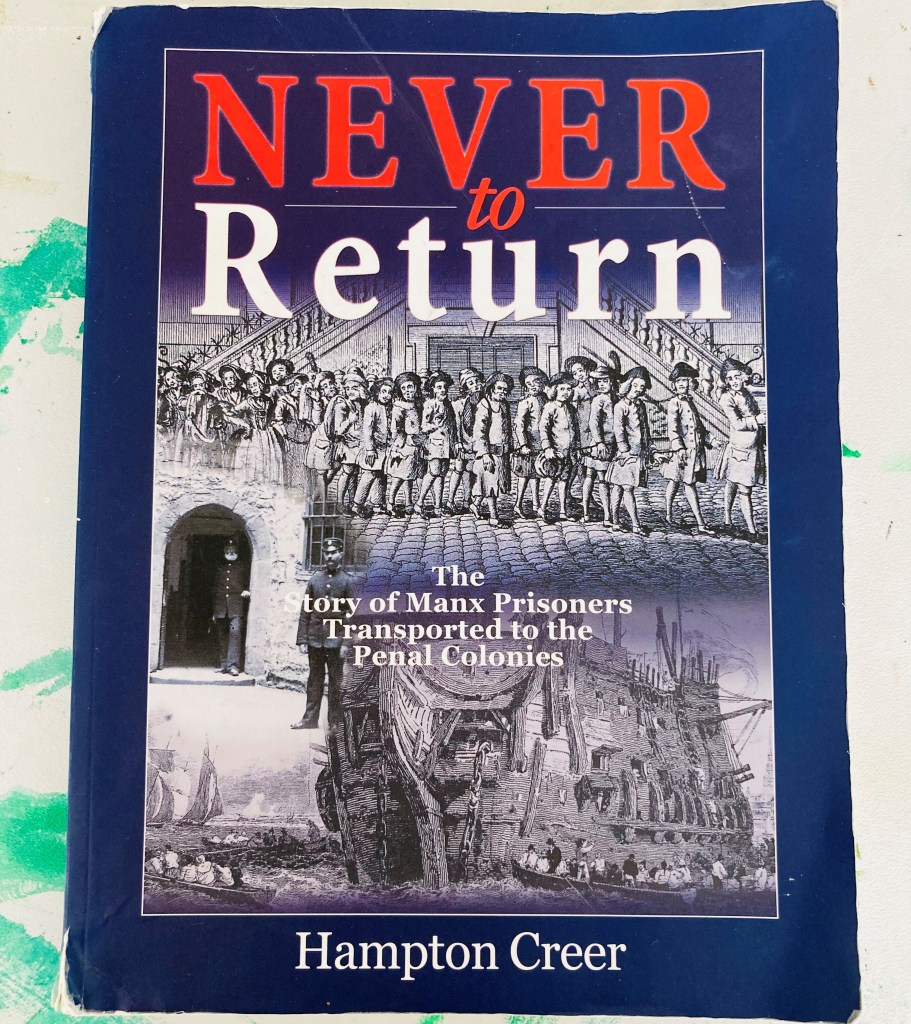
Before my fella went to Seattle, we had the great pleasure of filming Hampton Creer for the Ann documentary. Hampton wrote the book “Never to Return”, about the Manx involvement in the penal Transportation system, which is where I first came across Ann’s story. It was wonderful to see him again, and listen to all his stories. He is so knowledgeable, not just about Transportation, but about Manx history in general. I could listen to him for hours.

I am pleased to say, I finally have a name for the Ann painting, Anileis – which is a Greek word meaning merciless. Not only is it very fitting in its meaning, it is also a beautiful sounding word, and when you say it, it sounds like the words Annie + lace together, which makes it the perfect title for the painting.
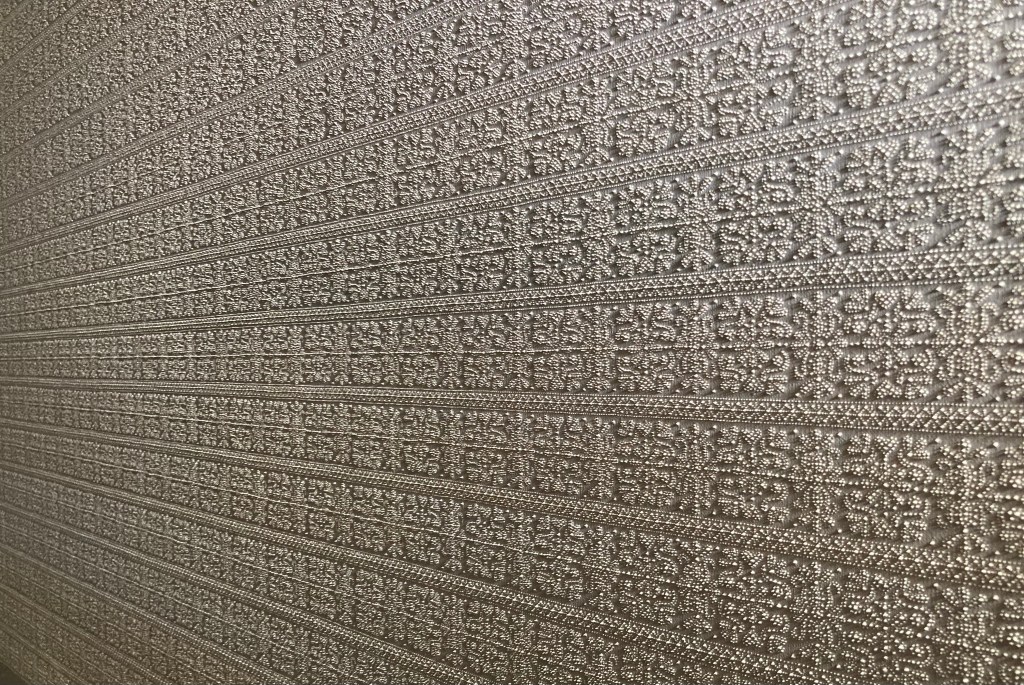
Here is a write-up about Anileis, that explains what the painting is about.

While I’ve been hold-up at Anam Cara, waiting to see if I too get Covid, I have been having a wonderful, undisturbed time painting away and enjoying my new satellite internet. What a difference it makes! Instead of waiting an hour or so for things to upload, it happens in an instant. This should definitely make my second year at art school easier.

Speaking of which, my second year starts in one week. I am looking forward to seeing everyone again, but am slightly terrified with how quickly the first year flew by and how much work I have yet to do on my research project. I have pretty much figured out what direction I am going in, which I did while on my long walks to the Point of Ayre this summer. It’s a wild, visually stunning landscape, which makes it perfect for thinking through creative projects.

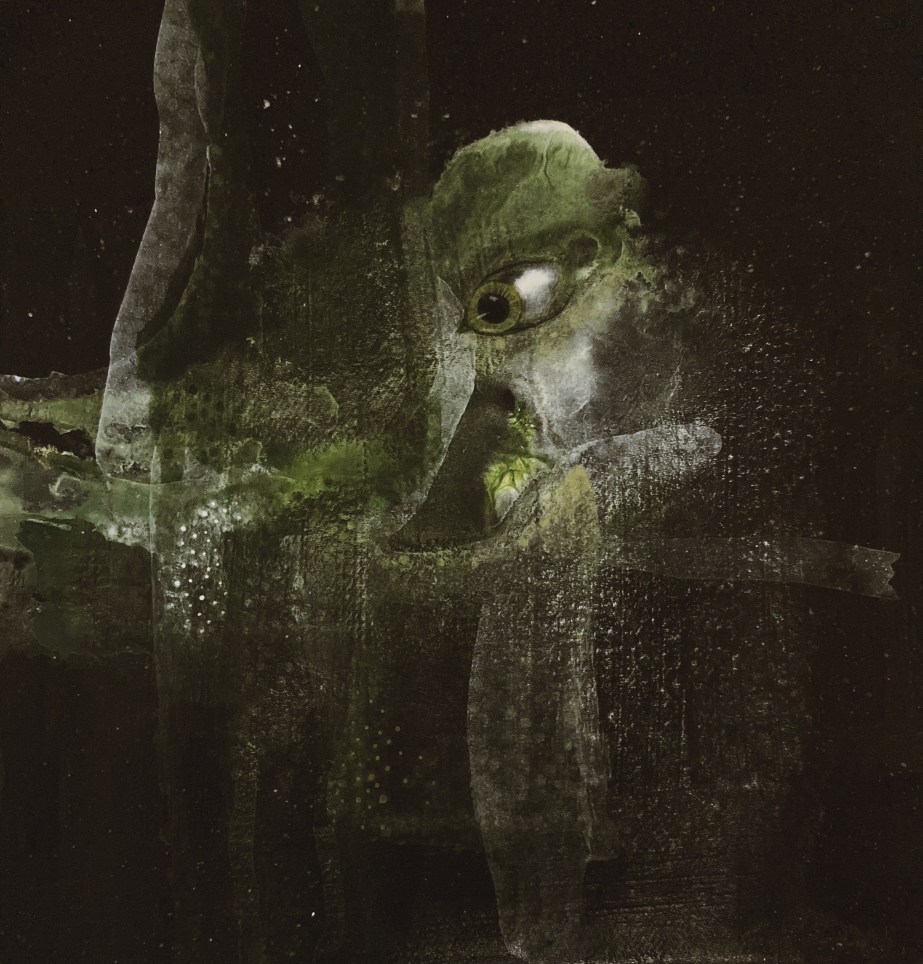
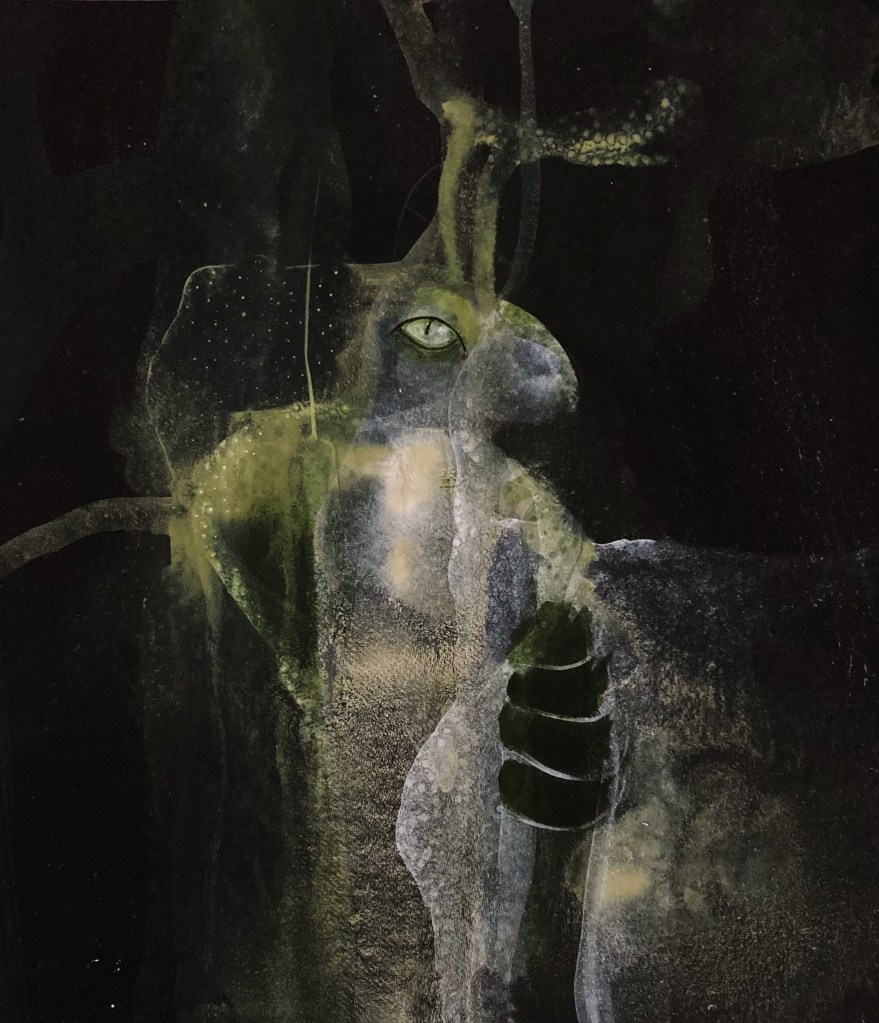
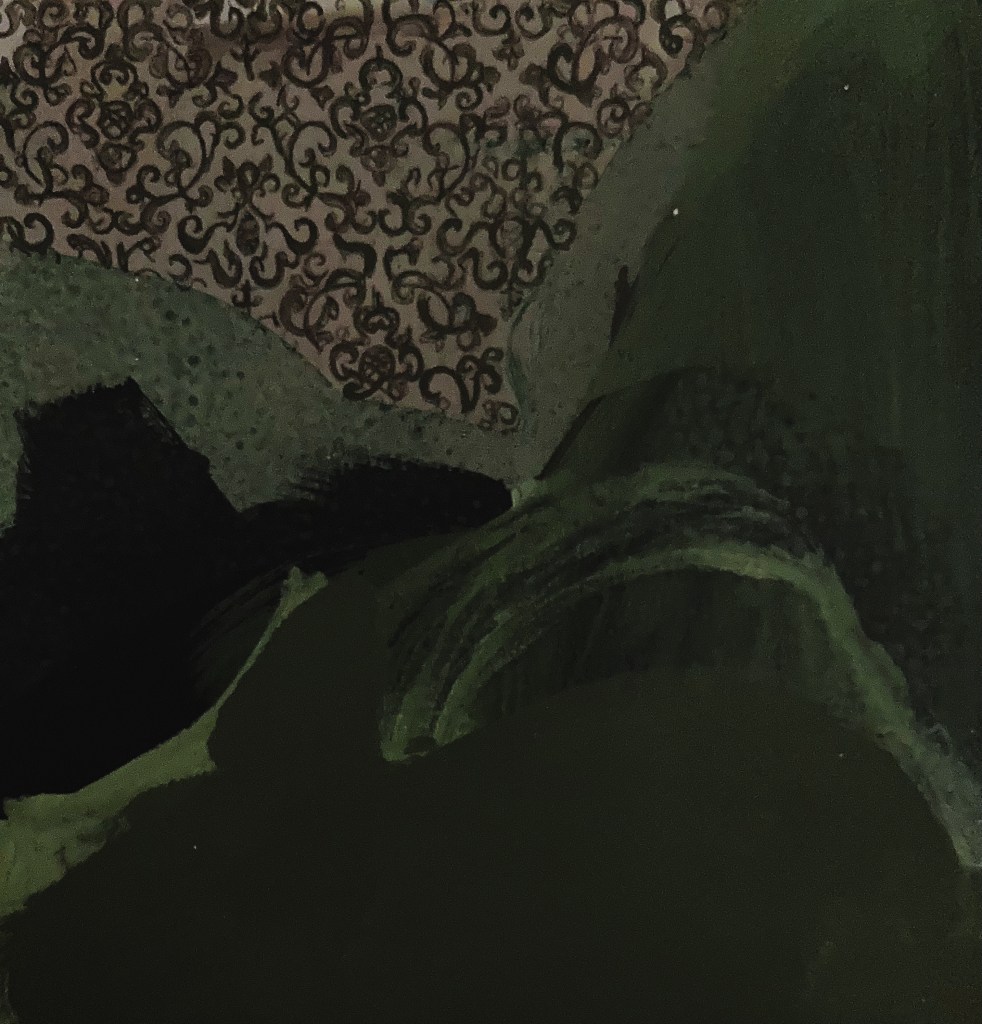
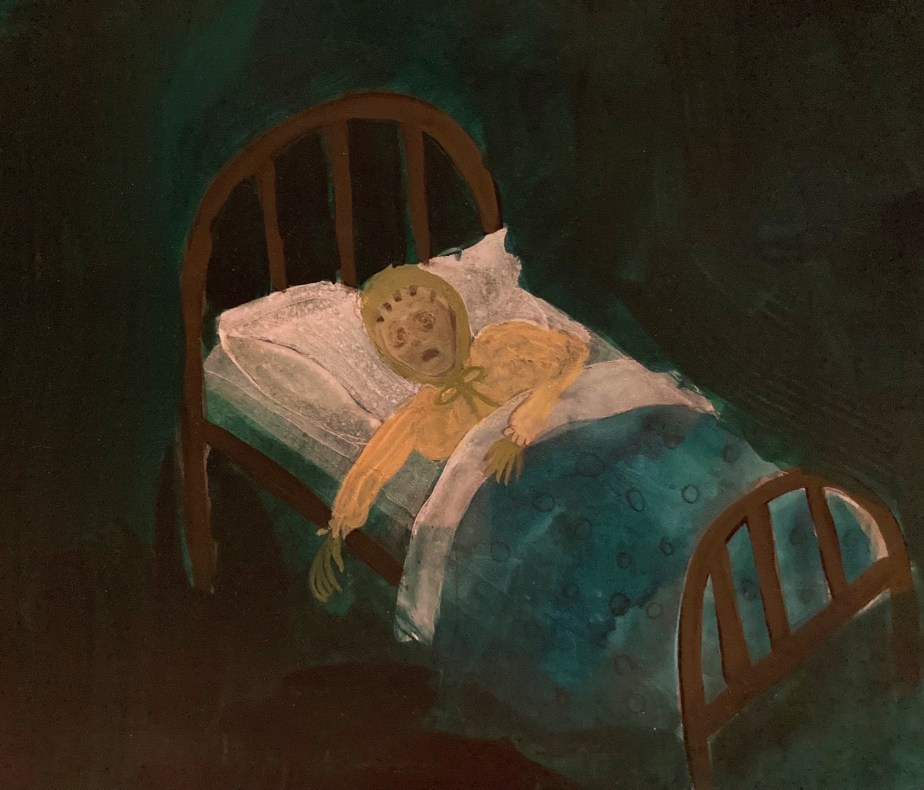
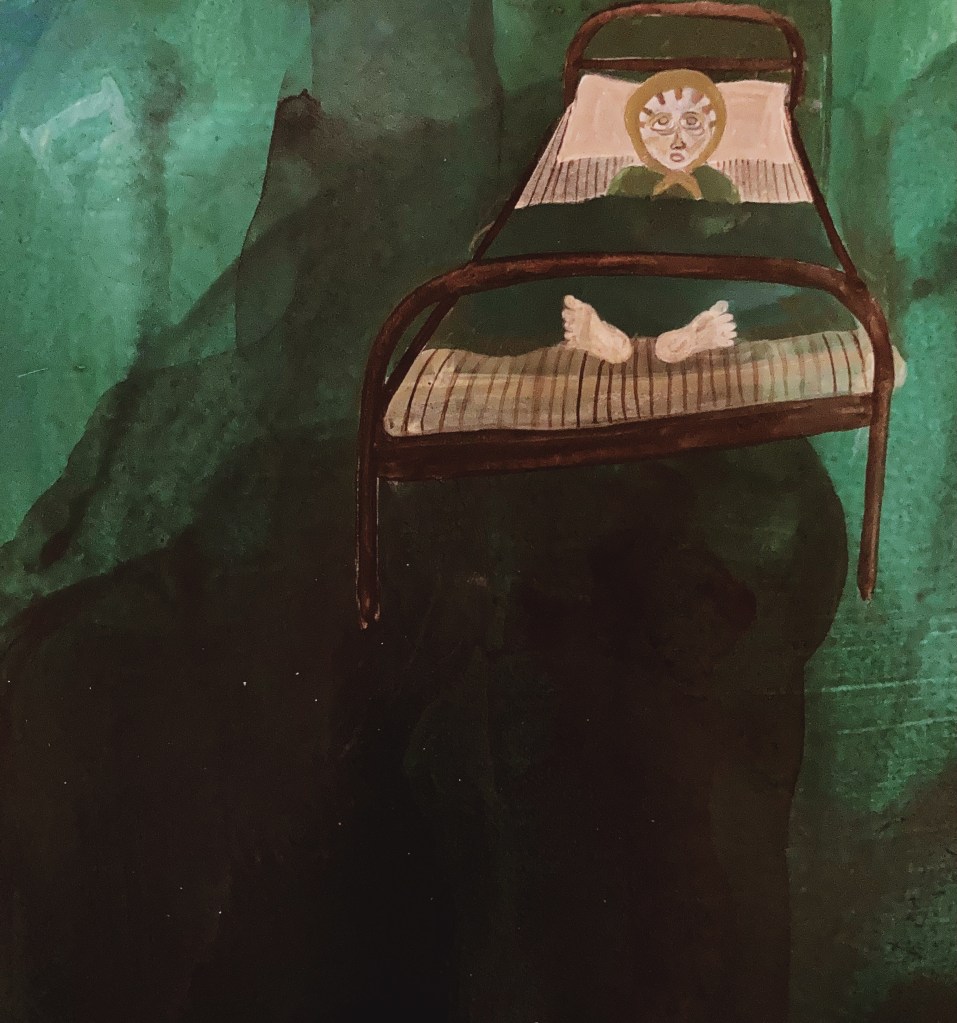
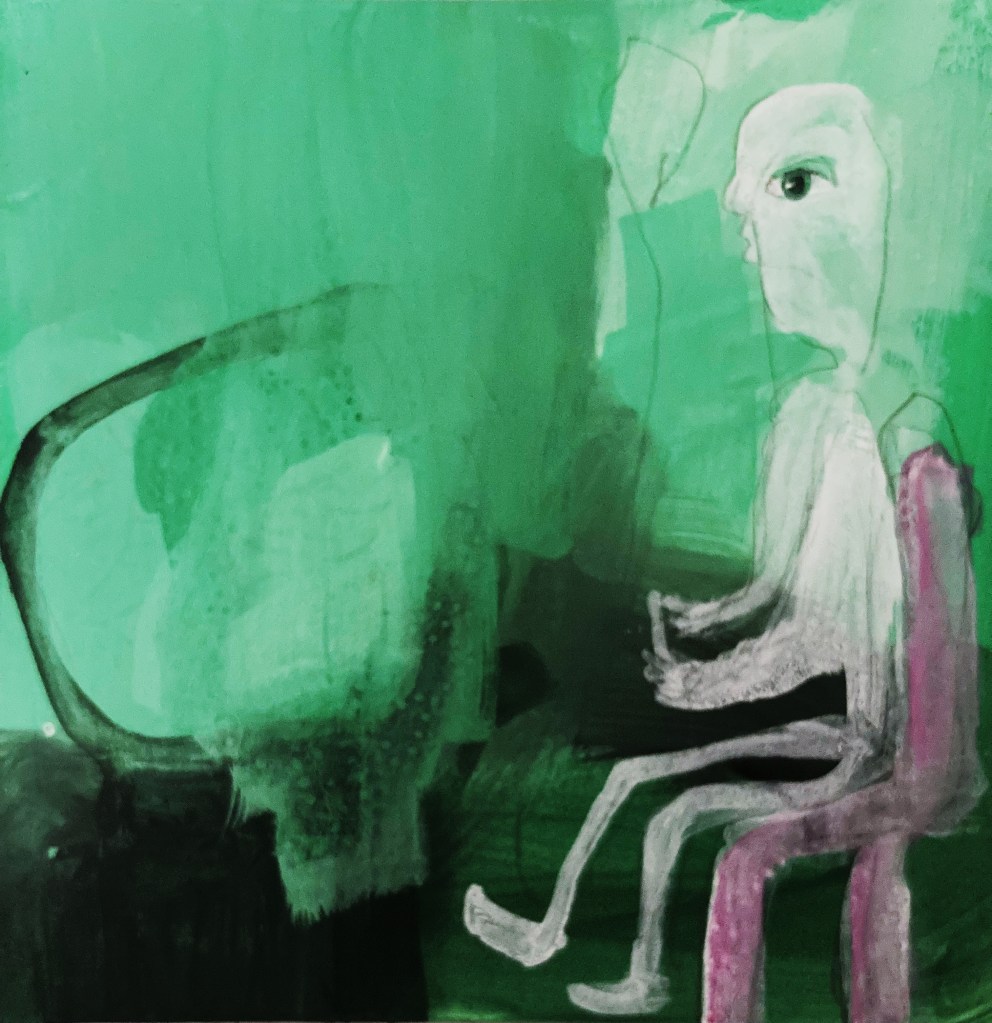
I am not quite ready to share exactly what I have in mind, but here are a couple of the experiments I did this week for one of the paintings. One thing I have noticed since retuning to painting after drawing all summer, is how much my drawing has improved.


Well, it appears I didn’t flee my fella’s house soon enough, as I too have tested positive for Covid. Luckily, I haven’t got the nobody’s-ever-been-this-sick-and-lived man variety like my fella, just mild lady-Covid. Still, it’s early days, so I shouldn’t be too smug. One good thing is, I can now hang out with my fella, us both being diseased and all, that’s if he is able to prize himself out of his sick bed.

The bear went over the mountain

I had a painting breakthrough this week, which is always a double-edged sword. On the one hand there was a huge sense of excitement and relief, like I am finally getting somewhere and all my previous hard work on this particular project appears not to be in vain. On the other hand, it’s like the bear in the children’s song who reaches the top of the mountain, and what does it see? Another mountain! That’s exactly how it felt, I was momentarily thrilled at the progress I made and the paintings I produced, but I was soon brought back to earth when I realised how far I still have to go to achieve the paintings I want to.

The paintings I did this week are just little snippets of what I hope to be much larger paintings. Scaling up is no easy task, and when it comes to figurative painting, I am yet to manage it, but I will surely to keep trying. One thing is certain after the week I’ve had, the drawing discipline I started at the beginning of the year is definitely paying off.

I’ve also been busy this past week writing the overview of my research paper, so our tutor can see what we intend to write about and give us feedback and guidance. I decided to do mine on the Ars Moriendi, the medieval dying how-to-manual that I mentioned in my last post. It hurt the old brain cells to do, but it was definitely worthwhile, as I now have a clear direction for the paper, which will make it much easier to write over the summer. I actually think I’ll enjoy writing it, as it is a fascinating subject, and has already sparked some interesting conversations with friends and family.

You can read my overview here if you have the time and/or inclination.

In other news, my fella and I have decided to make a documentary about Ann’s story. To begin the process, we had a pre-interview meeting with Hampton Creer, the author of “Never to Return”. It was such a privilege to meet him and his lovely wife Joy.

I absolutely love his book, it is beautifully written, and is a page turner from start to finish. It was also very special, because it was from his book that I first learned about Ann and was inspired to do a painting about her. We had a wonderful time talking all about penal transportation and other aspects of Manx history, such as witches. Once the TT races are over in a couple of weeks, my fella and I will return and interview him on camera.

Painting with my soul-friend

It was a beautiful day on Friday, so I decided to spend the afternoon painting with the sea. Similar to the rain paintings from term 1, I put blobs of paint on various pieces of paper and canvas, and then then let the sea swish it about. I then painted and drew into the marks left by the sea. The results so far have been really promising, and I am keen to experiment some more with this method.

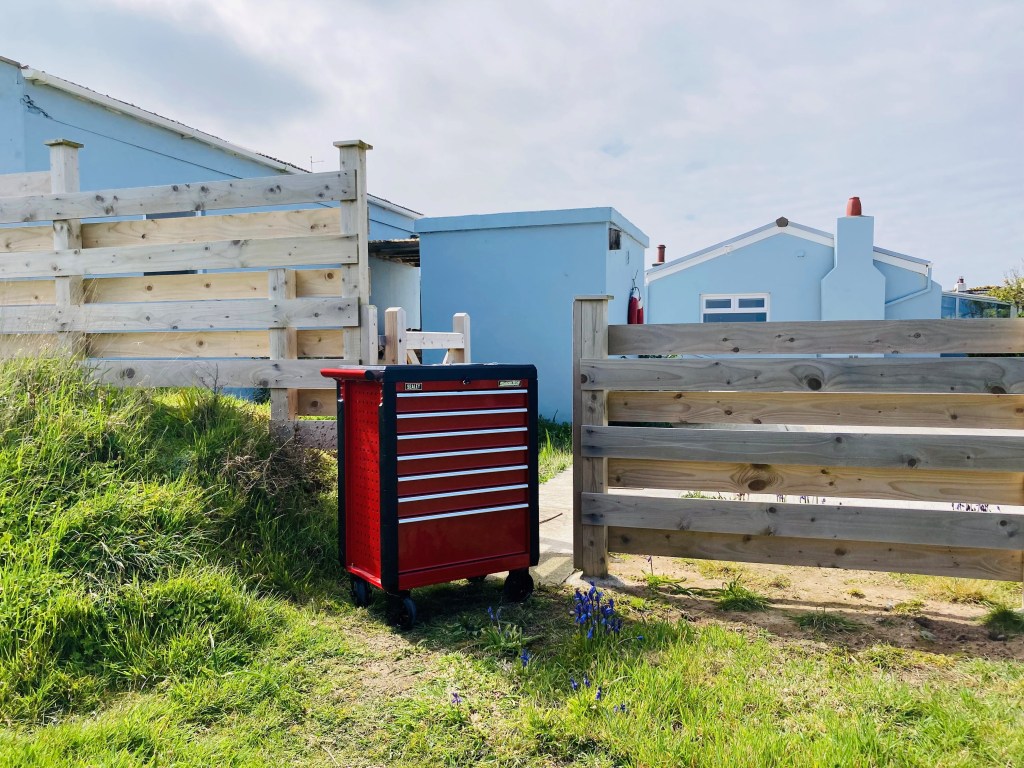
The reason I was able to paint with the sea, is I am now the proud owner of the most marvellous art-supply trolley (courtesy of my fella), that I can fill with everything I need and wheel outside nearer the sea, which saves me wandering inside to the studio every 5 minutes.

I attended an excellent workshop (notes below) this week, called “Joy Division into Research into Practice” with Clem Crosby. It explored a creative and organic way to approach research, sort of following a line of thought and being free to see where it takes you. I’m so glad I did the workshop, as I have been struggling to find a topic for my research paper, and it gave me an alternative way to approach my dilemma. I shall apply what I learned and hopefully come up with a good topic.

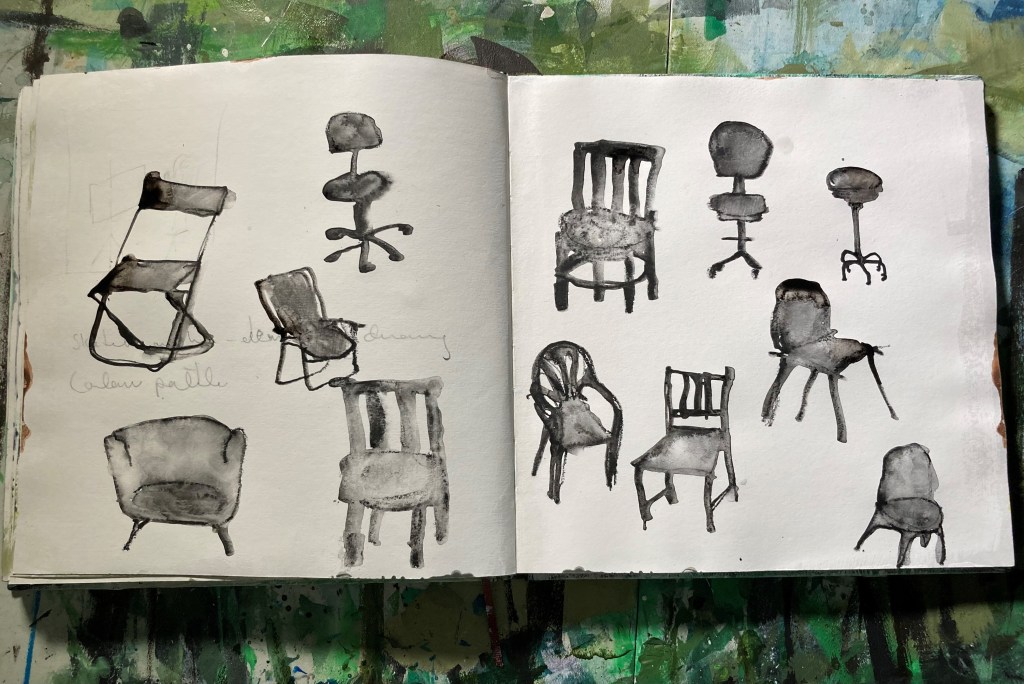
Also this week, instead of drawing horses, I have been drawing chairs. They are very enjoyable to draw, though some are obviously easier to draw than others. I love the aesthetic of chairs, and think they are very satisfying things to look at. I could go on and on about them, but I think it best I eke out my chair babble over the coming weeks, so as not to bore anyone rigid.

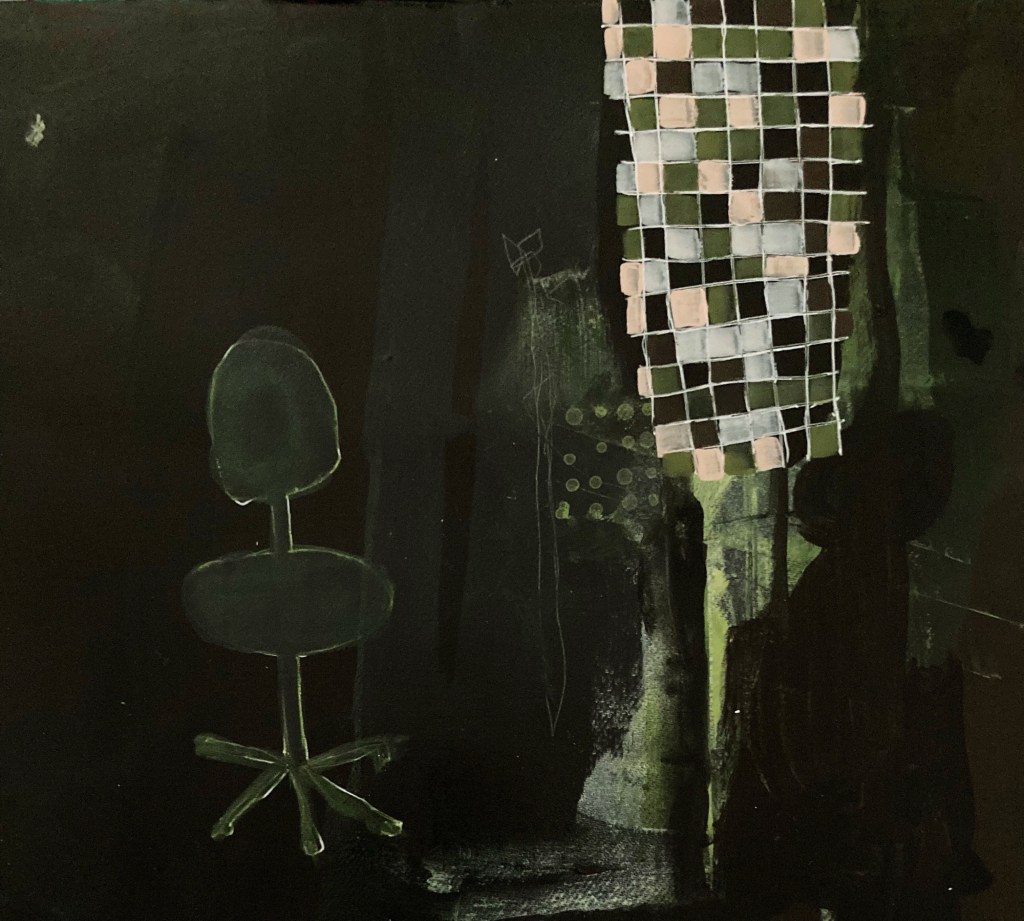
As well as drawing chairs, I have also been painting them (as below).

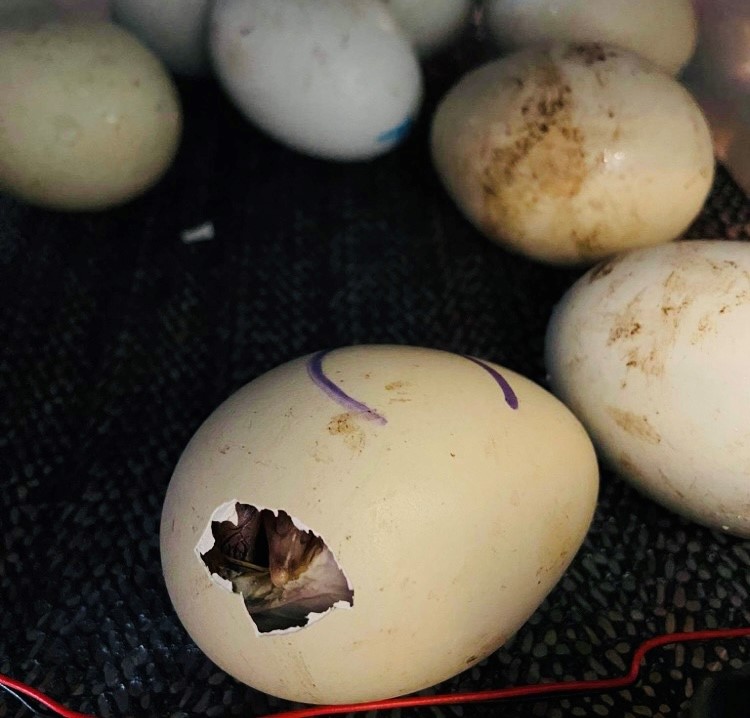
All in all, it was a very productive week painting-wise. It is amazing how much more time I have now that I have finished the Ann painting. Hopefully, with this extra time, I’ll be able to really develop the paintings for the Confluence project. Oh yes, and it was my birthday this week. It looked set to be one of those middle of the week, non-descript ones, but with a few visits from friends and family, some beautiful, thoughtful gifts, and my friend’s first chick of the year being born on the same day (to be named Rebecca, but it was a boy, so they named it Geoff) it turned out to be one of the loveliest I’ve ever had.

Never enter a river alone!

Term 3 began this week, which means it’s only 10 weeks until I have finished the first year of my masters. It is scary to think how fast the time is going, especially as I feel so faraway from achieving the creative goals I have set myself, especially related to my water-paintings project.

I am hoping I will feel a bit better about things once I have finished the Ann painting. I thought I’d finish last week, but alas, that was not the case. The hold-up isn’t for want of spending endless hours painting it each day, it’s just that it’s such an delicate, time-consuming painting, and I keep under-estimating how long it will take. Thankfully, I truly am nearly there.

While I’ve been on the home-stretch the past couple of weeks, my fella has effectively been banished from the studio, as I’m paranoid the painting will be knocked, so it’s just too stressful to have anyone around. I’m sure if he was telling the story, banished would be changed to steering clear of that mad woman and her “delicate painting”!

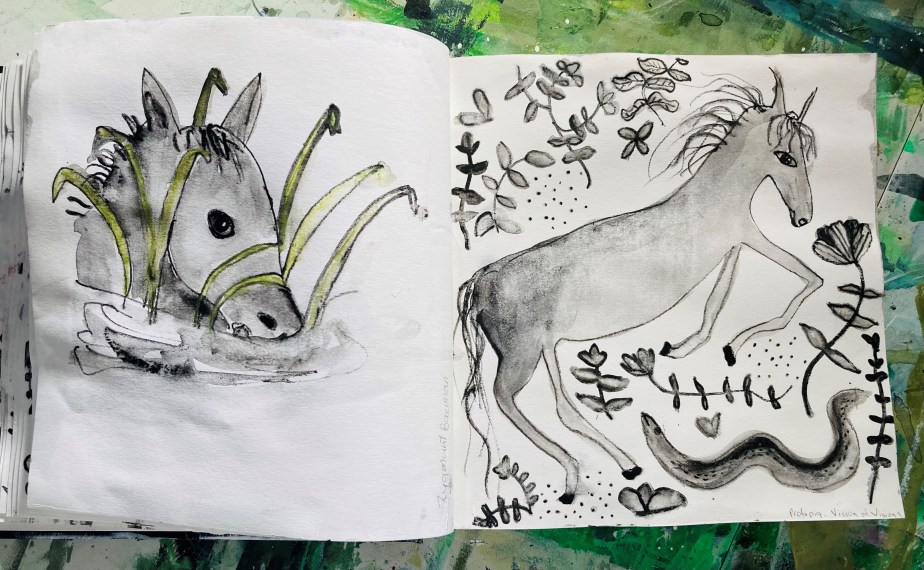
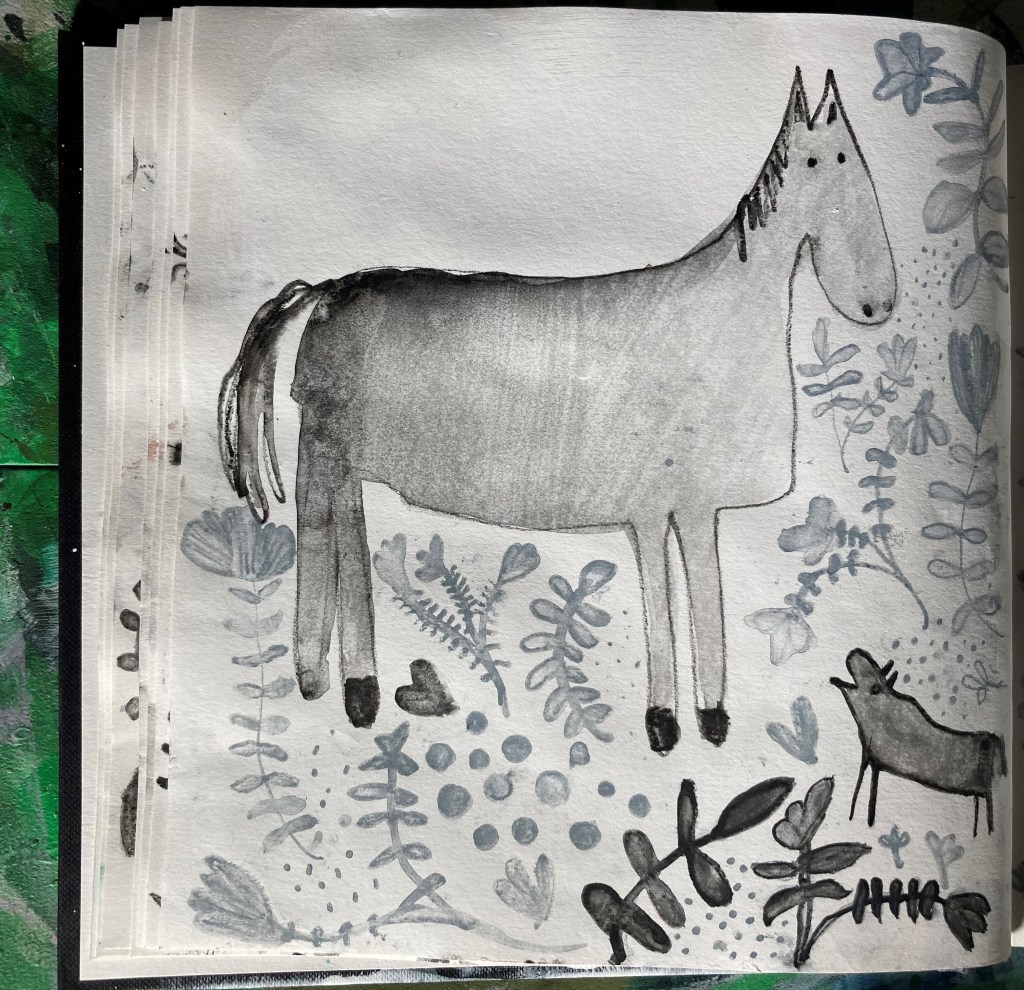
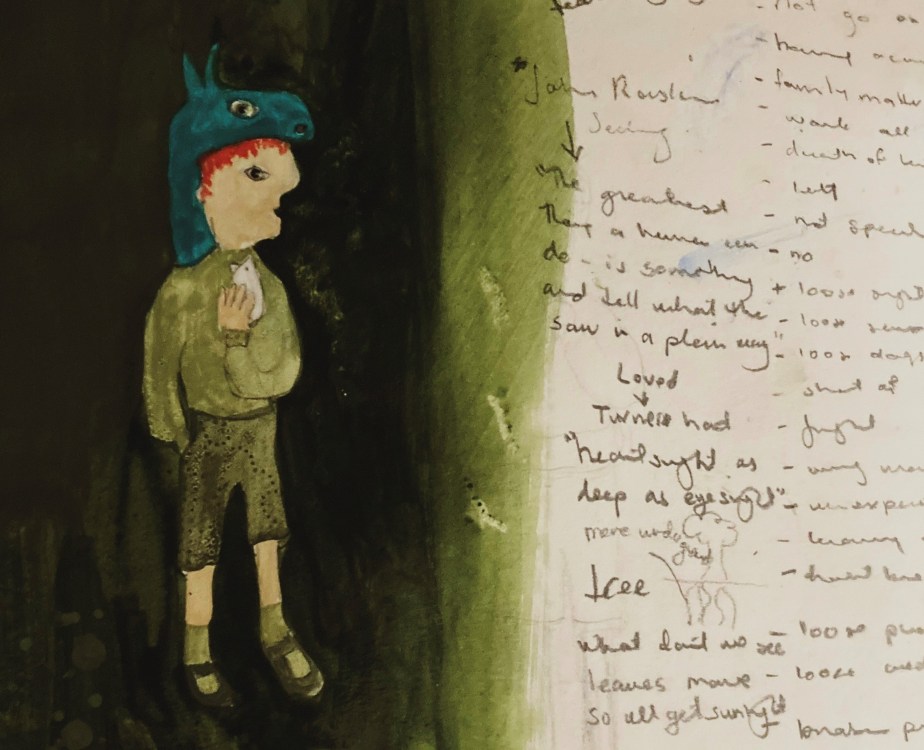
I continued drawing horses this week, which has been a pleasure as usual. My goal is to include a horse-like figure in my water paintings, a Kelpie to be precise. The problem is, a Kelpie is a malevolent water-horse that preys on people and drowns them, and my horses all look cute and cheerful. When told my fella I was having trouble making them look sinister, he suggested adding eyebrows. I think you’ll agree I nailed it.

I find the idea of a predatory, human-killing horse fascinating, considering that they are a prey animal, and left to their own devices, wouldn’t come anywhere near us. This contradiction is precisely why they are the perfect representation of the dangers of water, particularly rivers.

It cannot be over-stated how dangerous rivers are, especially ones that look calm and benign on the surface. For lurking underneath, you’ll often find a strong current that will easily knock you off your feet, making you vulnerable to shock, jagged stones, tangley weeds, to name but a few perils. Even a shallow river can be dangerous for these reasons, but if its deep, you’ve almost got no chance.

It is no surprise then, that the ancients told the story of a friendly horse by the riverside, that offered a group of children (or a lone adult) a ride. Once they mounted it, they were stuck-fast, and the Kelpie transformed into a malevolent spirit, and leapt into the water and drowned them. The warning being, children should not play unsupervised in rivers, and adults should not enter them alone.

Dotty is as dotty does

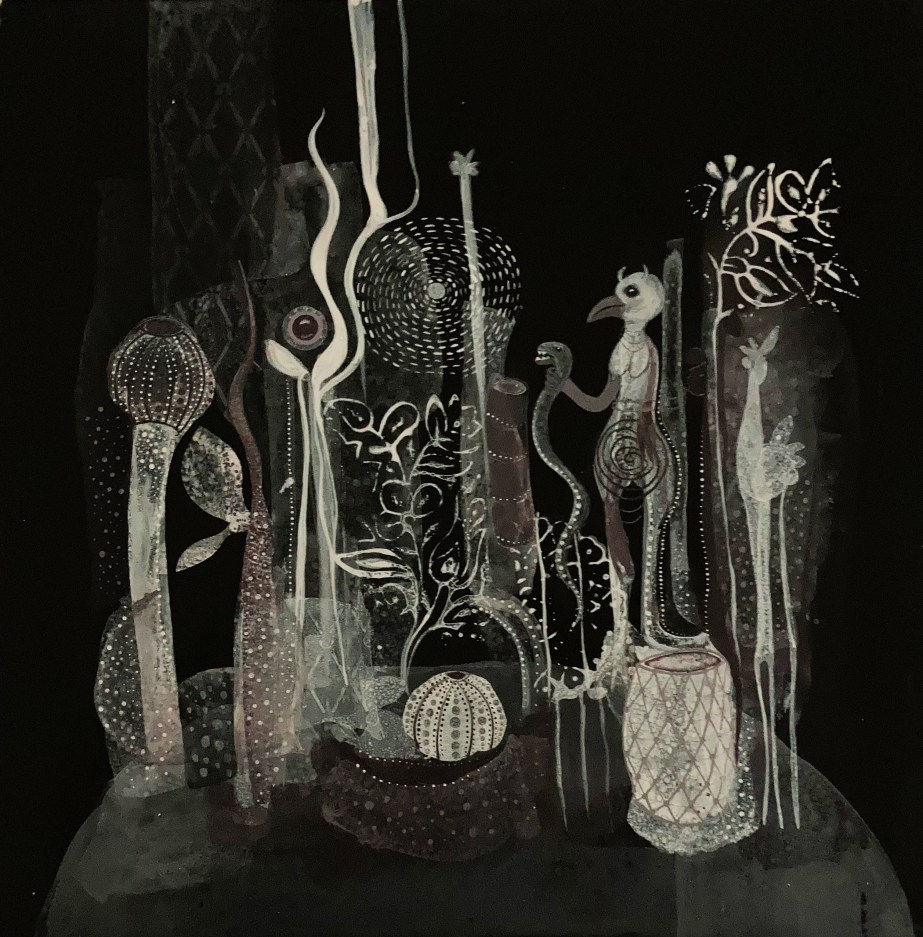
I love dots. I love seeing them and I love putting them in my paintings. Nearly all my paintings have at least a little bunch or line of dots. In fact, most have lots of dots, and there are some that are completely covered in them. Dots are a pleasure to paint and are like sugar for my eyes. Basically, I can’t get enough of them.

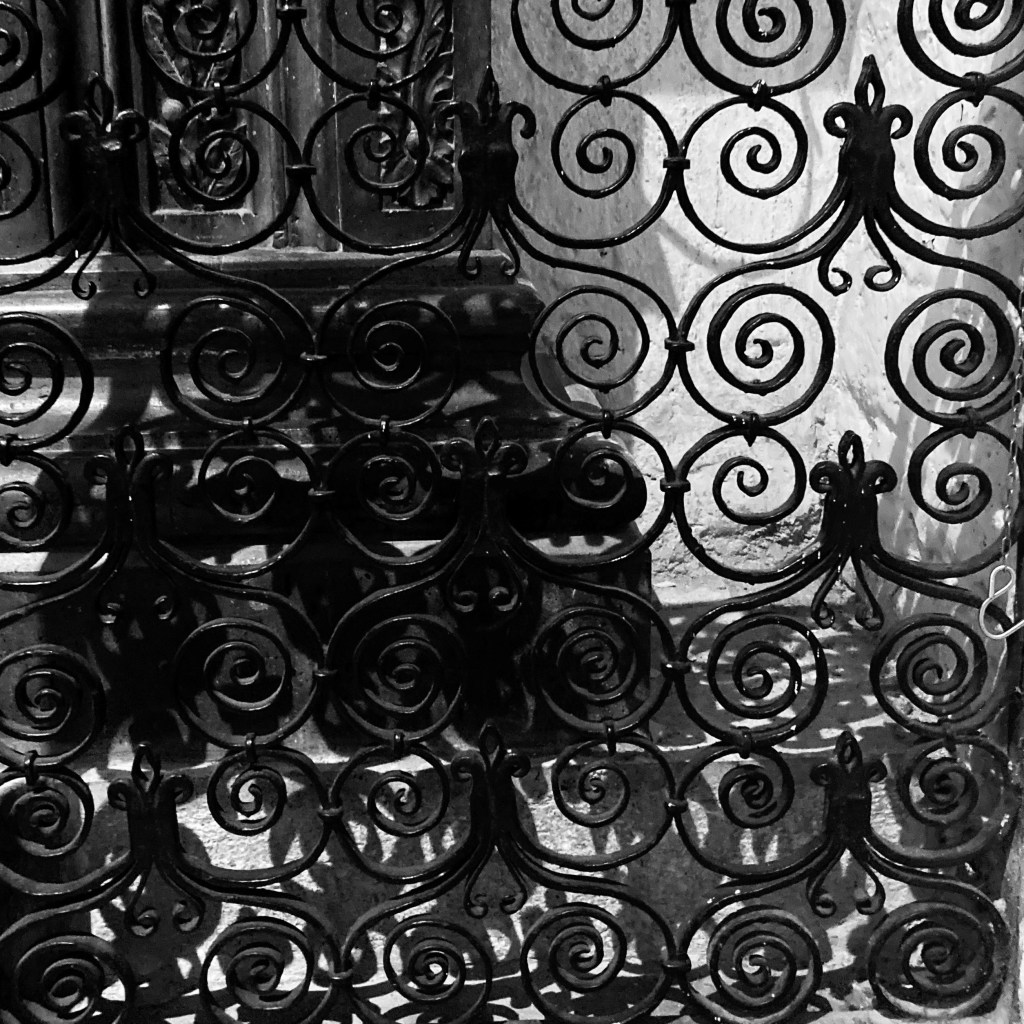
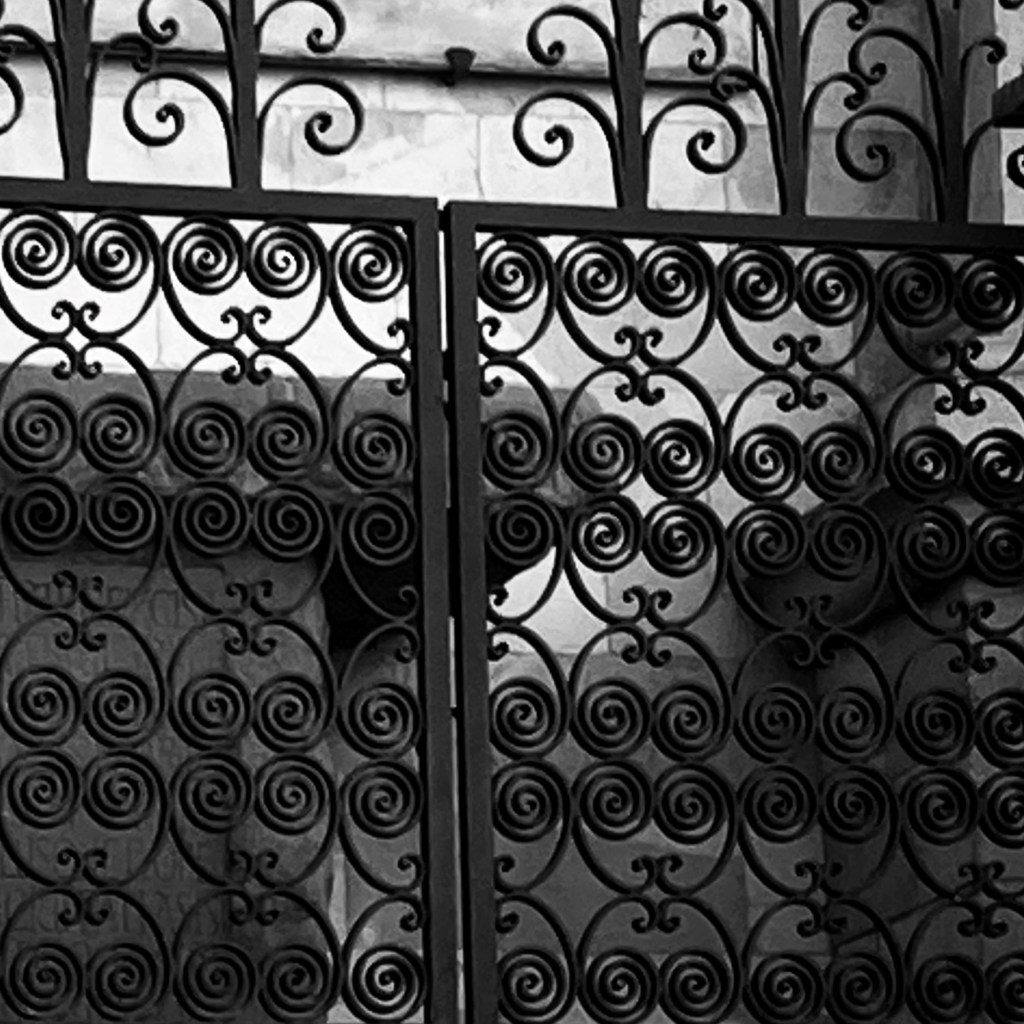
Another thing I love are patterns. Whether in nature or by human hand, seeing a pattern makes my heart happy. If coupled with symmetry, as any self-respecting pattern is, then I am compelled to stop and stare, and invariably take a photo. For this reason, I have more photos of the spectacular wrought-iron work I saw on our recent holiday to Tuscany, than of the stunning scenery. Just ask my fella, he had to stop and hold my handbag every time I saw a lattice, and practically every house in the hill-top medieval towns we visited had them.

The beauty of the lattice-work I saw, inspired me to begin including it my paintings, which I did for a series I painted while at the Royal College of Art Summer School. I think itโ€™s probably best not to over do it, but I little here and there looks lovely.

For the green paintings Iโ€™m doing for my first research project, Iโ€™d like to include more complex pattern work. So this past week, I have been experimenting with patterns from Victorian wallpaper. I like the results so far. When I am in London next week, I will try and visit the Victoria and Albert Museum to find some more inspirational patterns.

I miss my dead-lady-bed

I love a good nap. And by far the best napping I have ever done was in my dead-lady-bed. The bed was a fixture in my last apartment, which I rented for 12 years (the longest I’ve lived anywhere). It got its dead-lady moniker because I am convinced an old lady died in it. It was a single, motorised bed that moved up and down, like you find in an old-folks home, and had a mattress so insanely comfortable, that even though I now sleep in a fancy super-king bed with a memory-foam mattress, I still find myself hankering for the warm embrace of my dead-lady-bed.

Coincidently (or perhaps not), the painting I had in mind for the Interim Show featured a dead lady in a bed. Although I wasn’t able bring the whole concept of the painting to fruition in time (of which the dead-lady-in-a-bed was just one element), it certainly wasn’t for want of trying.

Even though the painting doesn’t yet exist in its final form, I love it with a passion, and will do everything within my artistic powers to make it exist. Seeing the little experiments above gives me heart that it will!

Keep it simple, Stupid

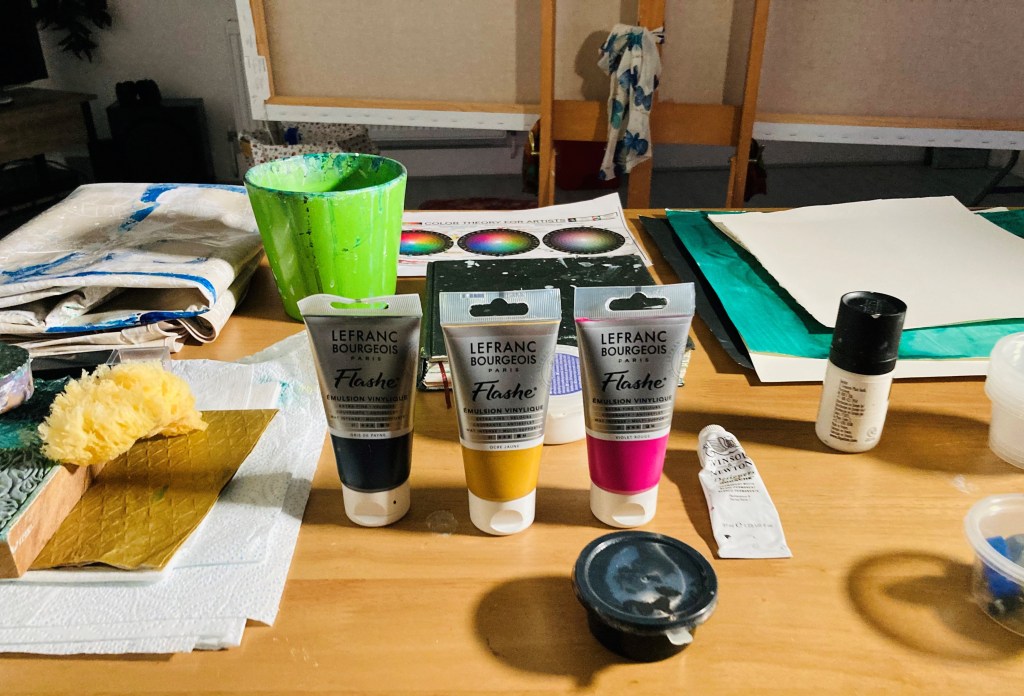
After getting myself in a right pickle with my interim show painting, and almost flogging it into oblivion, I decided to take a more simple approach to the green paintings. My main focus at the moment is colour. Using the colour wheel I mentioned in my last post, I set myself the task of mixing my own greens using two colours, and then adding black and white to create different tones. I then added a colour on the opposite side of the wheel, known as a complimentary colour, and painted some little paintings to explore the colours and tones I created.

For my first experiments, I used phthalo green (blue shade) and yellow light, with red violet as the complimentary. It was nice not to have the pressure of creating an actual painting, and because I wasn’t trying so hard, some little paintings did pop out. The lighter tones are too bright and minty for the underwater paintings I have in mind, although they might be good for the odd highlight here and there. I really like the darker tones, and will definitely keep them in my bag of tricks. I also think it works better when the complimentary colour is quite strong, as in the painting below (which is of my fella playing Destiny and losing his hair from the stress of it).

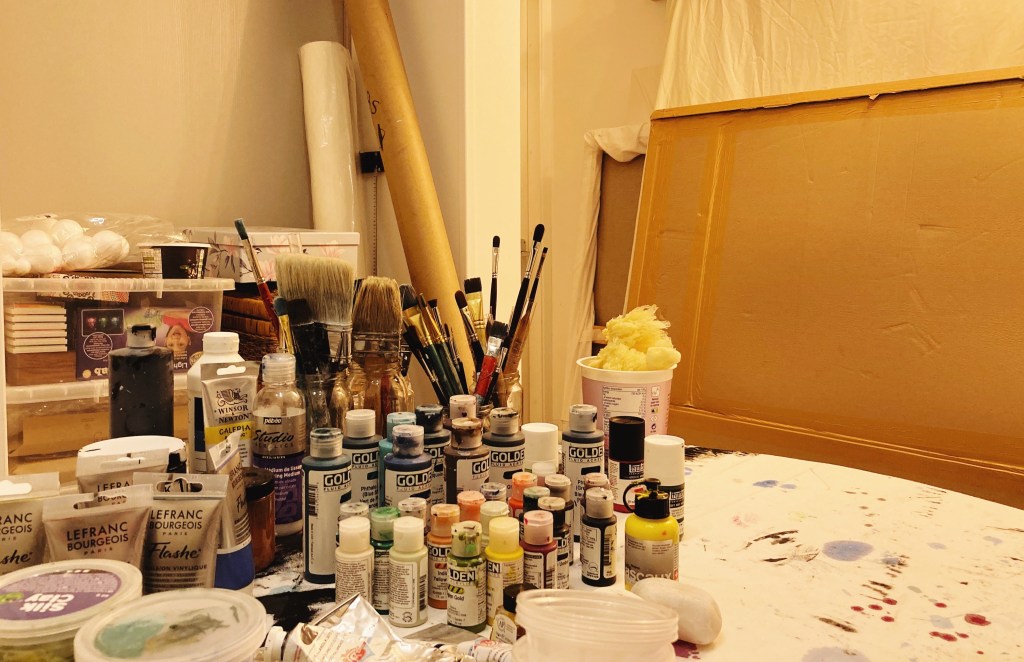
Last week I decided to declutter the studio. Wow, what a difference it makes. I love being in here even more now, and find it much more conducive to arting. Of course, unless you’re a de-clutterer of the ruthless variety, the clutter has to go somewhere. Mine has gone into the room that my fella was going to use as an office. However, the non-fibre broadband we have out here in the woop woops isn’t good enough for his job, so he still works in his flat in Ramsey. With the empty space too tempting not to fill, it is now home to canvases and paints and things. According to my fella, I have now peed in every corner of the house, and if we ever do get fibre out here, he’ll need to water-proof the shed.

Flogging a dead horse-hat

The other day I was lamenting to my fella about the agony I was going through trying to paint my green paintings, one of which I was hoping to get finished for the Interim Show. To clarify, he asked if I meant the paintings that if I didn’t do them there would be absolutely no consequences. That made me laugh so much. Because he was right, not just about the green paintings, but about painting in general. Absolutely nothing of consequence would happen if I never painted another thing. Sure, I’d fail my MA, and have a lot of time on hands, but no one would die, and except for a handful of people, no one in the world would even notice. And yet, I put myself under an inordinate amount of pressure, and approach my painting practice like my life, if not the world, depends on it. This has been true of the green paintings, particularly the one I had in mind for the interim show.
I absolutely love the painting I had in mind for the show, but I have come to the painful conclusion that it simply won’t be finished in time. Because it is a new type of painting for me, there is a certain developmental process that it has to go through, and rushing or missing out aspects of that process has so far resulted in a frustrating, dead-horse-flogging mess. So, before I flog the idea into oblivion, I’m going to return to the beginning of the development process, so I can build a firm foundation for the type of paintings I want to do. In which case, for the next couple of months, I will focus on colour and drawing figures.

During my last one to one tutorial, Jonathan put me onto a brilliant colour theorist, Florent Farges. I’ve already watched one of his videos, and it was extremely helpful, as is his self-designed colour-wheel system, that takes into account hue, chroma, and value. It’s all pretty technical, but I think it will be well worth the time and effort it will take to get to grips with it. So, watching his other videos, studying his wheel/s, and experimenting with colour is high on my list of priorities.

I have also signed-up for a couple of online illustration courses. So far, they have been enjoyable and easy to follow. I don’t want to do realistic drawings, and am not interested in portraiture, but I do want to develop my ability to draw expressive characters which convey emotion.

Instead of showing one of the green paintings at the Interim Show, I am going to show a painting I did when I lived in Australia. I have never shown it before, and very few people have ever seen it. That’s because I hid it in my studio due to what I perceived as a mistake in it. I always thought it was a shame, because apart from that, I thought it was a beautiful painting. Then COVID came along, the world went crazy, and I finally plucked up the courage to paint-out the mistake, and I’m pleased to say it worked, and the painting is now fit to be seen.

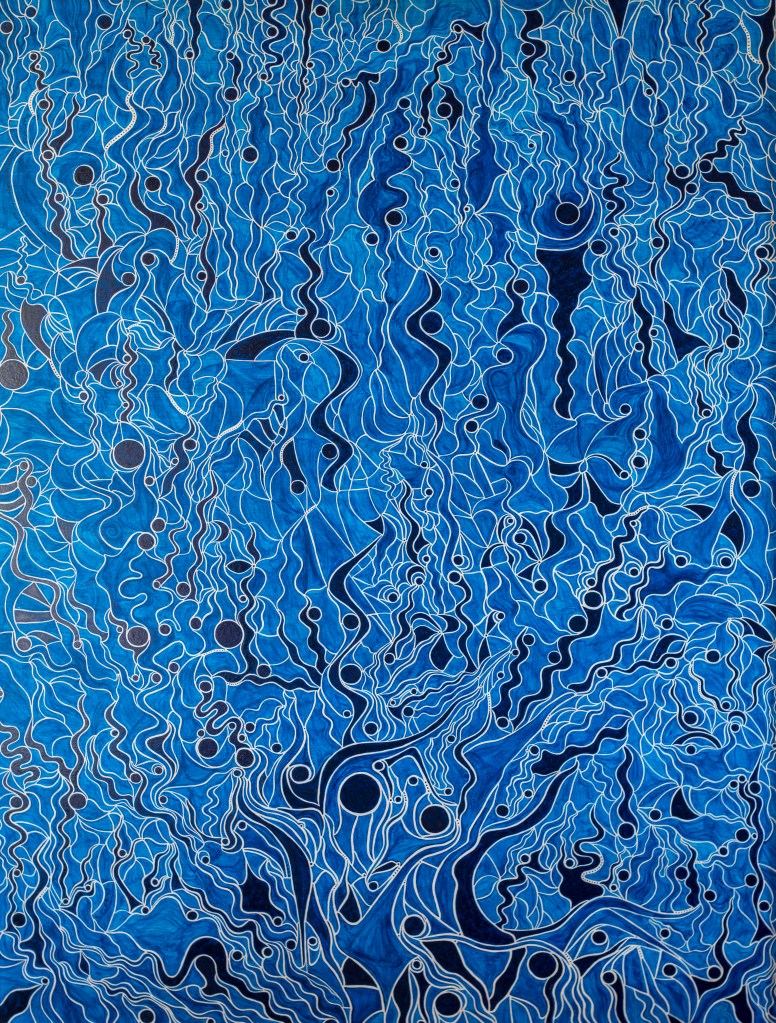
Acheron 90cm x 120cm acrylic on board

According to Greek mythology, Acheron (lit. river of woe) is the name of one the rivers in the underworld, which, along with the river Styx, Charon ferries the souls of the dead across. It’s an apt title for the painting, as I painted it at a time when I was miserable with unrequited love, an experience that sent my life into a tail-spin of hadesian proportions. Ahh, at least I got this painting out of it. A fair price I think.

A word salad with the right dressing is delicious

A word salad is defined by the Cambridge dictionary as:

a mixture of words or phrases that is confused and difficult to understand.

Borrowed from psychiatry, where it describes the unintelligible speech of those afflicted with particular psychiatric disorders, a word salad has come to be used to describe a style of academic writing or speech that is unintelligible to the uninitiated (and sometimes even the initiated). Often touted as the panicle of the academic word salad is the writing of philosopher and literary theorist Prof. Judith Butler. It’s not hard to see why with gems like this:

The move from a structuralist account in which capital is understood to structure social relations in relatively homologous ways to a view of hegemony in which power relations are subject to repetition, convergence, and rearticulation brought the question of temporality into the thinking of structure, and marked a shift from a form of Althusserian theory that takes structural totalities as theoretical objects to one in which the insights into the contingent possibility of structure inaugurate a renewed conception of hegemony as bound up with the contingent sites and strategies of the rearticulation of power.

Further Reflections on the Conversations of Our Time, published in the scholarly journal Diacritics (1997)

Personally, I find the above completely inaccessible and it hurts my head to even try. Unless Butler is being deliberately obtuse, and there is no “there there”, I assume an expert is needed to teach the meaning of what is being said, because knowing the language in which the ideas are being expressed is simply not enough. Of course, this is nothing new, the history of western philosophy is littered with great thinkers whose ideas were pretty much incomprehensible in their lifetimes, and remained so until greater minds rehashed and broke down the ideas over the years, making them accessible to average-Joes like me. So, who knows, in 100 years everyone might comprehend Butler.

There is an anomaly to my aversion to Butler’s word saladrey, that is a lecture Butler gave at a symposium called Topography of Loss, about Doris Salcedo’s 2017 The Materiality of Mourning exhibition at the Harvard Art Museums. The lecture was titled Shadows of the Absent Body, and I have to say it was the most powerful, mind-expanding, and heart-wrenching art lecture I have ever heard. On the surface, much of it is incomprehensible. However, the ethereal way Butler strings words together seem to perfectly reflect the theme of the exhibition, that is the terror and loss of disappeared people.

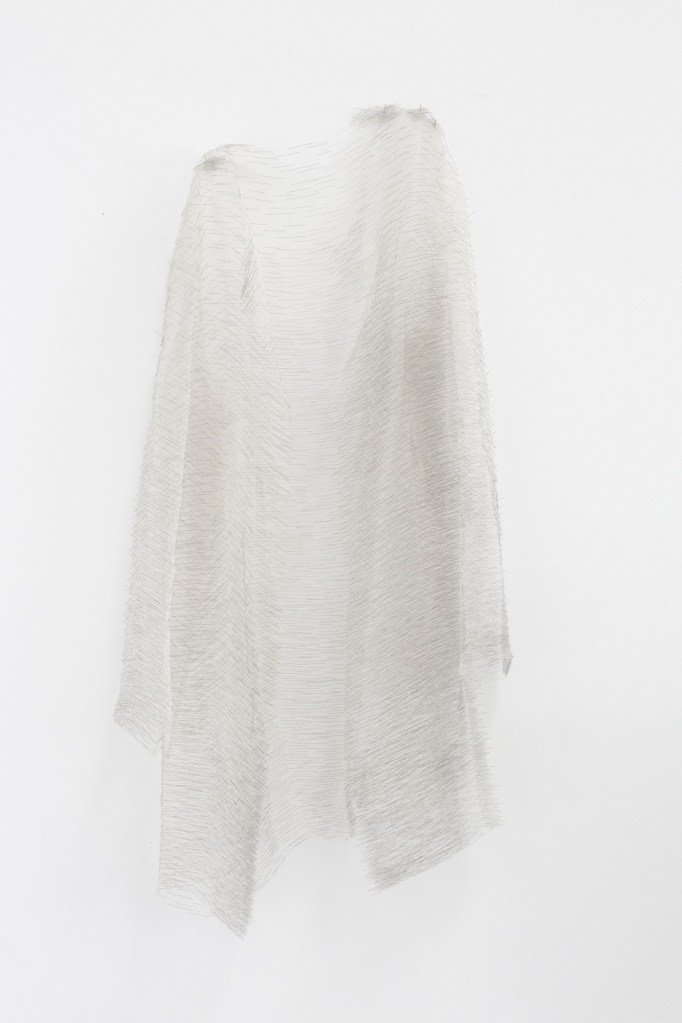
One of the best things about the lecture, was it introduced me to Doris Salcedo’s work, and allowed me to access it and fall in love with it in a way that I wouldn’t have were it not for Bulter’s sublime word salad. I am deeply inspired by Salcedo’s The Materiality of Mourning exhibition, particularly the textile piece below.

Disremembered VIII Sewing needles and silk thread

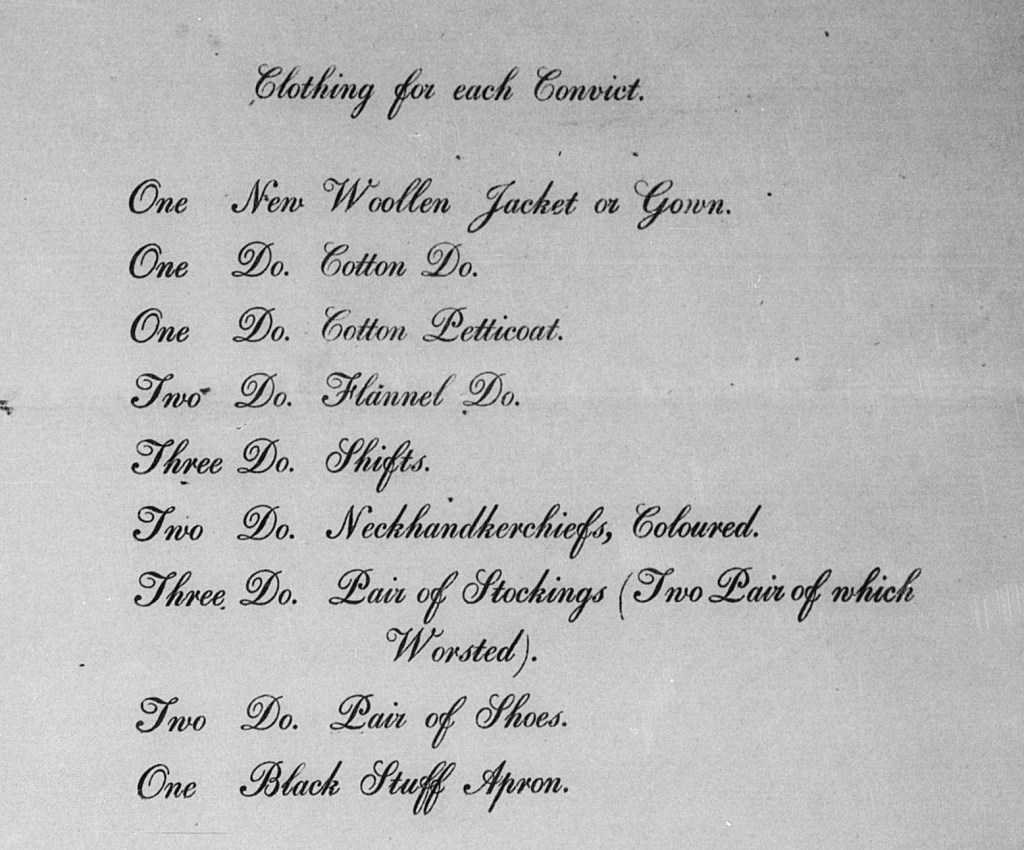
I would like to make a textile piece for my Ann project, to be shown with the painting. The idea I am toying with is something related to the clothes the transportation system officials required be sent with each prisoner, the list of which I found in Ann’s court records.

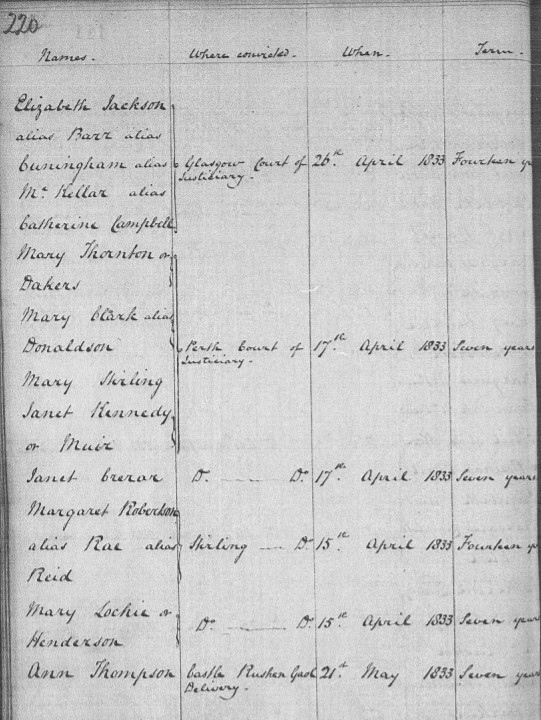
I am also thinking of including the list of the female convicts who were on the Amphitrite, all of whom died when it was shipwrecked. I think the contrast between the beautiful penmanship of the writing and the terrible fate that awaited the woman on the list is both poignant and haunting.

Amphitrite Indent List – Ann’s name at the bottom of the last page

I’m not quite sure how I will marry the two together, but as soon as I have finished the Ann painting, I will start experimenting with different ideas and fabrics etc. Who knows, maybe something will come to me in a dream in the meantime.

The benefits of getting high(er)

Having recently completed my study statements (detailed descriptions of my aims and objectives for my two projects, and how I intend to realise them), I now have a clear idea of where I am headed, and how I intend get there. The statements were arduous and uncomfortable to produce, as I had to think about, and then articulate, what it is I am up to, and what I want from my work and my time on the course. However, having gone through the process, the clear view I now have is my reward. It’s similar to climbing a hill. Sure, it hurts on the way up, but the expansive view (commensurate with the height of the climb) is generally well worth the effort. It helps you situate yourself in the landscape, and allows you to see the direction and path you should take to get to a particular destination.

On Saturday, my fella and I went to the pub. On the way, we decided to walk up a hill. After much huffing and puffing and moaning that quads hurt when you use them, we finally made it to the top. The view was spectacular, and our thumping hearts and near-hyperventilation made the moment transcendent, and reminded me that exertion in pursuit of elevation is usually worth the effort. Of course, sitting by the fire in a cosy pub and eating chips is also pretty transcendent, especially after you’ve just walked up a hill.

Prior to the hill-walking and pub-sitting, we went in search of a confluence (of the river variety), which is the title I have chosen for my water/green paintings project. The project centres around the idea of confluence – the meeting and running together of two or more things. Using the metaphor of a river confluence (a place where two rivers meet and begin flowing together), I want to explore various historical โ€œconfluencesโ€, where natural and human-engineered forces came together and resulted in disasters involving water. Within the selected historic disasters, I hope to find individual and/or forgotten stories of people who died as a result, specifically through drowning, and tell their stories. I also want to create a confluence within the paintings themselves, combining two or more stories within a given painting. If successful, the paintings will be an allegorical warning as to the fate that awaits more and more people due to the natural and human-made confluence of global warming.

Naturally, it remains to be seen if the paintings I produce even work as paintings, let alone achieve something as highfalutin as an allegorical warning (which, lets call a spade a spade, sounds pretentious). Still, I like the idea, and want to give it a go.

Anyway, back to the river confluence we went in search of. We found an absolutely beautiful one in Tholt-y-Will glen, where the Sulby river (the largest river on the Island) meets with a tributary (I don’t know its name) that runs down from the hills. Itโ€™s a heavenly spot, filled with magic and mystery. It is no surprise river confluences were once thought of as scared places where the gods danced. They were also viewed as portals to the underworld, and places where propitiatory offerings were made to secure the favour of the gods.

I meant to take a photo of the confluence, but I was too busy securing a favourable outcome for my project. However, I did take this video of a beautiful pool above the confluence, which is part of the tributary that flows into the Sulby.

Oh, and we also found a cave where I suspect the Cabbyl-Ushtey lives. The Cabbyl-Ushtey is a malevolent Manx water-horse that lures passers-by onto its back. Once on there, the person is stuck-fast, and the Cabbyl-Usthey leaps into the river and drowns them.