A word salad with the right dressing is delicious

A word salad is defined by the Cambridge dictionary as:

a mixture of words or phrases that is confused and difficult to understand.

Borrowed from psychiatry, where it describes the unintelligible speech of those afflicted with particular psychiatric disorders, a word salad has come to be used to describe a style of academic writing or speech that is unintelligible to the uninitiated (and sometimes even the initiated). Often touted as the panicle of the academic word salad is the writing of philosopher and literary theorist Prof. Judith Butler. It’s not hard to see why with gems like this:

The move from a structuralist account in which capital is understood to structure social relations in relatively homologous ways to a view of hegemony in which power relations are subject to repetition, convergence, and rearticulation brought the question of temporality into the thinking of structure, and marked a shift from a form of Althusserian theory that takes structural totalities as theoretical objects to one in which the insights into the contingent possibility of structure inaugurate a renewed conception of hegemony as bound up with the contingent sites and strategies of the rearticulation of power.

Further Reflections on the Conversations of Our Time, published in the scholarly journal Diacritics (1997)

Personally, I find the above completely inaccessible and it hurts my head to even try. Unless Butler is being deliberately obtuse, and there is no “there there”, I assume an expert is needed to teach the meaning of what is being said, because knowing the language in which the ideas are being expressed is simply not enough. Of course, this is nothing new, the history of western philosophy is littered with great thinkers whose ideas were pretty much incomprehensible in their lifetimes, and remained so until greater minds rehashed and broke down the ideas over the years, making them accessible to average-Joes like me. So, who knows, in 100 years everyone might comprehend Butler.

There is an anomaly to my aversion to Butler’s word saladrey, that is a lecture Butler gave at a symposium called Topography of Loss, about Doris Salcedo’s 2017 The Materiality of Mourning exhibition at the Harvard Art Museums. The lecture was titled Shadows of the Absent Body, and I have to say it was the most powerful, mind-expanding, and heart-wrenching art lecture I have ever heard. On the surface, much of it is incomprehensible. However, the ethereal way Butler strings words together seem to perfectly reflect the theme of the exhibition, that is the terror and loss of disappeared people.

One of the best things about the lecture, was it introduced me to Doris Salcedo’s work, and allowed me to access it and fall in love with it in a way that I wouldn’t have were it not for Bulter’s sublime word salad. I am deeply inspired by Salcedo’s The Materiality of Mourning exhibition, particularly the textile piece below.
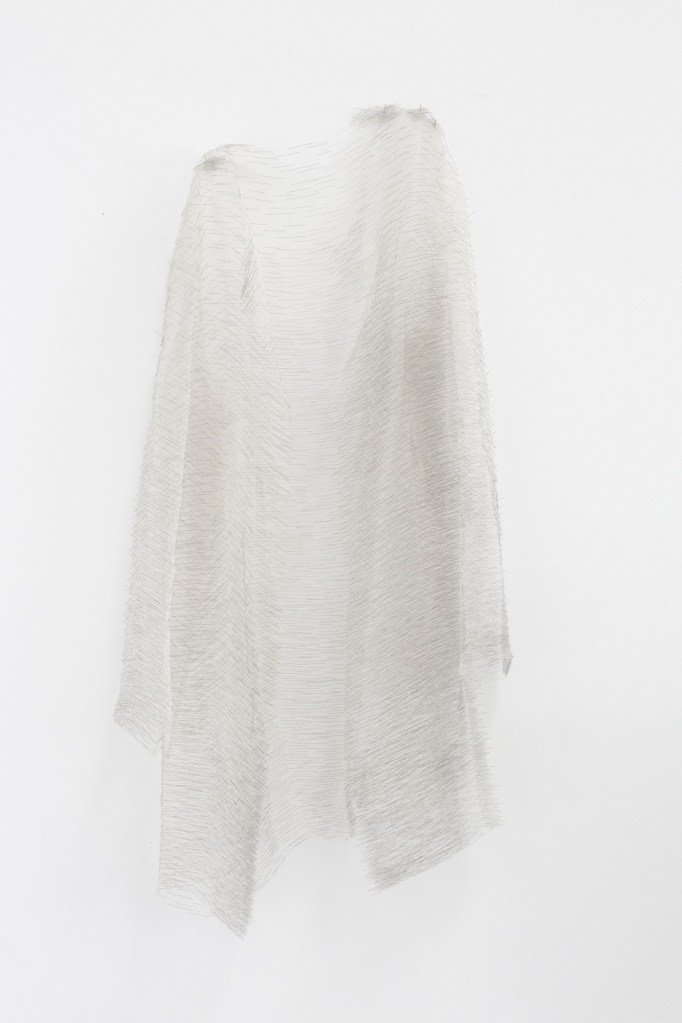
Disremembered VIII Sewing needles and silk thread

I would like to make a textile piece for my Ann project, to be shown with the painting. The idea I am toying with is something related to the clothes the transportation system officials required be sent with each prisoner, the list of which I found in Ann’s court records.
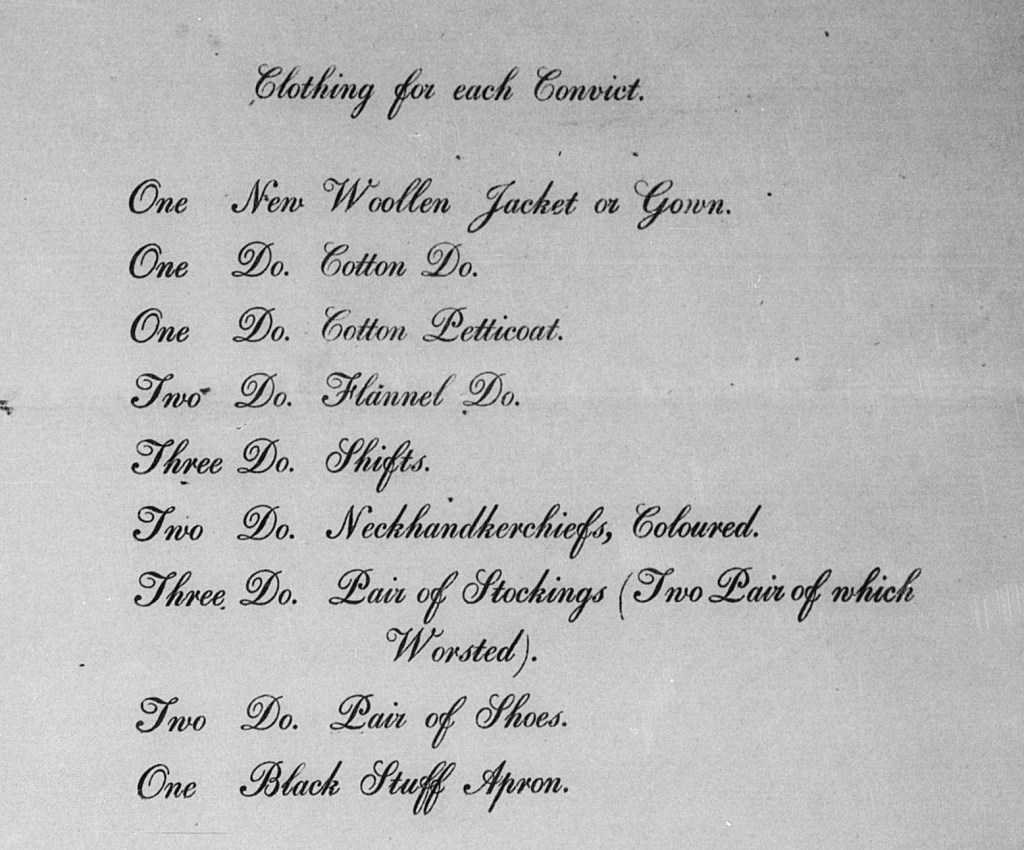
I am also thinking of including the list of the female convicts who were on the Amphitrite, all of whom died when it was shipwrecked. I think the contrast between the beautiful penmanship of the writing and the terrible fate that awaited the woman on the list is both poignant and haunting.
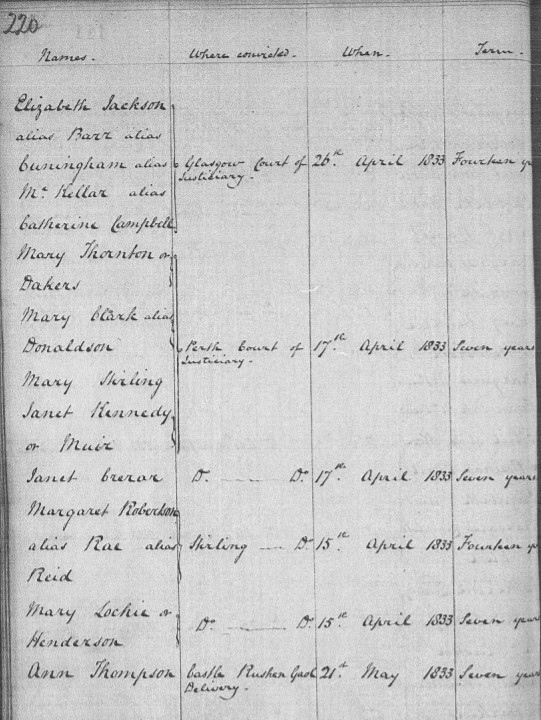
Amphitrite Indent List – Ann’s name at the bottom of the last page

I’m not quite sure how I will marry the two together, but as soon as I have finished the Ann painting, I will start experimenting with different ideas and fabrics etc. Who knows, maybe something will come to me in a dream in the meantime.

The benefits of getting high(er)

Having recently completed my study statements (detailed descriptions of my aims and objectives for my two projects, and how I intend to realise them), I now have a clear idea of where I am headed, and how I intend get there. The statements were arduous and uncomfortable to produce, as I had to think about, and then articulate, what it is I am up to, and what I want from my work and my time on the course. However, having gone through the process, the clear view I now have is my reward. It’s similar to climbing a hill. Sure, it hurts on the way up, but the expansive view (commensurate with the height of the climb) is generally well worth the effort. It helps you situate yourself in the landscape, and allows you to see the direction and path you should take to get to a particular destination.

On Saturday, my fella and I went to the pub. On the way, we decided to walk up a hill. After much huffing and puffing and moaning that quads hurt when you use them, we finally made it to the top. The view was spectacular, and our thumping hearts and near-hyperventilation made the moment transcendent, and reminded me that exertion in pursuit of elevation is usually worth the effort. Of course, sitting by the fire in a cosy pub and eating chips is also pretty transcendent, especially after you’ve just walked up a hill.

Prior to the hill-walking and pub-sitting, we went in search of a confluence (of the river variety), which is the title I have chosen for my water/green paintings project. The project centres around the idea of confluence – the meeting and running together of two or more things. Using the metaphor of a river confluence (a place where two rivers meet and begin flowing together), I want to explore various historical “confluences”, where natural and human-engineered forces came together and resulted in disasters involving water. Within the selected historic disasters, I hope to find individual and/or forgotten stories of people who died as a result, specifically through drowning, and tell their stories. I also want to create a confluence within the paintings themselves, combining two or more stories within a given painting. If successful, the paintings will be an allegorical warning as to the fate that awaits more and more people due to the natural and human-made confluence of global warming.

Naturally, it remains to be seen if the paintings I produce even work as paintings, let alone achieve something as highfalutin as an allegorical warning (which, lets call a spade a spade, sounds pretentious). Still, I like the idea, and want to give it a go.

Anyway, back to the river confluence we went in search of. We found an absolutely beautiful one in Tholt-y-Will glen, where the Sulby river (the largest river on the Island) meets with a tributary (I don’t know its name) that runs down from the hills. It’s a heavenly spot, filled with magic and mystery. It is no surprise river confluences were once thought of as scared places where the gods danced. They were also viewed as portals to the underworld, and places where propitiatory offerings were made to secure the favour of the gods.

I meant to take a photo of the confluence, but I was too busy securing a favourable outcome for my project. However, I did take this video of a beautiful pool above the confluence, which is part of the tributary that flows into the Sulby.

Oh, and we also found a cave where I suspect the Cabbyl-Ushtey lives. The Cabbyl-Ushtey is a malevolent Manx water-horse that lures passers-by onto its back. Once on there, the person is stuck-fast, and the Cabbyl-Usthey leaps into the river and drowns them.

Falling into green

Picasso was a horror when it came to women, but his insights into painting were spot on – like this:

Painting isn’t an aesthetic operation; it’s a form of magic designed as a mediator between this strange hostile world and us, a way of seizing the power by giving form to our terrors as well as our desires.

or this:

Colors, like features, follow the changes of the emotions.

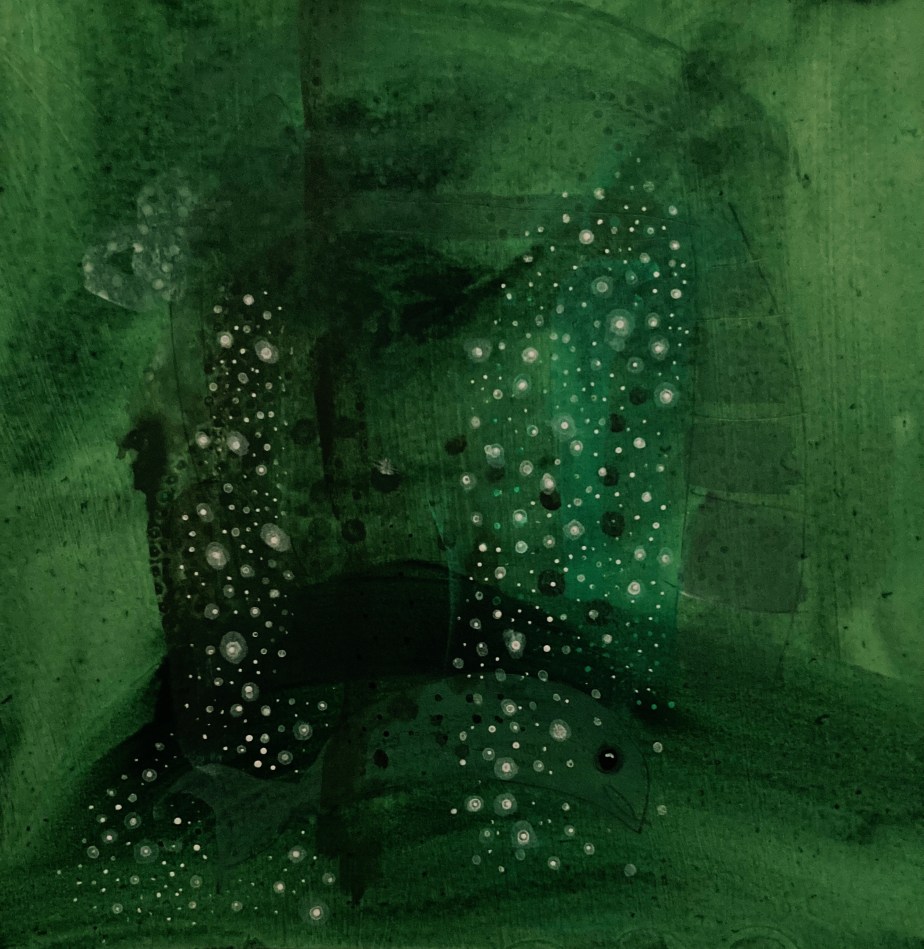
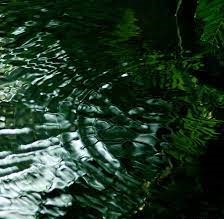
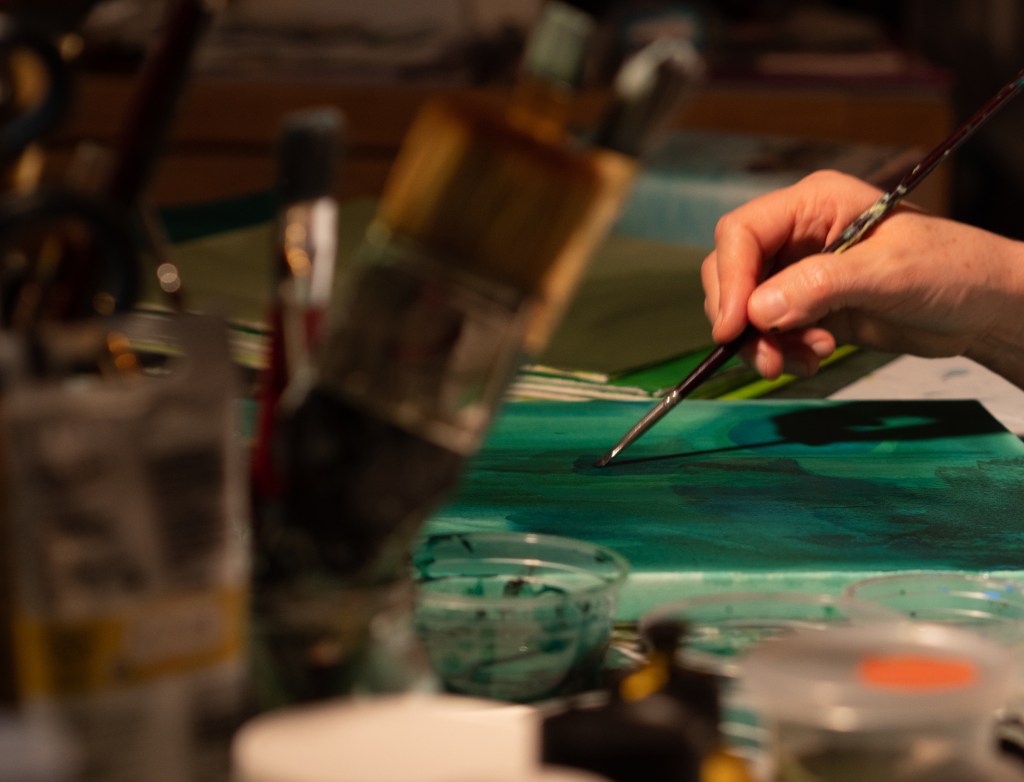
I am particularly interested in this second insight at the moment, due to my recent colour change from blue to green. Blue has always felt like a safe, knowable colour to me, which is why I typically used it when experimenting. But green – it is completely different. I don’t yet know its boundaries, or what its emotional resonance will be on a large scale. On a small scale, it feels mysterious and other-worldly, if not a little bit spooky. When I paint with its darker tones (as above), I am reminded of a time when I was a child, in a boat on the edge of a lake. I remember looking deeply into the water which rippled and swirled with tones of impossibly dark green that merged into unknowable inky darkness. I was completely captivated. Even though I was only a small child, probably no more than 5 or 6, I knew I would never forget what I was seeing, and so I never have.

The above picture, which I found on the internet, is the exact colour/visual I remember. Looking at it, even with its poor resolution, I have the same sensation of wanting to fall into its depths. What a truly mysterious colour. However, the trouble with this shade of green is, it doesn’t really go with anything else (perhaps because it is perfection in and of itself), so it would not really be suitable for the figurative painting/s I have in mind for the Interim Show (although, never say never).

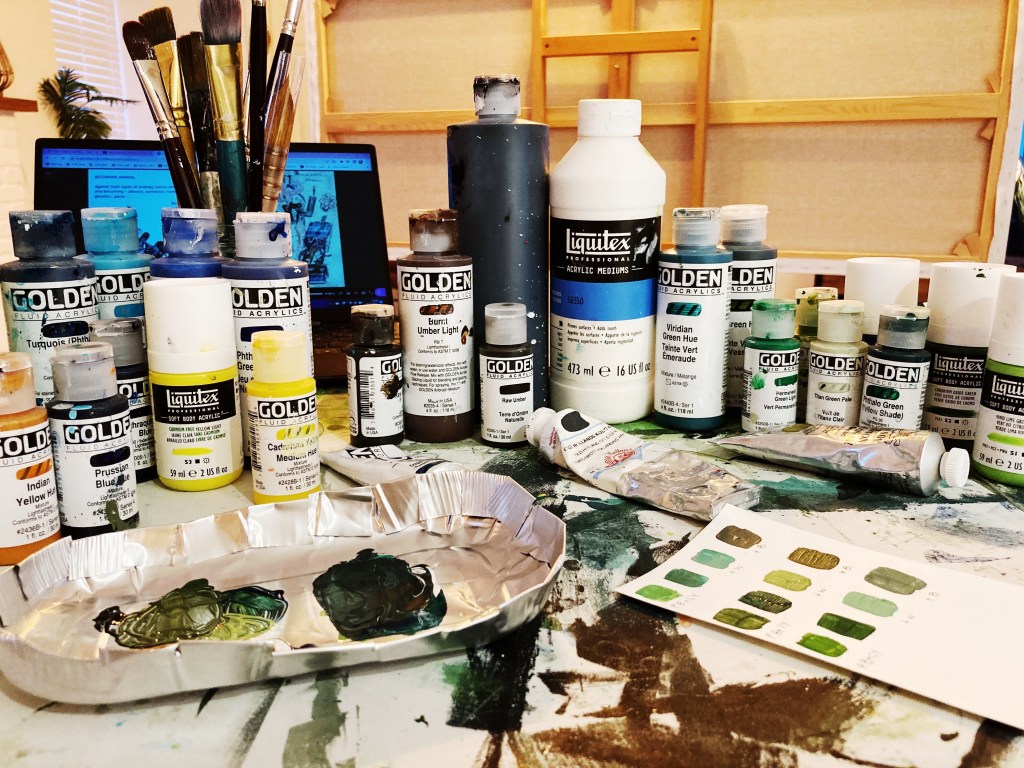
One thing is certain, if I am going to paint with green, I have to get it right, or I will end up with a garish mess that no one will want to look at. To avoid this pitfall, I have set myself the task of creating a suitable palette, so I’ll have a better chance of getting it right when it comes to the final work/s.