
Having recently completed my study statements (detailed descriptions of my aims and objectives for my two projects, and how I intend to realise them), I now have a clear idea of where I am headed, and how I intend get there. The statements were arduous and uncomfortable to produce, as I had to think about, and then articulate, what it is I am up to, and what I want from my work and my time on the course. However, having gone through the process, the clear view I now have is my reward. It’s similar to climbing a hill. Sure, it hurts on the way up, but the expansive view (commensurate with the height of the climb) is generally well worth the effort. It helps you situate yourself in the landscape, and allows you to see the direction and path you should take to get to a particular destination.
On Saturday, my fella and I went to the pub. On the way, we decided to walk up a hill. After much huffing and puffing and moaning that quads hurt when you use them, we finally made it to the top. The view was spectacular, and our thumping hearts and near-hyperventilation made the moment transcendent, and reminded me that exertion in pursuit of elevation is usually worth the effort. Of course, sitting by the fire in a cosy pub and eating chips is also pretty transcendent, especially after you’ve just walked up a hill.
Prior to the hill-walking and pub-sitting, we went in search of a confluence (of the river variety), which is the title I have chosen for my water/green paintings project. The project centres around the idea of confluence – the meeting and running together of two or more things. Using the metaphor of a river confluence (a place where two rivers meet and begin flowing together), I want to explore various historical “confluences”, where natural and human-engineered forces came together and resulted in disasters involving water. Within the selected historic disasters, I hope to find individual and/or forgotten stories of people who died as a result, specifically through drowning, and tell their stories. I also want to create a confluence within the paintings themselves, combining two or more stories within a given painting. If successful, the paintings will be an allegorical warning as to the fate that awaits more and more people due to the natural and human-made confluence of global warming.
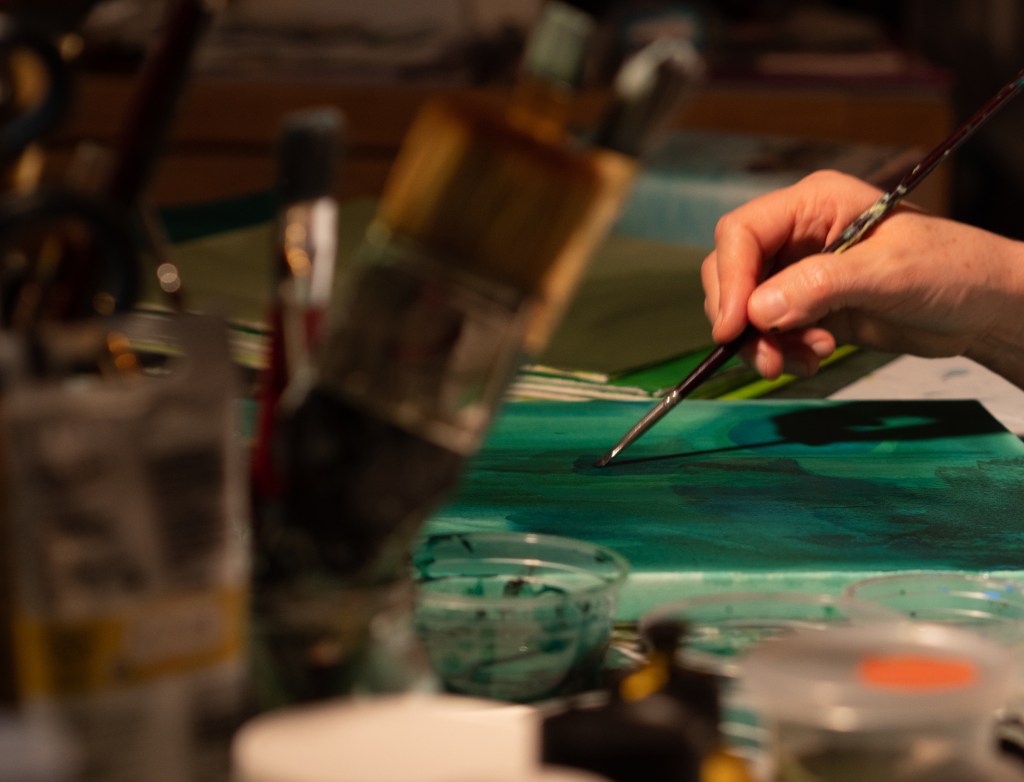
Naturally, it remains to be seen if the paintings I produce even work as paintings, let alone achieve something as highfalutin as an allegorical warning (which, lets call a spade a spade, sounds pretentious). Still, I like the idea, and want to give it a go.
Anyway, back to the river confluence we went in search of. We found an absolutely beautiful one in Tholt-y-Will glen, where the Sulby river (the largest river on the Island) meets with a tributary (I don’t know its name) that runs down from the hills. It’s a heavenly spot, filled with magic and mystery. It is no surprise river confluences were once thought of as scared places where the gods danced. They were also viewed as portals to the underworld, and places where propitiatory offerings were made to secure the favour of the gods.
I meant to take a photo of the confluence, but I was too busy securing a favourable outcome for my project. However, I did take this video of a beautiful pool above the confluence, which is part of the tributary that flows into the Sulby.
Oh, and we also found a cave where I suspect the Cabbyl-Ushtey lives. The Cabbyl-Ushtey is a malevolent Manx water-horse that lures passers-by onto its back. Once on there, the person is stuck-fast, and the Cabbyl-Usthey leaps into the river and drowns them.
 bexODESSA